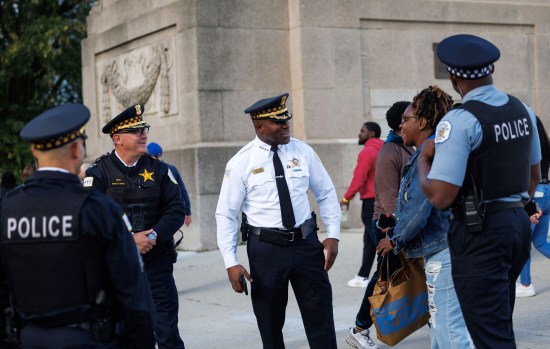

Police Superintendent Larry Snelling on Tuesday pushed back on a call by the Illinois attorney general’s office for a review of reported use-of-force incidents by Chicago police officers after department leaders acknowledged an increase in such reports since the end of the COVID-19 pandemic.
During a status hearing in the city’s ongoing federal consent decree, Assistant Illinois Attorney General Mike Tresnowski noted the “concerning” trend to U.S. District Judge Rebecca Pallmeyer that Chicago Police Department officers are reporting uses of force more frequently, including in interactions with juveniles.
CPD officials told Pallmeyer that reported use-of-force incidents fell sharply during the COVID-19 pandemic but have gradually increased each year since 2022. In 2025, CPD officers reported 3,044 such incidents — 800 more than were reported in 2023.
“We believe that now is an appropriate time, given the progress that CPD has made in its policies and training, to discuss among the parties how are we ultimately going to measure full compliance,” Tresnowski said. “This type of assessment would be the first step to getting at the bottom of some of the concerning trends we’ve seen.”
The consent decree monitoring team has repeatedly urged CPD to bolster its data collection and analysis practices, and in recent years, the department has increasingly relied on officers’ body-camera footage as a situational teaching tool.
The monitoring team, led by former federal prosecutor Maggie Hickey, also released on Tuesday its 13th biannual report of CPD’s reform compliance. The monitoring team found that the Police Department has established new policies to meet preliminary compliance with 97% of the consent decree. Full compliance, though, has been reached in 26% of the mandates.
In response to Tresnowski, Snelling said a “deeper dive” into those incidents would “take out the human element.” Of all interactions between police and civilians, just 5% involve an officer using force, Snelling said.
“If we just looked at numbers and we responded to calls for service and things of that nature based on statistics and numbers, we would take out the human element of what it is we need to respond to,” Snelling said. “The same thing needs to happen here when we’re assessing uses of force.”
“Are there times where our officers have used excessive force? Yes, and we can look historically at some of those things,” the superintendent continued. “But is that the most common practice that every time an officer uses force that force is excessive? No. What we need to do is look at what’s proportional, what is reasonable under the totality of the circumstances.”
In reference to uses of force involving minors, Snelling reminded the court of the sporadic “teen takeovers” that often draw heavy police resources to the downtown area after violence breaks out.
“Right now, what we’ve seen across the board, we’ve seen more CPS (Chicago Public Schools) students shot and killed this year than we have in the past 10 years, possibly,” Snelling said. “We need to pay attention to that and we need to make sure that we understand what it is our officers are doing to stop this behavior.”