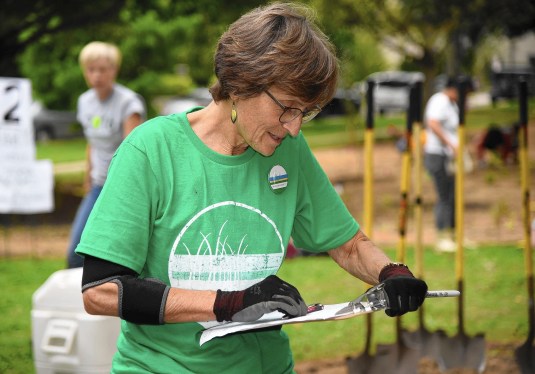

Amid the observance of Earth Month in April, a network of Go Green groups that started on Chicago’s North Shore and have spread to 38 Illinois communities, including in Lake and DuPage Counties, continue to mobilize on local environmental sustainability issues such as sustainable lawns and energy use.
Beth Drucker, president of Go Green Wilmette, helped found the group in 2006, after hosting a movie screening of “An Inconvenient Truth” at the Wilmette Public Library.
She said it was surprising to see how many people in the community showed up to learn about the future impacts of global warming and climate change.
“We filled the auditorium completely, and then we scheduled a second screening or two later,” said Drucker. “And I remember turning to the other handful of founders, and said, well, I guess this answers our question. There’s clearly interest in our community.”
Indeed, the group now has chapters in Highland Park, Glen Ellyn, Vernon Hills & Lincolnshire, Park Ridge, Northbrook, Northfield, Oak Park, Morton Grove, LaGrange, Kenilworth, Wauconda, Glenview, Glencoe, Skokie and many other areas.
Go Green Wilmette is now coming up on its 20-year anniversary since the group started meeting on local environmental sustainability efforts. Among the group’s achievements, Go Green Wilmette has contributed to the Village’s Environmental and Energy Commission.
After Drucker realized how many people from the community wanted to be involved, she started outreach in other surrounding suburbs to coordinate other Go Green groups.
In 2013, Drucker also started Go Green Illinois — an umbrella group that encourages other communities across the state to start their own version of the initiative.“It’s been growing now for 13 years, and we have contacts in about 40 different communities,” Drucker explained, adding she recently had conversations with a few residents who want to start Go Green groups in Rockford, Joliet and Lake Zurich.
Some of the environmental issues North Shore groups focus on are ones community members can directly influence, she emphasized, including sustainable suburban lawn care and energy use.
“One of our most popular events is a sustainable yard tour,” Drucker said. “We want everybody to stop by these yards to see what a wild and wonderful yard can look like and how much life it can support, as opposed to the typical American yard that supports almost nothing.”

Go Green Wilmette also hosts beach cleanups, EV car and bike shows and more events throughout the year, she said. In addition, the organization has a strong intern pipeline for college and high school students who are interested in making a difference in the environment.
She added that energy and the dependence on foreign oil is another big issue the groups are prioritizing, saying Go Green Wilmette specifically is working to promote solar energy conservation.
While the groups operate separately, volunteers and organizers will often collaborate by inviting other neighborhoods to a variety of events put on each year. They also share the environmental work being done across the Go Green groups, with leaders hosting monthly meetings and helping each other out when applicable.
“A great example of collaboration is Skokie and Winnetka had community drop-off bins because they couldn’t figure out curbside pickup. Well, one had curbside pickup of food scraps, but no free community drop off bins,” said Drucker. “And so we were able to say to our environmental coordinator, can you talk to the village of Skokie, talk to the village of Winnetka, find out how they do it, why they do it, and let’s see if we can have that here in Wilmette.”
Among those involved in the Go Green network is the leader of Go Green Winnetka, Liz Kunkle, who grew up in the suburb. She said she became interested in environmental work when she was a student at the University of Iowa and got involved in waste management and decided she wanted to continue this work into her adult years.
After moving back to Winnetka in 2008, Kunkle started participating in her children’s school’s environmental committee and eventually stepped into a leadership position.
Through her work with the committee, she met Drucker, who encouraged her to start a Go Green Winnetka group.
Nearly 15 years later, she said she is extremely proud of the work the community of Winnetka and other Go Green groups have been doing to make a change in their environment and to fill gaps where it’s needed.
“You want that community volunteer voice,” Kunkle said. “So that’s the purpose of the Go Green groups, is to make sure that there’s volunteers speaking on behalf of citizens and maybe connecting the dots for folks in ways when the governments aren’t.”