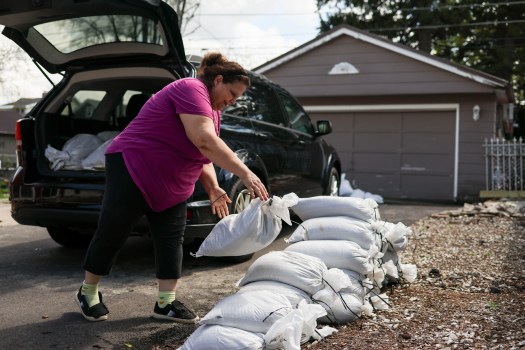


Homeowner Maha Amin moved three dozen sandbags from the trunk of her car to her driveway Thursday, bracing for more flooding in Des Plaines. After 16 years in her home without flooding incidents, she watched as a couple feet of stormwater poured into her basement during Sunday’s storm, destroying her clothes, furniture and TV.
After days of hauling out waterlogged belongings, Amin had to take a week off work to fortify her home with sandbags as flood risks linger into the weekend.
“It is really, really bad,” she said. “I need all those bags and, still, I don’t know if it will be enough or not.”
Amin lives with her dog, Jojo, and cat, Katyosha, who haven’t ventured back into the basement since the flooding began.
“They stay up with me,” Amin said. “They don’t go down anymore since the first time the water came. They don’t want to go down.”
Des Plaines was among the Chicago suburbs in Cook and Lake counties along the Des Plaines River experiencing flooding due to recent rainfall. Areas near the river from just east of O’Hare International Airport north to the Wisconsin border were under a flood warning due to the river’s rising levels, according to the National Weather Service. Agency officials expected the river to crest — when it reaches its highest peak before receding — over the weekend.

Brett Borchardt, a senior meteorologist with the National Weather Service, said Thursday afternoon that he expected the Des Plaines River to crest Saturday in the northern areas under the flood warning. Those down south near Des Plaines were likely to see the river crest late Saturday into Sunday.
Borchardt said more rain (about half an inch to an inch) was expected Friday night. But if Lake and Cook counties receive more than 1 inch, Borchardt said that would affect levels in the river.
“That would really push that crest to Monday or even Tuesday,” Borchardt said.
The flood warnings come during a spring that is the second wettest on record, according to the University of Illinois State Water Survey. The recorded rainfall Tuesday was 2.43” at O’Hare, according to NWS Chicago.
Many local governments prepped with sandbags to lessen the effects of any floods. Brad Burke, Lincolnshire’s village manager, said some residents have been making their own sandbags at public works facilities to place along their property.
Service road Londonderry Lane was impassible due to water on the road, Burke said. As water levels rise, Lincolnshire Drive may be affected, he added, but the homes there that back up to the Des Plaines River typically don’t take in water during flood events. Burke explained, however, the homes may be isolated by water covering the road.
Burke said water level predictions from the National Weather Service were 1 foot lower Thursday than those released Wednesday.
“That is hopeful for us because (its) original projections were close to major flood levels, and right now, (its) forecast is for the river to rise into moderate flood levels,” he said.

In Riverwoods, adjacent to Lincolnshire, sandbags were also available for residents who wanted them, said Laura Trevino, the village’s trustee of communications. She said that the river floods at around 17 feet, and the National Weather Service predicted the Des Plaines River in Riverwoods would reach 14.8 feet.
“Currently, we do not expect it to flood,” Trevino said.
Spokespeople for Gurnee and Libertyville said in emails that sandbags were available for residents. However, they added that their municipalities weren’t yet at the level to need sandbags, and Gurnee’s spokesperson referred to the flooding as a “nonissue” because structures would likely be spared impact.
The National Weather Service estimated that the Des Plaines River would crest at 9.7 feet in Gurnee, causing moderate flooding.
In the low-lying city of Des Plaines, which hugs the river, it was forecast to crest at about 16.9 feet Saturday afternoon, though that could change, said Public Works Director Tim Watkins.
The Des Plaines Public Works Department began supplying sandbags for residents and businesses Thursday morning as water levels rose.
For Amin, the flooding came as a shock. She saw flood warnings on TV Thursday morning and learned the city was offering free sandbags to some residents, but was told her home was not in the designated flood zone.
“What do you mean?” she asked. “I have a flood in the basement. What do you mean we’re not in the flood zone? We are, actually.”

Des Plaines businesses such as the Chicago Behavioral Hospital picked up more than 150 sandbags Thursday to fortify the facility, which sits on the river.
“In the past, we’ve had issues with the river cresting over here,” said Pedro Pajare, director of operations at the hospital. “We’ve taken measures so that doesn’t happen again.”
Public works crews were also pumping water from storm sewers on River Road that had reached capacity.
“The amount of water that we pump (into the river), we only pump enough to allow enough room for the next rainstorm,” said Watkins.
Des Plaines officials said there were no road closures at the time and no impacts west of River Road, but they were continuing to monitor conditions closely.
The city had invested over $50 million in flood mitigation projects in partnership with the Department of Natural Resources and the U.S. Army Corps of Engineers.
“If this situation was happening without that mitigation, we’d be in a very different situation,” said Bradley Goodman, the city’s communications director.

Public works was urging residents to stay out of standing water, both walking and driving, and for people handling sandbags and dealing with water to make sure they use simple hygiene because of contamination in the water.
“Des Plaines is low lying in proximity to the river,” Watkins said. “We’ve flooded many times over the years, some are worse than others. It’s hard to say what Mother Nature is going to do.”
Meanwhile, Amin was focused on protecting her home as best she could.
“It’s like it’s raining inside,” she said. “I have to fix it. I have to do something.”