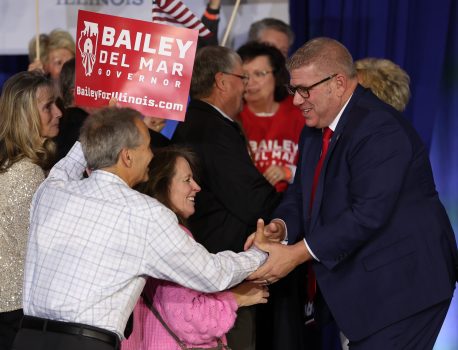

Buoyed by the name recognition he gained in his losing bid to Democratic Gov. JB Pritzker four years ago, Darren Bailey raised less than half a million dollars to win the GOP primary for governor and spent only about $2.30 per vote to handily defeat better-funded rivals, recently filed state campaign finance reports show.
The reports, filed with the Illinois State Board of Elections covering the first three months of this year, including the March 17 primary, showed Bailey raised only $450,938 to win the nomination and spent nearly $700,000 to capture more than 300,000 votes, or more than 53% of the ballots counted, according to unofficial totals with more than 95% of the vote tallied.
Bailey’s spending was a far cry from four years ago, when he had millions of dollars to spend in both the primary and general election. He ultimately lost to Pritzker, the billionaire business owner and heir to the Hyatt Hotels fortune, by about 13 percentage points. Since Bailey won the GOP nomination last month, the former state lawmaker and farmer from downstate Xenia has only received about $25,000 in large-dollar donations, the reports show.
Bailey’s largest individual donor was northwest suburban business owner Gary Rabine, who was also an unsuccessful rival for the nomination four years ago. Rabine donated $30,000 to Bailey, who was also helped by $40,484 in in-kind donations for a campaign kickoff fundraiser paid by the Save Illinois PAC. Less than 20 days after the event, the PAC’s chair, Brett Corrigan, went on to join the campaign of one of Bailey’s 2026 primary rivals, Rick Heidner.
To campaign, Bailey heavily used social media, as he couldn’t afford sustained TV advertising. He spent $283,392 on direct mail, $177,000 on consultants and staff salaries and more than $31,818 on yard signs.
Ted Dabrowski of Wilmette, the former head of the Wirepoints political advocacy organization, raised $2.1 million and spent more than $2 million in finishing a distant second to Bailey with nearly 29% of the vote. His spending was about $12.75 for each of the approximately 163,000 votes he received.
Unlike Bailey, Dabrowski was helped by a number of large donors, including $250,000 each from conservative mega-donor Richard Uihlein and James Perry, managing director of Madison Dearborn Partners. Dabrowski received $100,000 from Madison Dearborn CEO John Canning and $50,000 each from Todd Ricketts, a co-owner of the Chicago Cubs and a former Republican National Committee finance chair, and his mother, Marlene.
Dabrowski’s top expenses included $568,657 on TV ads and $250,000 to repay himself for a personal loan to his campaign. He also spent $150,000 to pay the political consulting firm of right-wing radio host Dan Proft of Naples, Florida, who has had a long string of political losses. Dabrowski also paid associates of Proft ally, former state Rep. Jeannie Ives of Wheaton, for digital and social media work.
DuPage County Sheriff James Mendrick, who finished third in the race with 9.6% of the vote, raised and spent the fewest dollars in the GOP contest, campaign reports showed. Mendrick raised nearly $170,000 to go with his existing political fund and spent $263,971 — the equivalent of $4.89 for each of his 53,943 votes.
Mendrick, who floated conspiracy theories during his campaign, gave $10,000 to Save Chicago Now, a fringe group headed by right-wing zealot and frequent failed political candidate William Kelly. Mendrick also paid out $58,000 in salaries, including $21,500 to former state Rep. Darlene Senger of Naperville, and spent $34,600 on yard signs. A planned fundraiser to raffle off a firearm was canceled, reports showed, due to a paperwork snafu.
Heidner raised and spent the most to finish a distant fourth in what appeared to be largely a vanity campaign to address his personal grievances against Pritzker. The video gambling firm owner and real estate developer raised nearly $3.3 million — $2.4 million of it from himself, his family and from his business interests, records showed.
Heidner spent nearly $3 million to get about 8% of the vote, or $65.34 for each of the more than 45,000 ballots he received. He spent over $1 million for media placement of largely digital and social media ads, more than $222,000 to canvass voters and another $180,845 on consultants.
Bailey’s successful frugal campaign may have worked in the primary, but it doesn’t appear sustainable for a general election campaign against Pritzker, who has spent $350 million in his two previous successful runs for governor and can easily tap into his personal wealth of $3.9 billion.
Pritzker, unopposed in the Democratic primary, gave his reelection campaign $25.5 million in November of last year and spent $14 million in the primary. The spending included more than $4.7 million in broadcast and digital media ads, $2 million on consultants, a $1 million donation to the Democratic Party of Illinois and $72,800 — the maximum political action committee contribution allowed — to incumbent state officeholders Attorney General Kwame Raoul, Treasurer Michael Frerichs, Secretary of State Alexi Giannoulias and his choice for state comptroller, state Rep. Margaret Croke, who won the primary nomination.