
The 1940s were looking dire for Henri Matisse. The Nazis had just invaded France, and an operation to treat his abdominal cancer had saved his life but taken a grisly toll on his body.
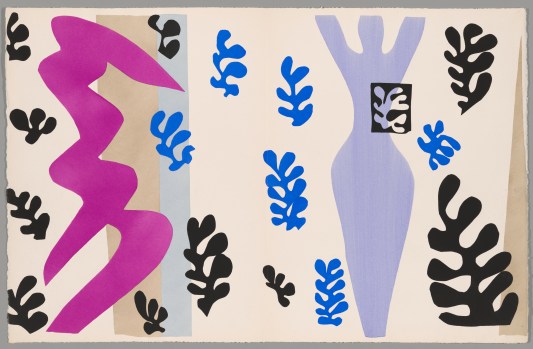
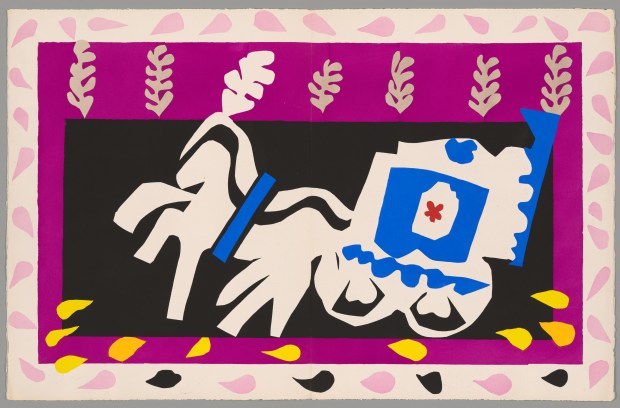
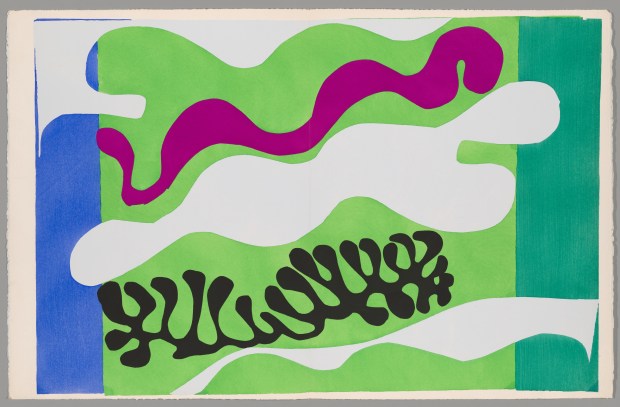
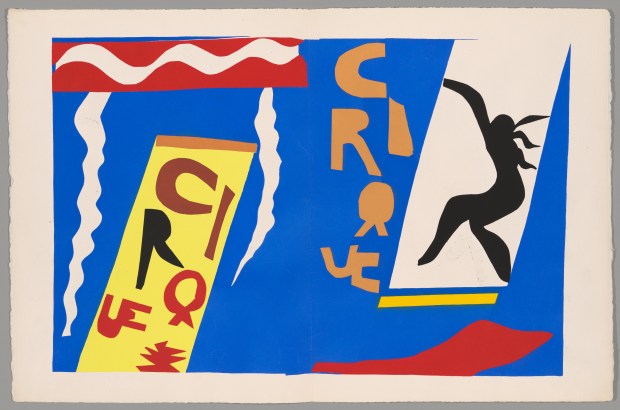
Amid that bleak backdrop, Matisse unveiled a dramatic new visual language: colorful, vibrant cut-paper collages. In 1947, faithful reproductions of the compositions, made through a hand-stenciling technique called pochoir, were released as a limited-run book, “Jazz.” Matisse sometimes accompanies his tableaus with brief, stream-of-consciousness writings which document his memories, creative philosophies and advice to younger artists.
“Hatred is a parasite that devours everything… Love, on the contrary, sustains the artist,” he writes on one page.
Just 250 copies of “Jazz” were produced. The Art Institute began the process of acquiring its copy even before the complete collection had been shown in the U.S.
“It was hot off the press, so to speak, and came to us sight unseen,” says Emily Ziemba, curator of the Art Institute’s prints and drawings department.
“Jazz” was recognized even in Matisse’s lifetime as a monumental chapter for the artist. A 1948 Philadelphia Museum of Art retrospective devoted an entire room to “Jazz,” and mass-consumer magazines like Time and Vogue printed covers and spreads inspired by its jaunty geometric designs.
Through June 1, the Art Institute is displaying its complete — and fragile — “Jazz” edition for the first time since it entered the museum’s collection in 1948. The “Matisse’s Jazz: Rhythms in Color” exhibition has proved as popular here as the collection was 80 years ago, tallying more than 60,000 visitors since opening in March. (The Reva and David Logan Center for the Arts, a host venue for International Jazz Day festivities, also keeps a revolving, albeit incomplete, set of “Jazz” prints on its lower level.)

That “Jazz” has taken over the Art Institute while jazz takes over Chicago is a happy accident, says museum spokesperson Megan Michienzi.
“I would love to say that we thought about that,” she tells the Tribune, noting the current “groundswell” of Matisse shows around the world. “But it’s just a lovely, serendipitous moment… We can shine in our lane while others are showcasing other aspects of Matisse’s career.”
International Jazz Day is right around the corner: 16 picks for the global event taking over Chicago
Hannah Edgar is a freelance critic.