
The Northwest Indiana community had a chance to hear developers’ answers to previously submitted questions about a potential artificial intelligence data center near Lowell, including about water usage, traffic and noise levels.
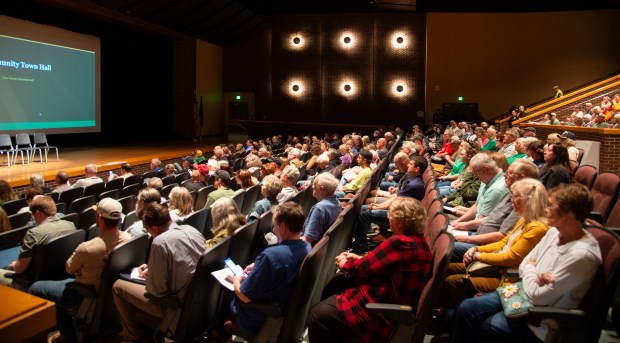
Representatives from Sentinel Data Centers, a New York-based company, participated in a Thursday night town hall at Lowell High School.

“These are tricky conversations,” said Josh Rabine, CEO of Sentinel Data Centers. “We’re going to try our best to address these as honestly as we can.”
Rabine participated in the town hall, along with Nicholas Marzorati, vice president of engineering for Sentinel Data Centers; consultant Mark Paul; legal counsel David Westland from Westland and Bennett law firm; Paul Higginbotham, deputy assistant commissioner in the Indiana Department of Environmental Management’s Office of Water Quality; Heather Ennis, president and CEO of the Northwest Indiana Forum; and Matt Reardon, founding partner at MCR Partners.
Rabine gave a presentation about the meeting before the town hall portion Thursday. Questions and comments were required to be submitted online before the meeting Thursday, and Lake County Councilman Randy Niemeyer, R-7th, read out the submitted questions to the panelists.
Sentinel Data Centers proposed to build Project Shirley — the proposed data center — on 160 acres of land in Eagle Creek Township, about six miles away from Lowell High School. If approved, the data center will be on the south side of Indiana 2 and east of Clay Street.

Project Shirley officials plan to apply for special exceptions to county rules on water usage and noise levels, according to the data center website. Project leaders don’t plan to file for a tax abatement, but that could change, according to Post-Tribune archives.
The Lake County Plan Commission would have to approve a rezone from A1 agriculture to M1 light industrial to build the project.
“Tonight is not the finish line — we’re in the middle of this,” said Randy Niemeyer, who emceed the town hall. “This is the time where we’re going to work to make sure that we apply good policy to whatever decisions are made.”
Rabine told attendees Thursday night that the data center is expected to bring a $5 billion investment to Lake County, create more than 2,500 construction jobs and more than 250 on-site jobs.

Developers expect that traffic will increase during data center construction, Rabine said, but it will “generate very little traffic when it’s up and running.”
Lake County has an ordinance that requires noise to not be above 55 decibels at the property, Rabine said, and the loudest parts of the data center will come from air cooled chillers and generators, which he claims will run only in a regional power outage. Rabine also claimed that the chillers will make a higher frequency noise, which he said dissipates quicker.
Marzorati said Thursday that a full environmental study and traffic impact analysis will be conducted before the data center’s construction. No development agreement has been proposed yet, but it will include water usage, later decommission rules and require an air permit.
Rabine also expects the facility to not use much water, he said Thursday, because the facility will use air cooled chillers, which he said is a “closed loop system.” Evaporative cooling is the system that uses more water and leads to water usage problems, Rabine said.

“(Air cooled chillers) cycle water through a single, large steel piping system,” he added. “That system uses zero water. On a daily basis, you’re consuming nothing, and you’re discharging nothing.”
Ennis said data centers will bring millions of tax dollars to the region, and she believes the community benefits will be rich.
“We’re at the gold rush of the data center industry right now, and we’re really seeing activity at a higher level than you’ve ever seen,” Ennis added. “This is not something that’s going to go on for the next 20 years.”
State Sen. Rick Niemeyer, R-Lowell, said Thursday that elected officials need to do their due diligence and ensure that unincorporated areas are protected when data centers come in.
“I’m not talking about cities or towns because they have their own plan commissions and councils,” Rick Niemeyer said. “We’re not trying to supersede local control … When we come to the unincorporated areas around the state, we need to do anything we can.”
Suzanne Jaworowski, Indiana’s secretary of energy and natural resources, attended Thursday’s meeting and said it’s best to look at these projects “with an open mind.” Rick Niemeyer and Jaworowski spoke before the presentation and town hall portion.
“Continue to come to these kinds of organizations, have your say, ask questions and do what you’re doing,” Jaworowski said. “But also be open to the fact that it’s important for the United States to be able to build our own AI infrastructure.”
Lisa Vallee, organizing director for Just Transition Northwest Indiana, previously said the potential Eagle Township project tells the same story as other projects nationwide.
“Lake County officials need to listen to the people and not hide behind inaccessible meetings controlled by the developer for a project that is already being rubber-stamped,” Vallee said in an email statement. “Community members have made it loud and clear: they don’t want another AI data center in their backyards!”
The Lake County Plan Commission is expected to have a public hearing for the project May 20. It’s likely the project will be heard by the plan commission at least four times, Lake County Council at least twice and the board of zoning appeals at least once.