
I’ve written about the anniversary milestones associated with the sinking of the Titanic on April 15, 1912, in previous columns.
But I haven’t revisited the horrible event from July 24, 1915, for another maritime disaster, which includes an anchor association with Michigan City.
It was on that summer day more than a century ago that thousands of employees of Western Electric’s Hawthorne facility planned a fun escape from city life to cross from the Chicago harbors over Lake Michigan to arrive in Michigan City for a day of picnics, games and fellowship at Washington Park in Michigan City.
The masses boarded the several ships along the Chicago River near the Clark Street bridge for the daytime trip, which would return them to Chicago later that evening.
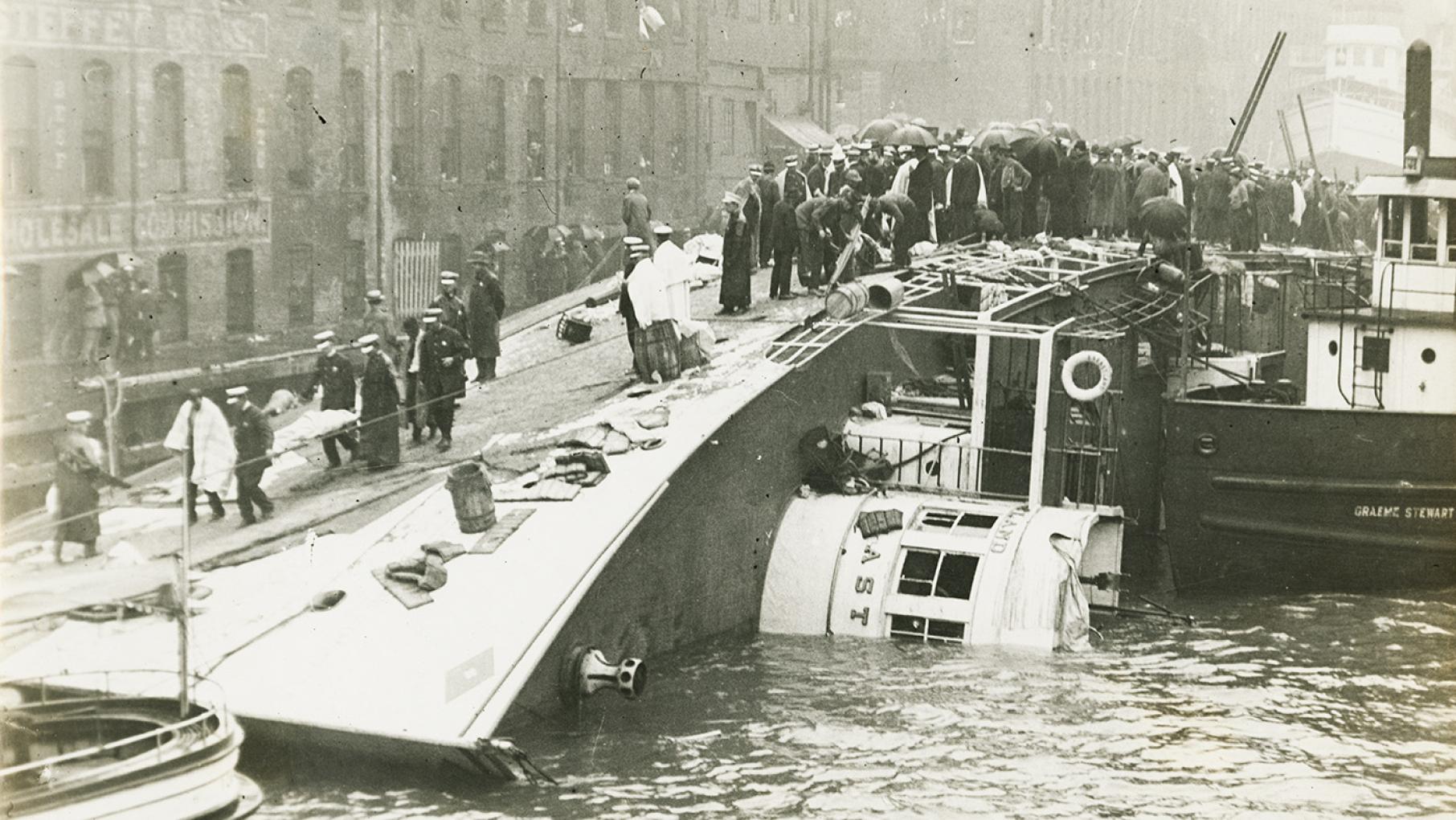
Tragically, 844 of those employees and their family and friends with tickets to board the SS Eastland died before the ship left the dock.
The vessel, with more than 2,500 people aboard, “rolled” at the dock because of the imbalance of weight along one side of the boat, launching some people in the water while trapping others inside.

Borghild Amelia Aanstad, just 13 at the time, was one of those trapped partially underwater inside one of the deck levels of the Eastland, along with her younger sister and family. Decades later, she would share the details of the nightmare with her granddaughters, Susan Decker and Barbara Decker Wachholz, both of whom continue today to marvel at their grandmother’s courage as a brave survivor. (It was after the death of Borghild’s first husband that she later married childhood friend Ernie Carlson, the latter who had taught her how to swim, which was instrumental in her survival of the Eastland Disaster.)
With Susan and Barbara’s mother, Jean Decker, and Barbara’s husband, Ted Wachholz, the four founded The Eastland Disaster Historical Society (EDHS) as a charitable 501(c)(3) organization in 1998.
Every July, a ceremony in Chicago remembers the 844 men, women, and children, many of whom were Polish immigrants, who died on that July 24, 1915, morning as they anticipated what was to be a day of relaxation and celebration for this fifth annual Western Electric Hawthorne Works Club picnic event.
Today, a chain with 844 links (each link representing the 844 victims of the SS Eastland disaster) lines the east side of the Old Lighthouse Museum campus in Michigan City, Indiana.

One of the victims, Anna Kubiak, was a Michigan City native who worked at Western Electric in Chicago to help support the family farm. She was elected the “princess” for the cable department’s float in the parade that would have been held had the SS Eastland arrived safely in Washington Park in Michigan City. Anna had just turned 17 on July 21, 1915, three days before her untimely death. A bench dedicated to her memory now stands on the Old Lighthouse Museum’s grounds in Michigan City. In 2022, the family of Anna Kubiak, in partnership with the Old Lighthouse Museum and Michigan City Historical Society, also dedicated an engraved monument for Anna’s unmarked plot at Resurrection Catholic Cemetery in Justice, Illinois.
In addition to the nautical tragedy historical society they helped to found, sisters Susan Decker and Barbara Decker Wachholz have made it a family mission to keep their late grandmother’s legacy and story of hope and survival alive for future generations to learn from the tragedy.
At 1 p.m. Saturday, May 2, the sisters will present a free 45-minute presentation about their grandmother’s story and the ship’s capsizing during a lecture at Michigan City Public Library, 100 East 4th St. Titled “What Really Happened? Was it Avoidable?,” the presentation will include color, simulated animation of the morning’s tragedy as recreated with technology as well as rare photos and media to accompany narration from the words of survivors as shared by descendants. For more information, call 219-873-3042 or visit https://www.mclib.org/.
“My grandmother, we called her Nana, was just a few days away from her 14th birthday when she joined her family for this company picnic outing,” granddaughter Barb said.
“She was joined by her younger sister, their mother, our great-grandmother, and her mother’s brother. At the time, Western Electric employed about 7,000 people, and 2,500 were invited for this day across the lake. When the boat turned over on its side, the water was shallow in that part of the river, so the ship was stuck in the mud. My grandmother talked about how they treaded water for hours waiting to be rescued. She said she could always see the sun and sky through one of the open portholes, which always gave her great hope and confidence they would survive.”
Barb said while her grandmother wanted others to hear her story and the details of the tragedy, her younger sister was a different survivor and wasn’t as open about talking about that horrible life moment in history.
“We loved our grandmother so much and we still do,” Barb told me by phone last week.
“She lived out her life in the same small apartment near Wrigley Field, and she was a great cook and baker. She’d put me up on a stool with an apron around me as a young girl and let me help measure out recipe ingredients. Our grandmother celebrated with her entire family with a big backyard birthday party for her 90th birthday in 1991 and then died peacefully in her sleep just five days later.”
Barb said every year at the anniversary date of the Eastland tragedy, her grandmother would be interviewed by media names from every medium.
Her favorite interviewer was always WGN radio’s Wally Phillips, who died at age 82 in 2008.
“Wally loved to talk to Grandma, and one time, he even took her out to eat downtown at Mike Ditka’s Steakhouse,” Barb said.

“He loved hearing her talk about the past events of her life and how this tragedy changed her perceptions forever.”
Barb said her grandmother’s favorite cookie recipe was a century-old simple brown sugar dough creation “with everyday ingredients to make a generous two dozen cookies for each batch to share with family and others.”
Barb’s Grandma’s Brown Sugar Cookies
Makes 2 dozen
Ingredients
1/2-pound butter
1 cup brown sugar, packed solid
1 egg yolk
2 cups flour
Salt
1/2 teaspoon vanilla
Directions
Combine all ingredients and mix well to make cookie dough.
Roll dough into small balls and place on ungreased cookie sheet.
Bake 11 to 12 minutes in a 350-degree oven.
Columnist Philip Potempa has published four cookbooks and is a weekly radio host at WJOB 1230 AM. He can be reached at philpotempa@gmail.com or mail your questions: From the Farm, PO Box 68, San Pierre, Ind. 46374.