
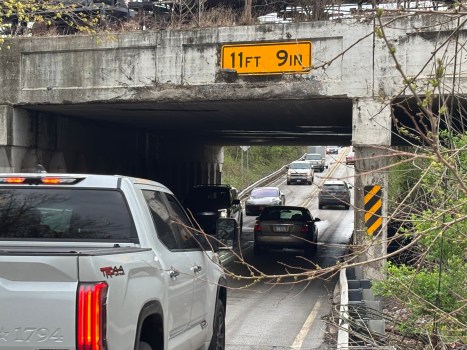

The viaduct that carries trains across Vollmer Road between Kedzie and Western avenues has been struck by over-height trucks enough times that the damage is visible on both sides.
“This has been discussed for a long time,” said Flossmoor Mayor Michelle Nelson. “I don’t think it would be too much to say decades.”
The section of Vollmer Road runs between Flossmoor and Olympia Fields, and each village polices traffic on one side of the road. The road itself is managed by Cook County, meaning all those entities have to work together on road issues.
“When there are issues, we’re really working collaboratively,” Nelson said.
The number of stakeholders makes any potential solution to the problem that much more complex, Nelson said.
“You have (Canadian National) rail lines, you have Metra rail lines, you have the county, so you’ve got all these different jurisdictions that are involved and that have their own legal requirements that they have to abide by,” Nelson said. “It’s a project that we definitely couldn’t handle locally.”
The viaduct has a clearance of 11 feet, 9 inches, a fact displayed repeatedly on signs approaching the viaduct from both directions.
The typical maximum height for trucks is 13 feet, 6 inches, meaning many semitrailers are more than a foot too tall for the Vollmer Road viaduct’s clearance.

“There are warnings in these drivers’ cabs about this particular viaduct. They are warned, they receive fines if they do hit the viaduct. Probably a lot of them lose their livelihoods, if they ignore them and go ahead and try to pass through and are not successful,” Nelson said.
But none of those deterrents have been sufficient to solve the problem of over-height trucks attempting to pass under the viaduct.
“We’ve looked at a lot of different options. I mean, it’s not a truck route,” Nelson said. “It’s not a designated truck route, yet truckers are still going down Vollmer.”

Don Tornow, a 90-year-old resident of Chicago Heights, has twice been taken in an ambulance twice down Vollmer Road to receive emergency medical care: a route that passes under the viaduct.
“I have been in an ambulance twice heading from my home, which is east of the viaduct, heading for St. James hospital,” Tornow said. “And when that’s blocked, the ambulance has to go all the way north to Flossmoor to get under their viaduct or it has to go all the way south to Route 30 to get to the hospital.”
That makes the recurring crashes and subsequent closures at the viaduct a matter of potential life and death for him and others, he said.

“Three or four times a month this road is closed due to a semi or large truck trying to get through,” Tornow said. “They are asleep at the wheel drivers not reading warning signs.”
In addition to ambulances, Vollmer Road is also an important route for fire trucks and school buses, Tornow said, which also have to circumvent the viaduct if it’s blocked.
“It also requires the police force from Flossmoor or Olympia Fields to direct traffic and tow trucks,” Tornow said. “It’s very costly to the police force from both communities.”
Tornow said he thinks truck drivers attempt the Vollmer Road route as a way of bypassing Interstate 294.
“There’s no room for these semis to turn around,” Tornow said. “Once they commit to turning down that road, they can’t turn around.”

Olympia Fields community advocacy group SHARPwatch, which has organized around improving the viaduct’s safety in the past, said on its website that since the warning signage was not working, the route should be closed to trucks entirely.
The question of when there will be a fatality at the viaduct is “not a matter of if but when,” SHARPwatch said on its website.
Nelson said Flossmoor is still considering solutions to the problem, which would require collaboration with the county.
“It’s an expensive situation to fix,” Nelson said. “We’ve tried lots of inexpensive ways to correct it. Those aren’t working.”
elewis@chicagotribune.com