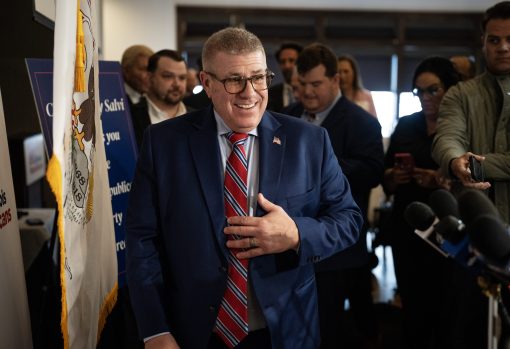

After Darren Bailey last month won the Illinois Republican Party nomination for governor, he quickly tried to separate himself from President Donald Trump, declaring, “I am my own person” and that “there will be no outside influence dictating anything that we do here in Illinois.”
Yet less than two weeks later, there was Bailey, sitting across from Trump’s daughter-in-law Lara Trump inside Chicago’s Trump International Hotel & Tower. In an interview for her Fox News show, Bailey urged the president’s U.S. Justice Department or the FBI to come to Illinois to investigate “waste and fraud at massive levels” without offering any proof.
It was just one example of the contradictions that have become a feature of the downstate farmer’s second bid to challenge Democratic Gov. JB Pritzker for the state’s top office, reflecting few lessons learned from his first unsuccessful effort or even from the stumblings of his GOP rivals in the March primary campaign.
Bailey 2.0 was supposed to be a chastened, more humble candidate after his nearly 13-percentage-point loss to Pritzker four years ago. But while he no longer declares Chicago a “hellhole,” as he did in 2022, and professes to better appreciate the city and suburbs, his social media remains filled with accounts of city crime and his vows to quickly end social justice and immigrant rights reforms that, as a matter of state law, a governor is powerless to unilaterally undo.
Bailey, whose evangelical Christian beliefs have been a pillar of his bids for public office, did chastise Trump for posting a now-deleted social media meme in which the president presented himself as a Jesus-like figure healing the sick as part of his criticisms of Pope Leo XIV’s opposition to the war in Iran.
“I’m a Christian and I’m an Illinoisan. President Trump mocking a Chicago-born Pope and posting himself as Jesus Christ is wrong. I don’t care whose name is attached to it — I’ll always call it like I see it,” Bailey posted Monday on the social media site X.
Bailey followed up on that with another X post on Tuesday, saying, “Look, I’ve had to eat my words before. But when you’re wrong, you say so. President Trump was wrong here and he should apologize to Pope Leo.”
Trump has said he won’t apologize, and Bailey’s comments drew derisive responses on social media from those who questioned whether he was trying to “sabotage” his campaign by alienating MAGA Republicans — the staunch supporters of the president’s “Make America Great Again” sloganeering.
A day later, Bailey went further, declaring he was not a MAGA Republican. Asked how voters can believe someone who has been a frequent visitor to Trump’s Mar-A-Lago estate in Florida over the last four years, vouched for the president’s intelligence and repeatedly backed his most controversial positions has suddenly left the MAGA universe, Bailey told the Tribune: “Well, they’ve got seven months to learn it.” He has rented a South Loop Chicago apartment to spend the next several months “to simply earn the trust and, ultimately, the vote of the people there.”
“I’m ready to stop some of the political rhetoric that I’ve been a part of in the past. I admit it, understand it and I want to turn away from that,” he said in Springfield after a gun-owners’ rights rally.
“At the end of the day, I think that my character speaks for itself. I think that people admire and understand that when I see a problem, I call it out, and I’ve honestly really always done that. And likewise, when I see something that is right, I will acknowledge that as well,” he said.
But Bailey’s attempts to navigate around Trump in Illinois may be as fraught as an oil tanker trying to successfully traverse the Strait of Hormuz. And by declaring himself not part of the MAGA Republican brand, the GOP candidate for governor risks moving into the general election campaign camped out on an island without a political base.
Opposition to Trump in Illinois deepened with last year’s controversial and aggressive federal immigration raids, actions backed by Bailey, and has only grown with economic concerns due to tariffs, sustained inflation and higher grocery costs, and increased gas pump prices as a result of joint U.S.-Israeli military strikes on Iran.
All of which makes Bailey’s chances for success in November even more daunting than they were in 2022, despite his attempts to convince voters he is not a MAGA Republican Trump disciple.

“I think he’s in a worse situation than he was four years ago in terms of trying to find a path to victory,” said Kent Redfield, an emeritus political science professor at the University of Illinois Springfield. “Bailey’s saying, ‘It’s time for a change,’ and the public is saying, ‘Yeah, it’s time for a change — away from whatever’s happened nationally.’”
Added to that are the financial realities of his campaign. Bailey raised only about $450,000 to win the GOP nomination in March, and big-money GOP supporters have not lined up to back his general election bid versus Pritzker as some did in 2022. Since winning the primary, the former state lawmaker and farmer from downstate Xenia has received only about $25,000 in large-dollar donations, recent campaign reports show.
“He has no money, and he has no way to get any money,” added Charles N. Wheeler III, a former longtime statehouse reporter and retired UIS professor. Large-dollar Republican donors staring at potential GOP losses in Congress “have to be a lot more concerned with that … and so why are they going to be putting money into Illinois?” Wheeler asked.
Bailey ardently sought and received Trump’s endorsement in the 2022 GOP primary race for governor. He sought it again in his unsuccessful 2024 primary challenge to U.S. Rep. Mike Bost of Murphysboro and did not get it. This time, Trump encouraged Bailey to run again for governor after a tragic helicopter crash killed Bailey’s son, daughter-in-law and two grandchildren, but the president stopped short of a formal endorsement.
“Throughout your career, you have been a true champion for the people of Illinois, and during this difficult time, I have no doubt that you will continue to Fight! Fight! Fight! for your beloved state in honor of your beloved family,” Trump wrote.
Resuming his campaign in December, Bailey said he “would be honored” to have Trump’s formal endorsement, calling the president “a smart man.”
“I’ve had many conversations with him, and he is a very, I believe, he’s a very genuine person. He is a man of integrity,” Bailey said in the interview with NBC-Ch.5.
In an interview with an internet blogger later that month, Bailey would not say whether he believed the 2020 presidential election was stolen to elect Democrat Joe Biden, as Trump has falsely claimed. But Bailey said, “There’s always been cheating.”

In more recent interviews and social media posts, Bailey has pledged to immediately end the state’s sanctuary protections for immigrants under the state’s TRUST Act as well as pretrial provisions for cashless bail for nonviolent offenders under the SAFE-T Act, though executive authority does not grant governors the power to defy state statutes.
“Hear me now and hear me loud: On day one of my administration, I will end Illinois’ sanctuary state status. State police and federal law enforcement will work together to sweep dangerous illegal criminals out of Illinois for good,” Bailey wrote on Facebook in March.
In one interview, Bailey went so far as to suggest that a governor had a choice in implementing the TRUST Act, even though it is a state law.
“We have the TRUST Act, which, under a governor’s order, can prohibit state and local law enforcement working with federal officials,” Bailey said, though no such provision for a governor’s order exists in the statute.
In his interview with Lara Trump, Bailey also described the TRUST Act as something “which a governor can use to prevent state and local law enforcement … working with federal law enforcement,” though a state chief executive would have no choice but to follow state law.
The TRUST Act prohibits local law enforcement from working with federal immigration authorities unless they have a judicially issued detainment warrant. Bailey has claimed Pritzker has used the law to invite “killers and people who are here illegally.” But the law was signed by Pritzker’s Republican predecessor, one-term Gov. Bruce Rauner, in 2017.
Bailey also has invoked the Trump administration by saying he wants to replicate the president’s Department of Government Efficiency, the ballyhooed and much-criticized agency run by Elon Musk to look for waste in government early in Trump’s second term. Numerous reports found that DOGE vastly inflated its claims of cost savings and may actually have forced the federal government to spend more money while terminating thousands of federal employees.

Bailey has sought to assure state workers that their jobs would be safe under his “Illinois DOGE,” but aside from claiming “massive” waste and fraud, he has not identified specific program cuts within the state budget.
Redfield said that while Bailey’s claims of fraud are “abstract,” voters’ concerns over rising gas and grocery prices are “real.” Pritzker, he said, can say, “This is what you get when you vote for Trump and when you vote for Bailey, you’re voting for Trump.”
For Bailey, he said, “The good news is everybody knows who you are and that’s fine for the primary. But when you get to the general election, everybody knows who you are.”
Both Redfield and Wheeler note that Trump’s name won’t be on the Nov. 3 ballot, dampening Republican enthusiasm to turn out at the polls, while recent elections have shown Democrats are more motivated to cast ballots.
“The likelihood of (Bailey) winning is, it’s always possible,” Wheeler said. “It’s not absolute zero, but it’s pretty close.”
Tribune reporter Jeremy Gorner contributed from Springfield.