

One thing Bob Zeni will never get behind is a grocery store tomato — suspiciously bright red and plump for the middle of winter and deceptively flavorless year round. Season after season he’s made it his mission to help wean people off of those “tasteless travesties.”
“I understand why (the food industry) has done what it’s done to tomatoes,” Zeni said recently while tending to his plants at Ted’s Greenhouse in Tinley Park. “But those are mass produced in farms the size of football fields and I’m a bit skeptical about how they grow all those tomatoes to make them all look so perfect so fast.”
For 26 years, Zeni, a La Grange Park resident who is also known as the Chicago Tomato Man, has been obsessively gardening heirloom tomatoes. What first began as a backyard project has turned him into one of Chicagoland’s leading experts on how to grow the fruit in its unique array of reds, purples, yellows and stripes.
Along with convincing the average consumer that a homegrown tomato is far superior to the uninteresting and bland tomatoes found in supermarkets, Zeni is hoping to help home gardeners cultivate plants using techniques that limit their carbon footprint, during a time when the effects of climate change have already made it more challenging to gauge optimal growing conditions for his heirloom tomatoes.
“The weather has definitely become more erratic,” Zeni said. “In Chicago, it’ll go from 30 to 60 degrees in one day. As a gardener, you have to figure out how best to help your plants.”
Zeni said that in 2021, his team started the season by planting 6,000 heirloom tomato plants, of which 2,000 were put in a greenhouse that was mistakenly believed to be heated.
“A cold snap killed the entire batch of 2,000,” Zeni said. They still had 4,000 plants left, but the lesson learned could not have been clearer.
Each year he finds new things to learn and teach, building on years of trial and error.
He recently started buying live ladybugs as an alternative to chemical pesticides and discovered that worm poop is a much more environmentally friendly fertilizer for his plants, far better in many ways than cow manure.
“Worms certainly don’t have a negative environmental impact like the methane-belching cows,” Zeni said. “So I’ve started recommending that and using it instead of fertilizer.”
Zeni’s business model is focused on pop-ups selling pre-ordered tomato plants in the city and suburbs, which he starts planning months in advance. Last week at Ted’s Greenhouse, Zeni was checking in on the plants poised for the Tomatopalooza, which was held April 18 at The Roof Crop in Chicago’s West Town, earlier than he’s held it in years past because of customer demand.
“We always tell people to monitor the weather because it can get really cold and these plants can all die,” he explained. “Hopefully that doesn’t happen, but we might have a 20-degree day on April 30 and your plants are not going to like it.”
If that happens, Zeni suggests bringing potted tomato plants indoors temporarily.
“As a grower, you just have to be more and more vigilant these days — if it’s really hot, you can throw a shade or netting over the plants, which will cut down on the sun,” he offered. “But if it gets unseasonably cold and the plants are outside, they could get shaken up a bit.”

The impact of inconsistent environmental conditions on plants, including tomatoes, and crop responses to climate change, is a large part of the research being conducted by Carl Bernacchi, professor at the University of Illinois Urbana-Champaign’s Departments of Crop Sciences and Plant Biology.
“To some extent, it has a lot of the same effect that it has on animals and people,” Bernacchi said. “When we go from a really hot day to a really cold day, it takes a little bit of time for our physiology to acclimate to those conditions. Of course, we have the advantage of putting on coats or taking off coats — plants, on the other hand, have to figure out how to adapt to these rapidly changing environments, while still dealing with the general pressures of growing under field conditions.”
Quite often, Midwesterners are faced with what’s known as “false spring,” a weather phenomenon that refers to an unseasonably warm stretch in late winter or early spring that fools fruit trees and flowering plants into blossoming, only to die out after a return to normal, colder conditions, Bernacchi said.
“And those frosts are normal, the extreme high temperatures early in the growing season or early in the spring are not normal,” he noted.
Zeni still grows his own tomatoes at home and a few dozen in a small basement greenhouse to test-run new varieties, but the bulk of his operation is off-site. The temperature-controlled environment at Ted’s Greenhouse, where Zeni has grown his tomatoes for the last five years, gives the plants the initial boost. The plants are typically six to eight weeks old when they’re handed off to customers.
Zeni sold 16,000 heirloom tomato plants last year and has already sold 10,450 plants since February. Though he was a lot more involved in the physical planting process before delegating that work to the greenhouse operators, he is still in charge of finding and buying the heirloom tomato seeds.
“Seed saving is very time-consuming, and we have 200 varieties of tomatoes and I grow about 30 varieties in my backyard and test them from year to year,” Zeni said. “I also want to support these companies that contribute to the diversity of the tomatoes that are out there.”

For a tomato to be considered an heirloom, the seed has to be at least 50 years old, Zeni said, and many are passed down from generations of families and tribes. The seeds themselves are like time capsules, he smiled.
“There are 5,000 to 10,000 varieties of tomatoes and I want to find the most interesting varieties with a stellar range of colors, shapes, sizes, textures and flavors,” Zeni said. He finds it cruel and impossible to list his favorite heirloom tomatoes, but was able to narrow it down to seven: green zebra, black cherry, Napa chardonnay, queen of the night, eye candy, Amish paste and costoluto fiorentino.
The names are as striking as their appearance. And before purchasing a plant from Zeni’s online shop, customers can peruse the gallery on his website, which includes pictures, detailed flavor profiles, sizes, harvest timing and where the seeds are from.
Each variety also has a cheeky descriptor. One named “the Gandalf” is said to be “wise, powerful and magical.”
Zeni said the different varieties have varied growing requirements when it comes to climate, heat tolerance and soil moisture.
But the sweet spot for growing all tomatoes is between 65 and 86 degrees. If there’s a 90-95 degree day and the plants are in the ground, the heat could potentially fry the flowering buds. Waiting for the next batch of flowers to come in, to then yield a fruit, can get frustrating, Zeni said.
Like some home gardeners, the agriculture sector also pays close attention to growing degree days, which are units of accumulated heat available for plants to grow and mature, explained Bernacchi. GDD varies across the U.S., but projections show that the growing season will considerably increase everywhere, said Bernacchi. And though some plant species may benefit from a longer growing season, it comes with other challenges.

“A lot of insects are also driven by growing degree days and sometimes the pollinators might emerge at different times because of climate change, so the pollinators we might need for certain crops may not be present when the plants hit their growing degree day requirement for reproductive development,” he explained. “There’s a lot we’re trying to understand about building resilience into these crops. But right now, things are changing faster than science is able to keep up, and it’s not for lack of effort — rapid climate change has rapid consequences.”
For Zeni, longer growing seasons recently resulted in tomatoes growing into early November, but it also meant having to adjust his pest control methods. He said he’s hoping some of his summer workshops will help gardeners learn to navigate similar issues.
Hannah Dembosky, founder and co-lead of Bridgeport Environmentalists, said she first reached out to Zeni last September about hosting a free “how to grow your tomatoes” workshop. The demand was so great that they quickly scheduled another one for March.
“Our community is full of gardeners. A lot of single-family homes in Chinatown and nearby neighborhoods have yards and they want to learn from the experts in an accessible manner,” Dembosky said. “But I think the barrier to entry can feel really high for gardening, and even as I’m getting into trying to plan my own garden right now, I’m so overwhelmed. There’s so many things to learn, so many things related to timing and temperature and things you can’t control.”
Dembosky said one of the issues home gardeners in Bridgeport deal with is contaminated soil because there’s been heavy industry in the area for so long.
“If you don’t know too much about the history of the neighborhood and environmental issues, you don’t necessarily know that you need to test your soil before you plant in the ground, or your tomato is basically a ball of lead,” she said.
To help weary gardeners in the Bridgeport area, Zeni’s second workshop used paper cups to demonstrate how much store-bought soil is enough for a single tomato plant and other best growing practices.
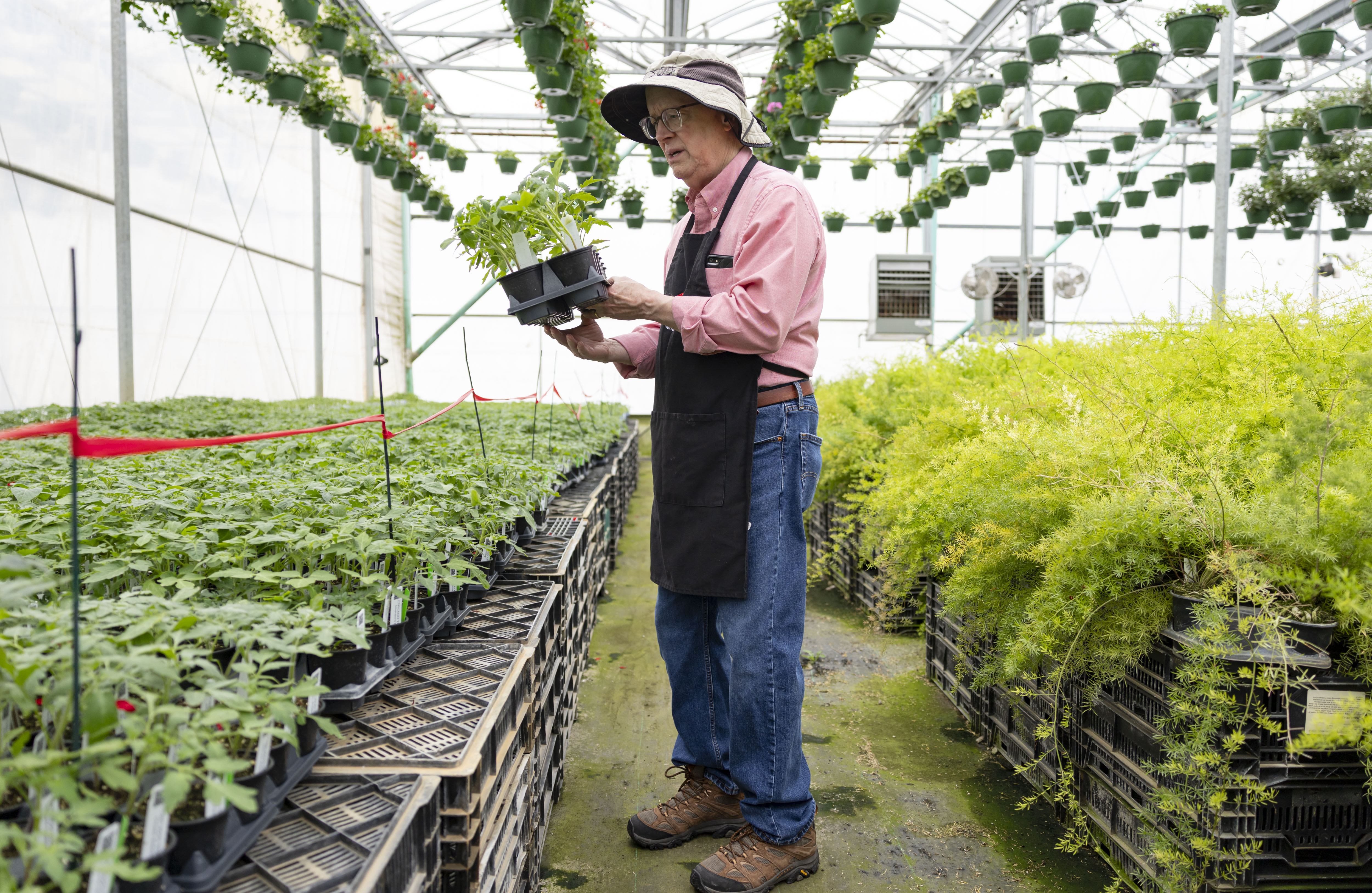
At Ted’s Greenhouse last week, Zeni walked around the massive tent, pointing at his hundreds of plants, some less than four inches in height, and others up to a foot. He said his tomatoes have always been grown without growth accelerants, which stimulate metabolic processes to make plants grow faster.

But more recently, he wanted to stop using chemical-based sprays to get rid of sap-sucking insects. So a couple of years ago, he started buying live ladybugs off Amazon.
“The ladybugs will just sit and eat the white flies and aphids all day long — there’s no sprays involved, there’s no chemicals involved,” Zeni said. “You can also buy a bunch of praying mantis, but they’re more expensive than ladybugs and they wander off.”
Along with help from small natural predators, he’s also experimented with companion planting basil, which is aphid-repelling. So is catnip, dill, fennel and garlic.
The ladybugs, like the worm poop fertilizer, are a newer facet of Zeni’s quest to spread the good word about the mystique of an heirloom tomato. Preserving the unmistakable quality of an heirloom relies on optimal growing conditions both for the fruit and its environment, Zeni offered.
On his website, Zeni sells a little container of worm poop, sourced from the Northern Illinois Worm Farm.
“Am I going to personally solve all of the environmental problems by myself? Well, of course not. But if everybody is doing a little bit, there will be a very big impact in my opinion — small acts can accumulate to make a big difference.”


