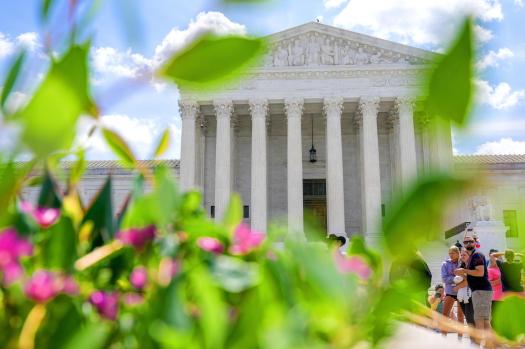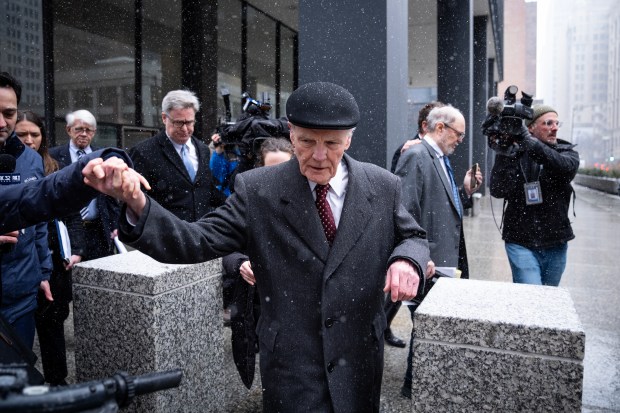





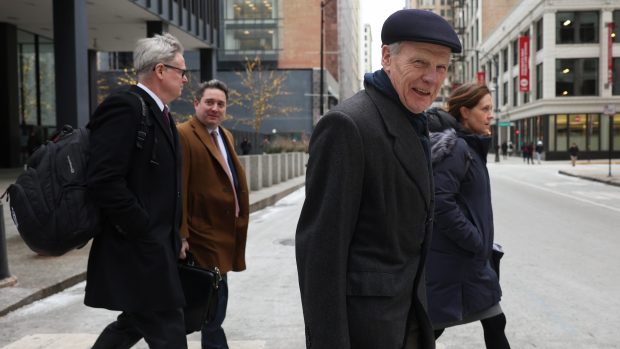


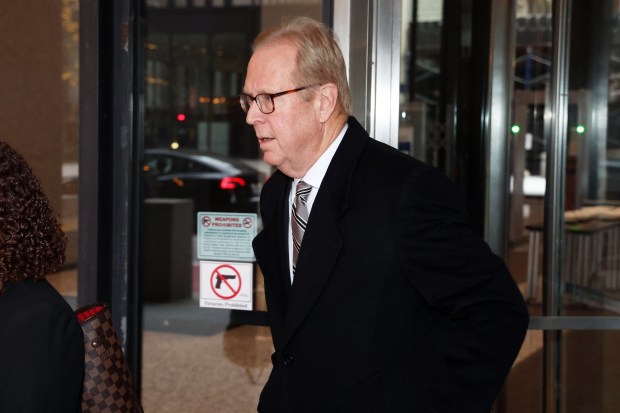








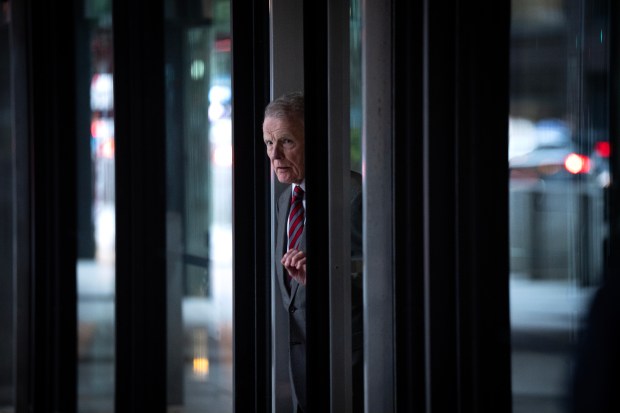


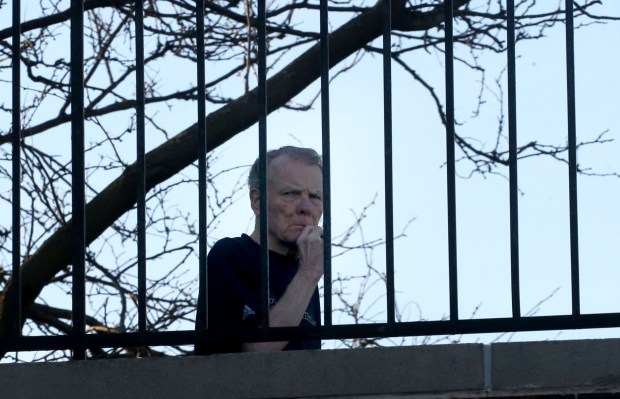


A federal appeals court in Chicago on Monday upheld the sweeping corruption conviction of ex-House Speaker Michael Madigan, brushing aside his arguments that schemes to help utility giant ComEd and trade favors with then-Ald. Daniel Solis were just everyday politics and saying the evidence of wrongdoing was “overwhelming.”
“Michael Madigan spent nearly a decade leveraging his power as one of the highest-ranking public officials in Illinois in exchange for over $3 million of financial benefits for his close political allies,” the unanimous 7th Circuit U.S. Court of Appeals panel wrote in its 29-page opinion about the ComEd plot.
“The linkage was clear and far from fleeting. He repeatedly facilitated changes to state law impacting countless energy consumers in northern Illinois, all because ComEd funneled money to the right people,” the court said.
The court also found there was “sufficient evidence supported finding that Madigan agreed to a quid pro quo” by agreeing to help Solis get a state board position in exchange for the alderman’s help landing business for the speaker’s private law firm and steering an insurance contract to Madigan’s son.
“The government presented evidence that Madigan understood the weight of his recommendation. He confidently told Solis to ‘just leave it in my hands’ and said that Solis would ‘come in as (Gov. JB) Pritzker’s recommendation,” the opinion stated. “We will not disturb these convictions.”
The opinion, written by Judge Michael Scudder and joined by Judges Frank Easterbrook and Nancy Maldonado, concluded by saying: “Madigan insists that this was run-of-the-mill politics. But a jury of twelve Illinois residents saw the evidence differently. So do we.”
The quick decision, which comes just 16 days after the court heard arguments in the case, means Madigan will have to serve out his 7½-year prison sentence barring a successful petition to the U.S. Supreme Court or a pardon or commutation from the White House.
U.S. Attorney Andrew Boutros issued a statement Monday saying the “significant opinion” affirmed his office’s work and the jury’s verdict in the long-running corruption case.
“It was the grit and determination of our team of prosecutors and law enforcement agents, led by our former Public Corruption Chief, Amarjeet S. Bhachu, that sent this resounding message heard throughout the State that criminal conduct by our public officials — especially those in top leadership — will never be accepted by the Chicago U.S. Attorney’s Office,” the statement read.
Madigan’s lawyers did not immediately respond to calls seeking comment.
The ruling also stands in stark contrast to the decision earlier this month by a different 7th Circuit panel, which abruptly reversed the May 2023 convictions of former ComEd CEO Anne Pramaggiore and lobbyist Michael McClain, who were accused of orchestrating the plot to bribe the speaker. Both Pramaggiore and McClain were released from prison the next day.
The U.S. attorney’s office has not said whether they intend to retry that case, known as the “ComEd Four,” which unfolded under different legal theories than Madigan’s case before being upended by a series of U.S. Supreme Court rulings that raised the bar for prosecutors on bribery and false statements.
Madigan, who turned 84 last week, was sentenced in June 2025. He reported Oct. 13 to a medium-security camp in Morgantown, West Virginia, and his current release date is in early 2032, when he would be nearly 90.
After a trial that stretched nearly four months, Madigan was convicted on Feb. 12, 2025, of bribery conspiracy and other corruption charges. The jury found him guilty on 10 of 23 counts, including a multipronged scheme to accept and solicit payments from ComEd to Madigan associates for do-nothing subcontracts.
Madigan also was convicted on six out of seven counts — including wire fraud and Travel Act violations — regarding a plan to get Solis, who testified at length in the trial, appointed to a state board in exchange for Solis bringing Madigan business for his private law firm.
The jury acquitted Madigan of several other schemes alleged in the indictment and deadlocked on other counts, including the overarching racketeering charge. In handing down the 90-month prison term, U.S. District Judge John Robert Blakey said Madigan’s crimes represented “abuse of power at the highest level” and were aggravated by the fact that Madigan had every advantage in life, including a privileged education and a thriving law practice.
The judge also found that Madigan lied repeatedly and willfully when testifying in his own defense during the trial. Blakey called it “a nauseating display of perjury and evasion” that was “hard to watch.”
In his appeal, Madigan’s attorneys said the prosecution’s case “improperly criminalizes the rough-and-tumble business of state politics in direct contradiction of recent Supreme Court rulings.”
Madigan’s lawyers also accused the U.S. attorney’s office of “throwing years’ worth of legislative action and political relationships at the jury in the hopes of making something stick.”
“To be sure, the evidence showed that ComEd and the alderman sought to curry favor with Madigan,” their appellate brief stated. “Constituents do this every day, whether through hiring politically connected individuals or offering other support to legislators. These interactions may strike federal prosecutors as unbecoming. But they do not constitute bribery.”
But in its opinion Monday, the 7th Circuit had harsh words for Madigan — the longest-serving statehouse leader in the country and the former longtime head of the Illinois Democratic Party — saying a reasonable jury could easily conclude from the evidence that he agreed to an illegal “stream of benefits” from ComEd in exchange for his official actions in the capitol.
“The particulars of evidence reveal that ComEd faces regulatory uncertainty surrounding its rates, that it sought a legislative solution to its financial turmoil, while funneling large sums of money to Madigan’s close political allies, and that Madigan, in exchange, delivered in Springfield,” the court said. “Indeed, the evidence was overwhelming.”
In recapping the evidence from trial, the appeals court said Madigan “took steps to avoid being caught red handed,” in particular by delegating authority to McClain, his trusted confidant.
The 7th Circuit said the conspiracy by ComEd began in 2011 with payments to former Ald. Frank Olivo, who was paid $4,000 a month for what was “not your average aboveboard sub-contract.”
It continued for years as more subcontractors were brought on and had their pockets lined by the utility for doing little or no work, including Madigan’s longtime precinct captain, Edward Moody, and former state Rep. Edward Acevedo, another key ally of the speaker, the opinion stated.
And ComEd benefited enormously from the arrangement, the opinion noted, getting Madigan’s help in passing key legislation granting a formula rate, investing in electric grid infrastructure and rescuing two underperforming nuclear power plants owned by the utility’s parent company.
“This was not politics as usual or ordinary lobbying,” the opinion stated. “The trial evidence exposed a sustained and concealed arrangement to exchange enormous political influence within the Illinois General Assembly for over $3 million of benefits for political allies. There was no agreement signed at a sit-down meeting. But there did not have to be.”
In the scheme involving Solis, the 7th Circuit opinion again said there was ample evidence for the jury. When Solis approached Madigan in June 2018 and mentioned he was interested in sitting on a state board, Madigan “said he would ‘take a note down’ and that he had a ‘file,'” the opinion stated.
Madigan also told Solis in that meeting that he had been trying to connect with Harry Skydell, the developer of the deep-pocketed developer overseeing the Old Main Post Office renovation in Solis’ ward. After Solis promised to make an introduction, Madigan delivered documents to Solis’s office describing the different board seats and their compensation amounts.
Later, Madigan “took affirmative steps to help Solis choose his preferred seat” and said he would recommend him to Governor-elect Pritzker,” the 7th Circuit said. When Solis asked if Madigan was interested in anything other than an introduction to Skydell, Madigan responded, “There’s one thing you can do,” and asked Solis to steer insurance business to his son, Andrew.
While Madigan’s attorneys argued he never intended to actually make the Solis recommendation, the 7th Circuit opinion stated prosecutors only needed to show he planned to.
“He asked for Solis’s resume to prepare for an upcoming meeting with Governor-elect Pritzker, affirmatively sent Solis materials outlining the different board positions and their compensation, and took notes on Solis’s preferred seats,” the opinion stated. “The jury could have rationally concluded that Madigan intended to recommend Solis.”