
The Fox River Water Reclamation District is increasing its sewer rates by 9% to help pay for about $55 million in capital projects to meet state sewer treatment mandates and to replace aging equipment.
Executive Director Eric Johnson said the amount is about eight cents per day for the average homeowner, or about $2.27 a month.
Currently, the agency has about 225,000 customers in Elgin, South Elgin, West Dundee, portions of Sleepy Hollow, Streamwood, Hoffman Estates, unincorporated St. Charles Township, and surrounding areas in Kane and Cook counties.
The district’s bill is made up of a fixed-base charge and a volumetric rate, the latter based on how much a household or business uses. The fixed base charge is currently $6.09 and the usage rate is $2.94 per 1,000 gallons, Johnson said. Costs are based on an average residential customer, with the base charge varying depending on the size of the meter.
A household using about 5,000 gallons per month pays $6.09 for the base charge and $14.70 for the usage charge, for a total of about $20.79.
Beginning May 1, the fees will increase to $6.76 for the base charge and $3.26 per 1,000 gallons, Johnson said.
The same household using 5,000 gallons per month will pay $6.76 for the base charge and $16.30 for the usage charge.
The increases will appear on June water bills.
Elgin includes the charges on its water bills and collects fees on behalf of the water reclamation district. Because the city doesn’t set the rates, fees are listed on the bill as Sewer Treatment FRWRD and Sewer Treatment FRWRD Availability.
What’s driving the increase are capital improvements tied to Illinois Environmental Protection Agency regulatory requirements, including the removal of phosphorus, one of the nutrients found in human waste, Johnson said. Phosphorus is removed from wastewater through the use of chemicals or biological methods so what’s released into the Fox River doesn’t cause algae blooms, he said.
“We want to make sure the water we put back into the Fox River is cleaner than the river itself,” Johnson said.
The state has requirements on how much phosphorous treated wastewater can contain, and the requirements are getting more rigorous.
“The majority of the projects identified in our facility master plan are tied directly to meeting that more stringent standard across our three treatment plants,” Johnson said. “These are significant upgrades to treatment processes and equipment and represent the largest driver of long-term costs.”
The reclamation district, which is primarily funded by user fees, has an annual budget of $70.4 million for operations and capital costs, he said. It has identified various capital projects that need to be done in the next three to five years at a cost of about $55 million and has already taken $60 million in revolving loans from the state over the last eight years to pay for required improvements, Johnson said.
“In addition to those regulatory-driven improvements, we are also maintaining and reinvesting in aging infrastructure,” he said. “The oldest parts of our system date back nearly 100 years and like any utility of that age, there is an ongoing need for repair, replacement and modernization to ensure reliability and avoid more costly failures in the future,” he said.
There’s no indication whether the fees will increase again in the near future, he said.
“We evaluate (potential increases) every year to see where we are at and see what existing capital projects are,” said Johnson, noting their annual report is available at www.frwrd.com. “We want to be good stewards of taxpayer dollars and be transparent.”
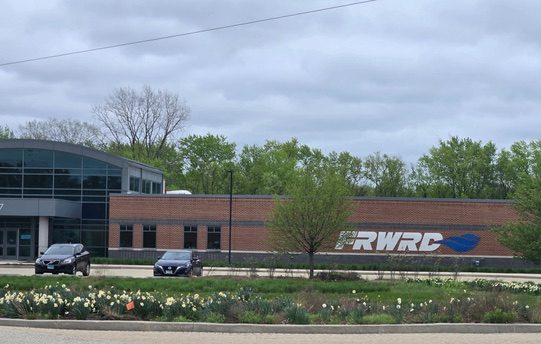
FRWRD operates three plants in Elgin, and its corporate office is located in South Elgin. It was created as the Sanitary District of Elgin in 1922.
Gloria Casas is a freelance reporter for The Courier-News.