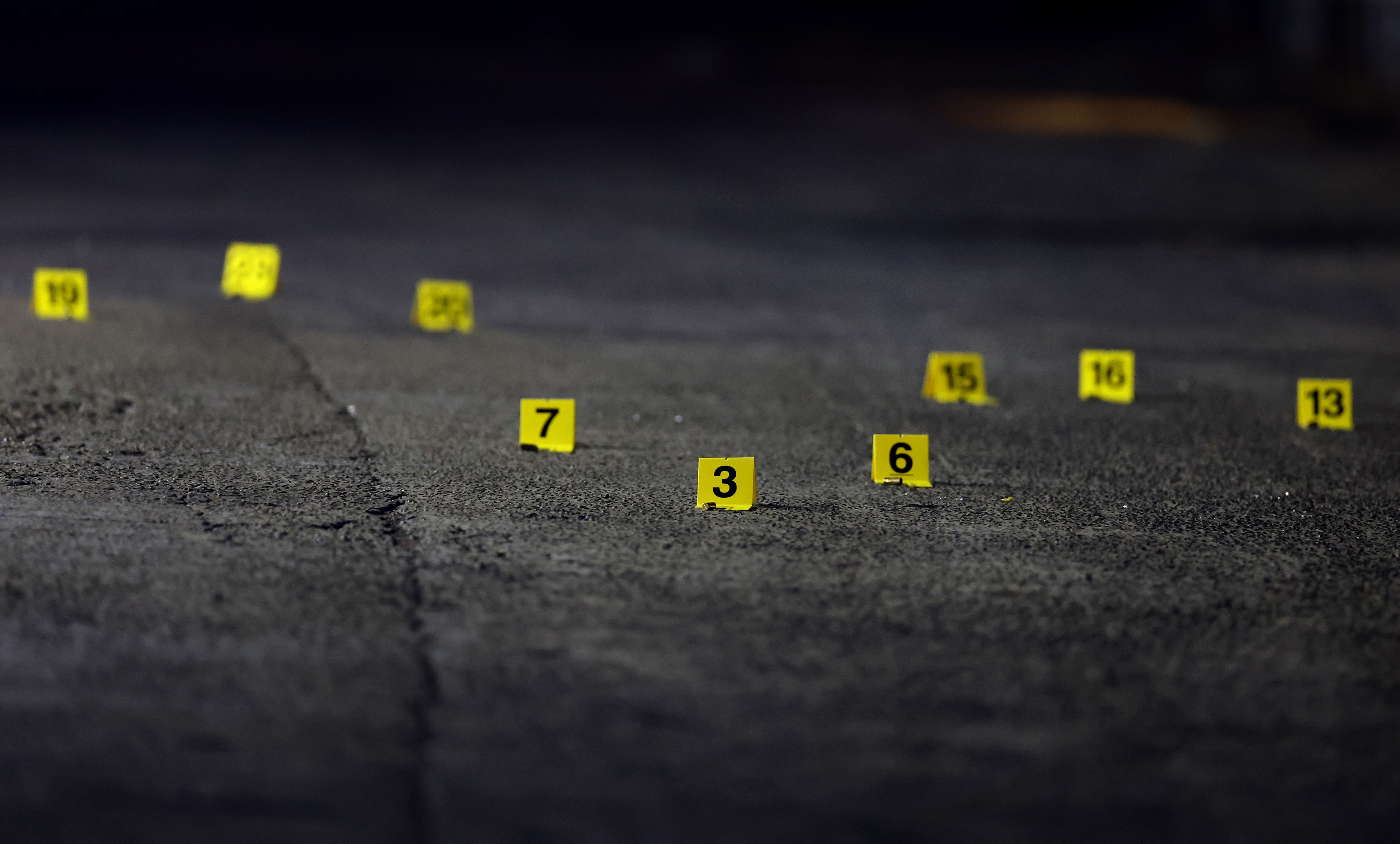

“It’s Halloween, and somebody is going to die tonight.” Those were the chilling words of a Chicago gang member who made good on his threat by firing a hail of bullets into a car on Halloween night in 2009 in Chicago’s Humboldt Park neighborhood. A passenger in the car was shot multiple times and died. It’s a tragedy we sadly see all too often in Chicago. It also was entirely preventable.
I, Andrew S. Boutros, was then a new assistant U.S. attorney in Chicago when I received a call from an experienced federal agent about a large-scale case that had just been reassigned. Turns out the gang member who committed the drive-by murder had been under federal investigation for months. Prior to Halloween, federal agents coordinated undercover firearm purchases from him and referred the matter for federal prosecution. Federal agents had identified the defendant as highly dangerous and volatile, but the U.S. attorney’s office had opted not to charge him then while prosecutors looked for more evidence. The agent soon came to meet with me, and he did not mince words. I heard him; he was right.
Working alongside another assistant federal prosecutor returned multiple indictments charging nearly two dozen members of that violent gang and others. All defendants were convicted and sent to prison. But should the case have sat for as long as it did in the quest for better evidence and case building? After all of our experience, the answer to that question is almost always: No.
As I, Andrew, embark on my second year leading the Chicago U.S. attorney’s office and working closely with many law enforcement partners, including Christopher Amon, special agent in charge with the Bureau of Alcohol, Tobacco, Firearms and Explosives, I can now do something about cases that trouble me, such as what happened in Humboldt Park in 2009.
We, Andrew and Christopher, decided to chart a different course, which we will describe here.
With dozens of newly minted federal criminal prosecutors coming on board in Chicago, many with deep experience handling violent crime cases in federal and state courts around the country, we are building the team to do it. Indeed, we will do it, all while we continue to prosecute corrupt public officials, narco-terrorists, drug traffickers, large-scale fraud, corporate crime, government benefit schemes, child predators, human traffickers and other worthy federal targets. Just scroll through our office’s news releases from last year and this year — including the first-ever annual report we issued in January: Under fresh office-wide leadership, we are doing significantly more with far fewer resources.
On the violent crime front, there has long been a perception from some in Chicago that federal prosecutors must turn to large-scale conspiracy cases against street gangs as a centerpiece of urban violence reduction. The theory is intuitive: Dismantle the organization, incapacitate its leadership and send a deterrent message that reverberates across the streets. These noteworthy prosecutions, often built under racketeering or similar statutes, are resource-intensive, multiyear undertakings that culminate in sweeping indictments, dramatic news conferences and lengthy sentences. They are also, as a primary strategy for reducing today’s street violence, not the principal tool for the job.

If the goal is reducing shootings this week, next month or even this year, the overwhelming evidence based on empirical research and law enforcement experience — including Christopher’s more than two decades of experience in multiple cities — as well as common sense, points toward rapid, targeted and responsive interventions that interrupt violence in real time.
This is the strategy that gets results quicker. It’s the strategy that reduces violent crime and saves lives. It means measuring success not by the size of an indictment but by the absence of violence and, even more pointedly, the prevention of violence. And with the summer months ahead, it’s the strategy that will drive our violent crime initiatives at the federal level here in Chicagoland.
Long-term federal gang and violence cases are built deliberately and painstakingly. Investigations often take years, involving wiretaps, informants, controlled drug and firearm transactions, financial tracing and coordination across agencies. Arrests and charges often occur long after the individuals contributed to cycles of violence and retaliation. That means by the time an indictment is returned, the factual narrative typically reflects a backward-looking account of conduct that may stretch over a decade. That retrospective orientation is inherent to the model. It is designed to tell a comprehensive story of enterprise criminality, not to disrupt the next retaliatory shooting.
Violence, however, operates on a different clock. Most shootings are not the product of hierarchical gang directives or long-term conspiracies; they are reactive, situational and often impulsive. A slight, a social media post, a perceived encroachment on territory, a dispute involving a girlfriend can escalate into lethal violence in hours or even minutes. The individuals involved are frequently known to local law enforcement and community members. What is missing is not information. What is needed is clear deterrence and accountability through immediate arrest, detention and prosecution of worthy targets. Arresting and federally charging a dangerous felon in possession of a firearm before he shoots someone are far more effective — and decent — actions than prosecuting that defendant for murder after he has already killed somebody.
There is also a mismatch in scale. Long-term federal gang and violence prosecutions are designed to take down organizations. But as the data shows, violence is largely concentrated among a small number of individuals and increasingly smaller, yet no less violent and lethal, groups of street gangs and crews. Strategies that focus on rapid, targeted intervention operate at the right level of analysis and on the right timeline. They are not about building perfect courtroom cases; they are about preventing the next act of violence.
When it comes to dangerous offenders, simple and straightforward gun cases spearheaded through violent crime prevention centers like ATF’s Chicago Gun Intelligence Center and charged swiftly by federal prosecutors can do more with less to immediately curb violence in Chicago. As the head of ATF Chicago, I, Christopher, have seen firsthand that by leveraging technology such as ballistic evidence, law enforcement can identify the true drivers of violence to intervene early and disrupt the violence cycle. In doing so, we can focus on individuals with extensive criminal histories who illegally possess guns as well as those linked to prior shootings.
Federal law can also serve as a backstop when state prosecutions face complicated legal or factual scenarios, such as self-defense. In those instances, perpetrators can be charged under federal firearms statutes that carry a maximum 15-year prison sentence.
Critically, real-time prosecutions also are far less resource-intensive. A single long-term federal gang case can consume enormous prosecutorial, investigative and judicial resources. Agents are tied up for years. Prosecutors devote substantial time to managing multidefendant litigation, complex evidentiary records and massive volumes of discovery. Even successful prosecutions may not bring about the desired force-multiplier effects. Convictions have frequently resulted in retrials for one reason or another. Lengthy prison sentences imposed years after the crime may not influence other individuals making split-second decisions in volatile situations.
Meanwhile, those same law enforcement resources, if redeployed toward proactive intervention such as gun prosecutions and rapid-response initiatives, can produce swift, predictable justice that is more immediate, measurable, exact and effective in reducing violence, even if they lack major headlines, courtroom drama, celebrated outcomes and obvious career advancement.
Rapid-response strategies are not ad hoc; they depend on structured, robust collaboration among law enforcement partners and prosecutors. In Chicago, when it comes to anti-violence work, we are lucky to have first-rate federal agents and experienced federal, state and local leadership in place at all those levels, including FBI Special Agent in Charge Doug DePodesta, Drug Enforcement Administration Special Agent in Charge Todd Smith, Homeland Security Investigations Special Agent in Charge Matthew Scarpino, U.S. Marshal LaDon Reynolds, Chicago police Superintendent Larry Snelling, Illinois State Police Director Brendan Kelly, Cook County Sheriff Thomas Dart, Cook County State’s Attorney Eileen O’Neill Burke, Illinois Attorney General Kwame Raoul and many others.
This shift in mindset took hold in the federal law enforcement community many years ago, even if it has not made its way to some former prosecutors and others who practiced decades ago or never really practiced in this space at all. Those who reminisce about large-scale, multiyear violence prosecutions often speak of a bygone era when prosecutors and defendants operated with beepers, typewriters, fax machines, Dictaphones and cassette players — as opposed to the lightning speed of social media, encrypted messaging apps, drones and other forms of modern technology, such as computers, the internet and smartphones.

The Chicago U.S. attorney’s office and the ATF’s Chicago Field Division play a key role in providing investigative and prosecutorial muscle for tough-on-crime enforcement that quickly disrupts the cycle of violence and leads to safer streets and fewer victims. The next shooting will not be prevented by a case that will be indicted three years from now. It will be prevented by what happens in the next 24 to 72 hours.
The tragic murder of that young man in Humboldt Park years ago is a prime example of what we speak. But his senseless death has informed the thinking of today’s law enforcement leaders, who are working, strategizing and innovating to try to prevent such tragedies from happening again.
Against that backdrop, at the U.S. attorney’s office and ATF, our collective focus squarely resides in acting now, all while upholding the most cherished traditions of our storied offices.
Andrew S. Boutros is the U.S. attorney for the Northern District of Illinois. Christopher C. Amon is the special agent in charge for the Bureau of Alcohol, Tobacco, Firearms and Explosives’ Chicago Field Division.
Submit a letter, of no more than 400 words, to the editor here or email letters@chicagotribune.com.