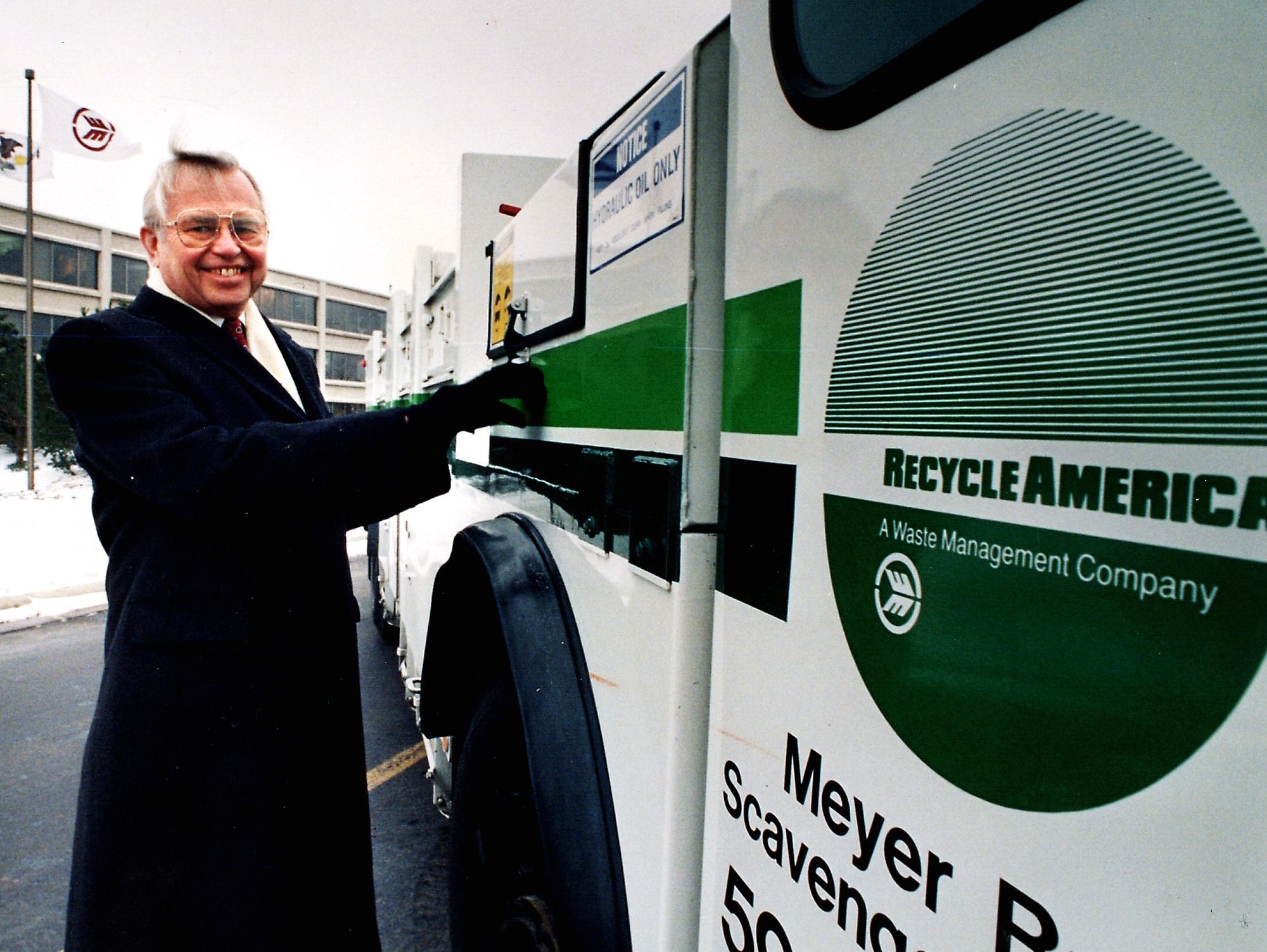

Dean L. Buntrock co-founded Waste Management, then based in Chicago and later in Oak Brook, and helped oversee the firm’s meteoric growth in the unglamorous world of trash hauling and landfill operations as the company acquired numerous regional refuse collectors.
“Whenever an opportunity presented itself, Dean was never put off by the fact that it involved expertise that we had never demonstrated before,” said Hal Gershowitz, a retired Waste Management senior vice president of public affairs who worked at the firm from 1972 until 1985.
“If there was an opportunity that he felt we could respond to successfully in terms of whatever it took to get the job done, he would pursue it,” Gershowitz said. “Dean’s response to, ‘We’ve never done anything like this before’ was, ‘Well, so what? We just have to find out what it would take to do it really well, and do it.’ That was kind of a guiding principle, and it served Waste Management very well.”
Buntrock, 94, died of natural causes on April 17 at his winter home in Indian Wells, California, said his wife of more than 41 years, Rosemarie. He was a longtime Hinsdale resident, and he also had a home in Fontana, Wisconsin.
He was born Dean Lewis Buntrock in tiny Columbia, South Dakota, in 1931 to parents who owned a farm and operated a farm services business. As a teen, Buntrock drove a truck hauling grain during harvest time, and also was a salesman for his family’s business.
Buntrock served in the Army, and he earned a bachelor’s degree in business and history in 1955 from St. Olaf College in Minnesota.
After college, Buntrock sold insurance in Colorado until the death of his father-in-law, Peter Huizenga.
Huizenga’s father, Dutch immigrant Harm Huizenga, in 1893 had started a trash-hauling company that became the family’s business, Ace Scavenger Service, on Chicago’s West Side.
Upon Peter Huizenga’s death in 1956, Buntrock began working at Ace, which consisted of 15 collection routes and had an interest in a Stickney waste incinerator.
Buntrock assumed leadership of Ace just four months later, after a partner in the business, Larry Groot, died.
Buntrock began growing Ace rapidly, expanding into Wisconsin and Minnesota, and he soon teamed up with his first wife’s cousin, H. Wayne Huizenga, who was operating his own fast-growing garbage-hauling business in Florida. The duo joined with a third operator, Larry Beck, merging their companies in 1968 and dubbing it Waste Management.
As CEO, Buntrock took Waste Management public in 1971, shortly after the 1970 establishment of the United States Environmental Protection Agency. The EPA’s founding was pivotal for Waste Management, because it led to the regulation of old-school garbage dumps — now rebranded as landfills — that were capital-intensive and highly regulated.
Waste Management held a competitive advantage in owning landfills, and from there, the company pursued consolidating numerous trash haulers.
Waste Management expanded rapidly, acquiring 75 waste collection companies between 1971 and 1973. By the mid-1970s, Waste Management was operating coast to coast.
With 110 municipalities and 120,000 industrial customers in the U.S. and Canada by 1977, Buntrock led Waste Management’s first expansion overseas, managing street cleaning and waste collection in Riyadh, Saudi Arabia’s capital. The job was “the largest contract for sanitation services ever entered into anywhere,” Buntrock told the Tribune’s William Gruber in 1977.
“What is really attractive about this contract is that it opens up a whole new frontier,” he told the Tribune. “If this is successful, the Saudis have indicated they plan similar ventures in other large cities such as Jeddah and Mecca. And it could lead to other projects in the Middle East.”
Buntrock was prescient. The company did wind up winning a similar contract in Jeddah, as well as in countries such as Argentina.
By the 1990s, Buntrock had grown Waste Management to $9 billion in annual sales. He also had expanded operations into hazardous waste solutions, waste-to-energy initiatives, clean water technologies and environmental engineering.
“I know this will sound like it was almost written by a promoter, but Dean really led by example,” Gershowitz said. “The people who would gather around him as time went on would just go the extra mile to please him, not because he was demanding of them, but everyone so respected his willingness to pursue opportunity. The attitude was, ‘If Dean feels we can do this, we have to try.’ He was a quiet motivator, and he was remarkably inspiring to everyone involved in management.”
Charles “Chuck” Lewis, a retired Merrill Lynch investment banker who represented Waste Management, said Buntrock “had a certain kind of calm about him, and determination, kind of a quiet determination.”
“He had the confidence and nerve that it takes to do the kind of stuff like essentially creating a department of public works for Jeddah,” Lewis said. “Also, he had this longevity. Waste Management started in 1968 and he kept going through 1998. There are few people who last that long. He had a persistence to him, and he was kind of learning as he went. There was an audacity to do what he wound up doing.”
Buntrock presided over Waste Management’s 1993 renaming as WMX Technologies, aimed at reflecting efforts to branch out into environmental services. He told the Tribune’s Casey Bukro in 1993 that he personally had named the firm Waste Management in 1968.
“It’s like naming one of your own children,” he said. “(But) we’ve really outgrown it. We thought it was a good time to have an umbrella name.”
The name change and broadened focus both were short-lived, as a 1997 shareholder initiative approved renaming the company Waste Management.
Buntrock retired as the company’s CEO in 1996, but he returned to the helm eight months later when his successor resigned amid clashes with shareholders.
Buntrock stepped back as chairman and CEO a second time in 1997, but initially remained on Waste Management’s board. He exited the board at the end of that year amid a restructuring and increasing demands from investors that the company trim fat and find internal ways to grow sales and profits.
The U.S. Securities and Exchange Commission initiated an investigation into Waste Management over accounting irregularities in 1998, resulting in a settlement with shareholders later that year. In 2002, the SEC filed a civil complaint in Chicago federal court, accusing Buntrock and five others of accounting fraud and wrongdoing.
Buntrock denied the allegations, insisting that all of the company’s financial documents were reported fairly and in compliance with generally accepted accounting principles. Ultimately, the company — which was not a party to the lawsuit — settled the case for Buntrock and the others in 2005, agreeing to pay $26.8 million on their behalf.
Buntrock, who separately paid a $2.3 million penalty himself, and the others admitted no wrongdoing. The firm said its rationale for the payments was to stop paying legal expenses related to the case. Buntrock’s lawyer told Bloomberg News that the suit “involved highly complex and judgment issues that would have resulted in a long and complicated trial. My client decided it was better to settle the case.”
Outside of work, Buntrock was a major donor to St. Olaf College, where he chaired the board of regents from 1986 until 1995. In 1996, Buntrock gave St. Olaf $26 million — the largest gift given at that time to any Lutheran college in the U.S.
He also was a life trustee of the Chicago Symphony Orchestra and supported the development of Buntrock Hall there, a contemporary space that seats 350 and is often used for rehearsals by other choruses and orchestras.
Buntrock and his wife, Rosemarie, gave a $21.4 million gift to Luther Seminary in St. Paul, Minnesota, in 2018 to pilot an accelerated master of divinity program, and in 2023 they donated scholarship funds to Augustana University in South Dakota.
Buntrock was an early contributor to the conservative group Turning Point USA, and he also enjoyed the outdoors. He was an avid pheasant hunter and a member of the National Wildlife Federation’s board.
A golfer, he had been a member of the Butterfield Country Club in Oak Brook, Big Foot Country Club in Fontana-on-Geneva Lake, Wisconsin, and the Vintage Club in Indian Wells. Buntrock also was a Chicago Bears season ticket holder for more than half a century.
A first marriage to Elizabeth “B.J.” Huizenga ended in divorce. In addition to his wife, Rosemarie, Buntrock is survived by three daughters, Dana Buntrock, Margot Buntrock Weinstein and Charley Buntrock Zeches; six granddaughters; and two great-grandchildren.
A memorial service will take place Wednesday in Aberdeen, South Dakota, and another memorial service will take place at 10 a.m. June 10 at Redeemer Lutheran Church, 139 E. 1st St., Hinsdale.
Bob Goldsborough is a freelance reporter.