
Valparaiso University offered up the work of the next crop of articulate engineers on Saturday at its annual Senior Design Expo.
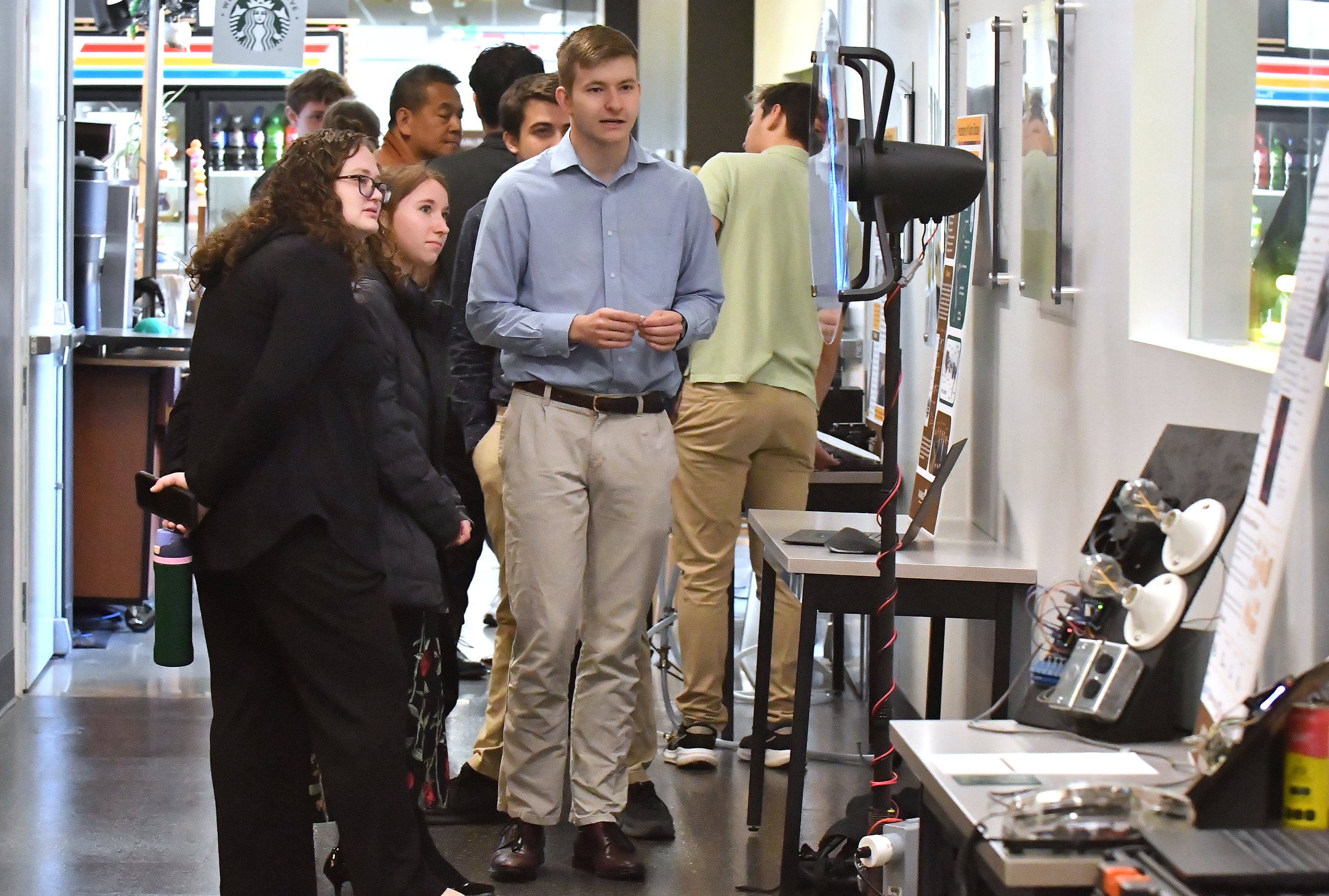
Soon-to-be graduates from the school’s six engineering majors practiced their presentation and demonstration skills, explaining their projects in the busy, crowded hallways of the College of Engineering.

“The goal of senior design projects isn’t the hardware, the design it looks like on paper, but the point of the course is to walk them through that whole project design,” explained Dan White, associate professor of electrical and computer engineering.
He said the two semesters of Senior Design, also referred to as Capstone, often see the students running out of time to tweak their work once they’ve tested it, “but when they get their first job, they understand why we made them do all the planning.”
And the students did all seem to have jobs lined up after graduation. Senior computer engineering major Sean Toolis has a job at Raytheon in Tucson, Arizona, waiting for him. His group designed and built a SMART brace that has self-monitoring analysis and reporting technologies to aid in the rehabilitation of stroke patients.
The whole device costs just $50 to build and will help occupational therapists not only support their patients’ mobility, but also measure how range of motion changes over time. “From week to week they’ll be able to see maximum angle for flexion and abduction,” Toolis said, and if they “need to increase the tension, or decrease.”

Fellow team member and senior mechanical engineering major Katie Bennett explained that it’s common for stroke patients to have partial dislocation of the shoulder. Partial paralysis of the arm causes dead weight that strains the shoulder. She said the brace “uses tension bands to support movement depending on what level of assistance you need.”
Of course, it’s the nature of engineering to solve problems, and students from the mechanical, bio, civil, environmental, electrical and computer engineering majors worked together in groups to fill a variety of societal needs. A big group worked with the University’s Bio Lab to design a $300 ride-on prototype for children with mobility issues.
The lab has been modifying kids’ ride-on motorized toys for the purpose, but the vehicles they use often sell out, so they thought they’d make their own for a comparable or cheaper price. Senior computer engineering major Ayat Haque said parents can connect to the vehicle’s microcontroller via a Bluetooth app on their phone to control such features as speed.
“It also has a slow acceleration, so the kid is not having any jerking motion,” she added of the ride-on.
“The car is designed to be modular,” added senior mechanical engineering major Weston Markham, who explained that the wheels, steering wheel and junctions were all 3-D printed.

“If a hobbyist wants to, they can easily make this in the backyard,” added his classmate and fellow senior mechanical engineering major Drew Moser.
Another group developed a solution to a problem with 3-D printers. “A big problem with 3-D printers is there’s a lot of waste produced,” said senior mechanical engineering major Andrew DeMik. His group was presenting the third iteration of their SME, short for shredder, molder, extruder.
It takes the “bins and bins” of waste plastic, shreds them, melts them down, molds and extrudes them into something useful a lot faster than a traditional 3-D printer. The group made a coaster, for example, in 30 minutes versus the three to four hours it would take a 3-D printer.
Andrew has a manufacturing engineer job waiting for him at Panduit in Tinley Park, Illinois, where his dad Jonathan DeMik, a mechanical engineering alum from VU, just celebrated 30 years of employment.

“I love these projects that have multi-facets to them,” said the elder DeMik, whose younger son Jonah is a sophomore engineering major at VU as well. “Most of them have mechanical and electrical controls.
“Engineering is about continual improvement. There are entire groups at manufacturing companies dedicated to continual improvement.”
Shelley Jones is a freelance reporter for the Post-Tribune.