
Union leaders and some school board members decried proposed cuts to teaching positions at Chicago Public Schools on Wednesday as the district looks to plug its massive budget deficit.
Officials released school-level budgets to principals earlier this week, likely increasing class sizes by raising the student-to-teacher ratio it uses to allocate funding by one student. Schools with under 250 students will also lose funding for assistant principals, according to their union.
Chicago Public Schools to cut teaching staff to help close $732.5 million deficit
The district did not share how many positions would be cut or the projected savings to alleviate its $732.5 million shortfall, but said it is capping teacher losses at six per high school and four per elementary school.
The Chicago Teachers Union and other advocates have sought to place the onus on the state, urging CPS leaders to press legislators for more funding. State money to CPS has remained relatively flat as the district grapples with rising costs, aging infrastructure and billions in long-term debt.
“How do you have school without teachers? … That’s what you have to ask Springfield, and that’s what we have to do in chorus,” CTU President Stacy Davis Gates told the Board of Education at a meeting Wednesday. “This budget, as announced yesterday, is unsatisfactory and dead on arrival.”
In response to cuts affecting assistant principals, the Chicago Principals & Administrators Association sent the district a cease-and-desist letter this week — a formal demand to halt an action it says violates its interim agreement with CPS. But the district is still moving forward with the tighter budgets, according to CPAA President Kia Banks.
CPAA represents roughly 1,200 school leaders. About 120 assistant principal positions are on the chopping block, Banks said, potentially shrinking the union’s membership by about 10%.
“What we saw was disappointing, frustrating and sad, and it is actually self-defeating,” Banks told the board. “We understand financial pressures, but families do not leave this district because we are too well-supported. They leave when schools are unstable.”
Flush with federal pandemic relief dollars, CPS has hired more than 9,000 positions since 2019, mostly at the school level. Now facing a fiscal cliff, district leaders say staffing must be rightsized to adjust for declining enrollment.
The district is “committed to ensuring equitable funding at the school level and directing resources to address student needs, minimizing the impact on classrooms as much as possible,” a CPS spokesperson said Wednesday. The district has stressed that potential reductions are still not finalized.
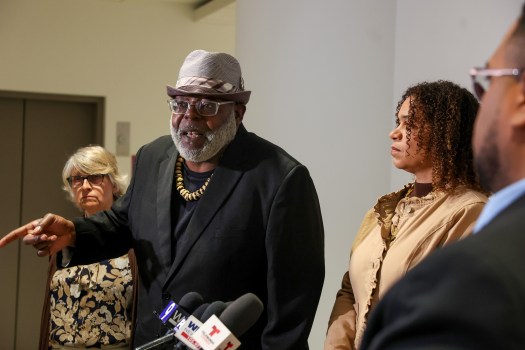
Prior to the meeting, a faction of seven CTU-backed board members held a press conference to urge the state to funnel more money into schools. Illinois’ Evidence-Based Funding formula, launched in 2017, aims to improve equity by prioritizing education funding to districts with the highest needs.
Still, by the state’s own calculations, fewer than half of Illinois school districts are considered adequately funded. CPS is funded at just 73% of the state’s adequacy target, down from 79% in the previous fiscal year, according to district officials.
Yet the state is facing its own tight budget, and legislators are unlikely to divert a substantial amount of additional cash.
“We are pledged to provide students a daily experience that is rigorous, equitable and joyful, and that will not happen at these cuts,” said appointed board member Karen Zaccor, who represents District 4A on the North Side.
The school board is poised to vote later this month on a resolution calling on the state to explore additional progressive revenue sources, which are funding mechanisms or taxes that increase as wealth rises. Last month, Illinois Democrats failed to advance the so-called “millionaire’s tax” resolution, a proposed constitutional amendment that would have channeled hundreds of millions to CPS.
“The students who will be most harmed by these budget cuts are disproportionately black and Latino,” said board member Jitu Brown, elected to represent District 5A on the West Side. “Continuing to harm a population that has never received equity in Chicago Public Schools should be off the table.”