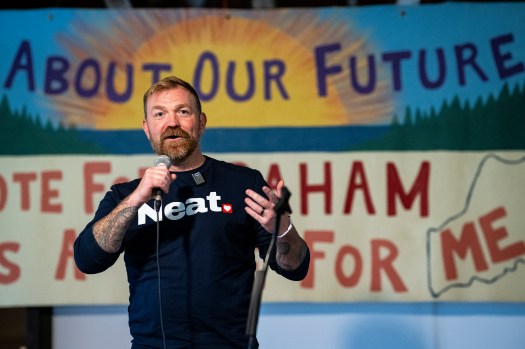

It’s no surprise that Mainers are willing to overlook the problematic art tattooed on Democrat Graham Platner, who is leading in his bid to unseat Republican U.S. Sen. Susan Collins — just as millions have dismissed the taboo and hateful provocations of President Donald Trump over a decade.
Economic populism is demonized for its tendency toward demagoguery. But policies that make the economy fairer for the populace are more justified than ever. American families feel that they can’t afford to live amid decades-long housing inflation and more are afraid of exhausting their savings than dying.
Whatever was left of a people-centered economy is gone. We gave Trump two chances to repair it, New Yorkers are testing Mayor Zohran Mamdani’s resolve and now Mainers are poised to do the same with Platner. Democrats have the opportunity to embrace an oppositional agenda for the first time since the 1960s — an unabashed return to the party’s Rooseveltian roots that won four consecutive terms in office and improved the quality of life for millions.
President Franklin D. Roosevelt famously promised citizens “freedom from want,” an old-fashioned idea that guarantees not only universal basic income but also what is better defined as “Universal Basic Vitality” — an all-encompassing promise for law-abiding citizens to never be priced out of good housing, healthcare, nutrition and other fruits of life, liberty and happiness.
This idea is not socialist or partisan. In fact, the richest man in the world, Elon Musk, has acknowledged so himself, declaring not only that the takeover by artificial intelligence will require basic income but also that people deserve “universal high income.” The irony is that neither Musk nor the oligarch-serving candidates he’s endorsed, namely Trump, have any idea of how to do this. In fact, they are complicit in systemic inequity and corruption that every day make this mission more impossible. And, as The New York Times recently reported, Congress has no plan to address the fallout of AI.
I have ideas. So do the mayors I’ve interviewed on a special for my PBS series “Mayors of the World.” While not at national scale, these leaders are imagining answers to the broader problem that Platner and Musk identify and holding themselves accountable to the people.
Mayor Olivia Chow of Toronto is charging a vacancy tax to owners who don’t live in or rent their properties (similar to what Mamdani has proposed for New York City). Mayor Andre Dickens of Atlanta is building free housing from shipment containers no longer in use. Mayor Carlos Moedas of Lisbon, Portugal, is offering matching grants to first-time renters so they are not priced out of apartments in their home city. Across the political spectrum, from the conservative mayor of Santiago, Chile, to the liberal mayor of Athens, Greece, there is consensus: Housing is fundamental to one’s ability to participate in civil society and the foundational source of vitality.
But the notion of “abundance” — simply building more in a system that lacks incentives for shared prosperity — is not going to cut it.
It’s time for the country to do something bold: Social Security on the front end, not just a safety net at the end for retirees. With the Trump administration’s demolition of Medicare and the Affordable Care Act, there’s ample opportunity, if not necessity, for this. U.S. Sen. Cory Booker, D-N.J., has called for modest upfront payments — “Baby Bonds” — but any realistic proposal to offset the economic displacement of AI demands much more.
In his 2020 presidential bid, Andrew Yang came up with the idea of Big Tech companies paying data dividends for surveilling and exploiting us for their own profit.
But the simplest path to Universal Basic Vitality is an oligarch tax on individuals like Musk and companies like Meta to lay the groundwork for economic livelihood in the AI age.
When Thomas Jefferson wrote about the “pursuit of happiness,” he didn’t intend for the well-being of the population to be dictated by whether you got access to invest in an initial public offering or to insider information for betting markets.
Today, we are dealing with the consequences of an oligarchic society and still live in the aftermath of the Great Recession. That’s why most of us will dismiss tattoos and taboos: We’re more desirous of the decency in economic fairness than afraid of the indecency in tawdry or incendiary rhetoric.
Americans are hungry for solutions to the most lopsided economy in our history.
Alexander Heffner is host of “The Open Mind” on PBS.
Submit a letter, of no more than 400 words, to the editor here or email letters@chicagotribune.com.