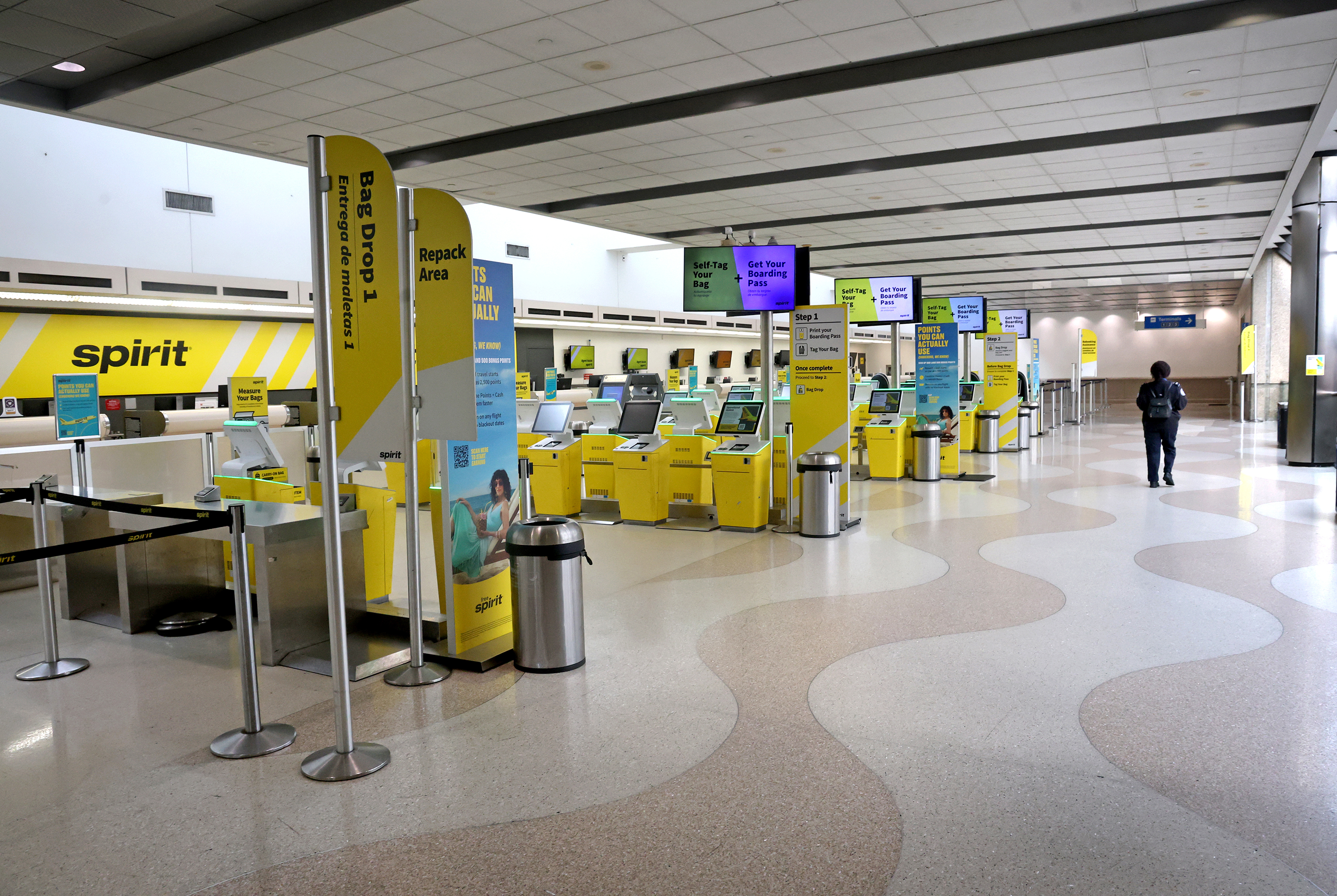

Spirit Airlines’ abrupt shutdown this month was too abrupt under the law, a group of terminated employees allege in a proposed class-action lawsuit.
Their complaint, filed in U.S. Bankruptcy Court for the Southern District of New York, asserts that management misled its workforce about its prospects for staying in business and still owes employees back pay and benefits after going out of business.
The workers are six laid-off Spirit employees who seek to represent a class of approximately 17,000 people who were terminated when the airline ceased flying in the early morning hours of May 2. The lack of advance notice violated the federal Worker Adjustment and Retraining Notification Act, according to the complaint filed Tuesday.
News of the airline’s shutdown, the suit says, came from CEO David Davis in an email to employees stating the Dania Beach-based budget airline was immediately halting operations. Those left without jobs included more than 4,800 direct and indirect employees in South and Central Florida, according to a WARN notice the company belatedly filed with the state of Florida on May 4.
The company shutdown announcement, the suit says, stated that employees would be paid “for hours worked through May 2, 2026.”
“However, to date, employees have not received their final paychecks, accrued vacation time, or unused sick time,” the suit alleges.
A Spirit spokesperson said the company does not comment on litigation.
New York attorney Todd Duffy, who filed the suit late Tuesday on the employees’ behalf, did not immediately respond to a voicemail seeking comment.
The lawsuit was brought on behalf of five Spirit former employees who live in Florida and one in South Carolina. They held positions including software engineer, DOT compliance specialist, flight attendant, senior maintenance planner, heavy maintenance project manager, and senior software engineer.
All were terminated without cause and without prior notice, the suit says. The airline failed after filing for Chapter 11 bankruptcy protection in August 2025.
The suit suggests the airline made various positive statements about its prospects amid media reports that its end was near.
April assurances
“As recently as April 16, 2026, Spirit had advised its employees that it planned on continuing operations and that they should ignore the rumors that Spirit was near a termination point,” the suit says. “Plaintiffs and other similarly situated employees were reassured by Spirit and its senior executives, including Davis, through this statement of confidence. Spirit continued to disseminate positive misleading statements to employees and others, assuring them that normal operations would continue in the hours immediately prior to the announcement.”
The suit asserts that Spirit workers were “entitled” to advance written notice of their impending terminations 60 days ahead of the shutdown. That meant that under the federal WARN Act, the notices “should have been delivered to the workers [and others required by law] on or around the week of March 4, 2026.”
Spirit, in its WARN notice filed with the state after the shutdown, said it had good reasons to delay word of its possible closure: The airline was still negotiating with its lenders and the U.S. Government for more financial help.
“Issuing a notice would have materially and adversely impacted” the airline’s ability to raise capital, a company official said in the filing.
In a note to employees that was attached to the WARN notice, Spirit said: “We regret that we are not able to give you more notice of your layoff. We were not able to do so because the company was actively seeking capital to avoid these layoffs and closures, and notice would have precluded the company from obtaining the capital needed.”
Retention bonuses
The suit also takes issue with the company’s request of the bankruptcy court to approve millions in retention bonuses for senior executives and others to help wind down the airline’s operations.
After its efforts to reorganize failed, the suit asserts, “Spirit pivoted to a wind-down, shut down operations, and proposed retention and bonus programs to maintain a skeleton workforce and compensate remaining employees during liquidation. Spirit requested authority to pay up to $10.7 million in retention bonuses to non-management employees. Spirit also sought approval of a revised, one-time retention bonus plan specifically for three unidentified senior executives.”
Company statements filed with the court indicated the airline still needed up to 130 people who were familiar with Spirit’s operations to help complete the process of closing the business.
No hearing on the proposed class action has been set by the bankruptcy court as of late Wednesday.