
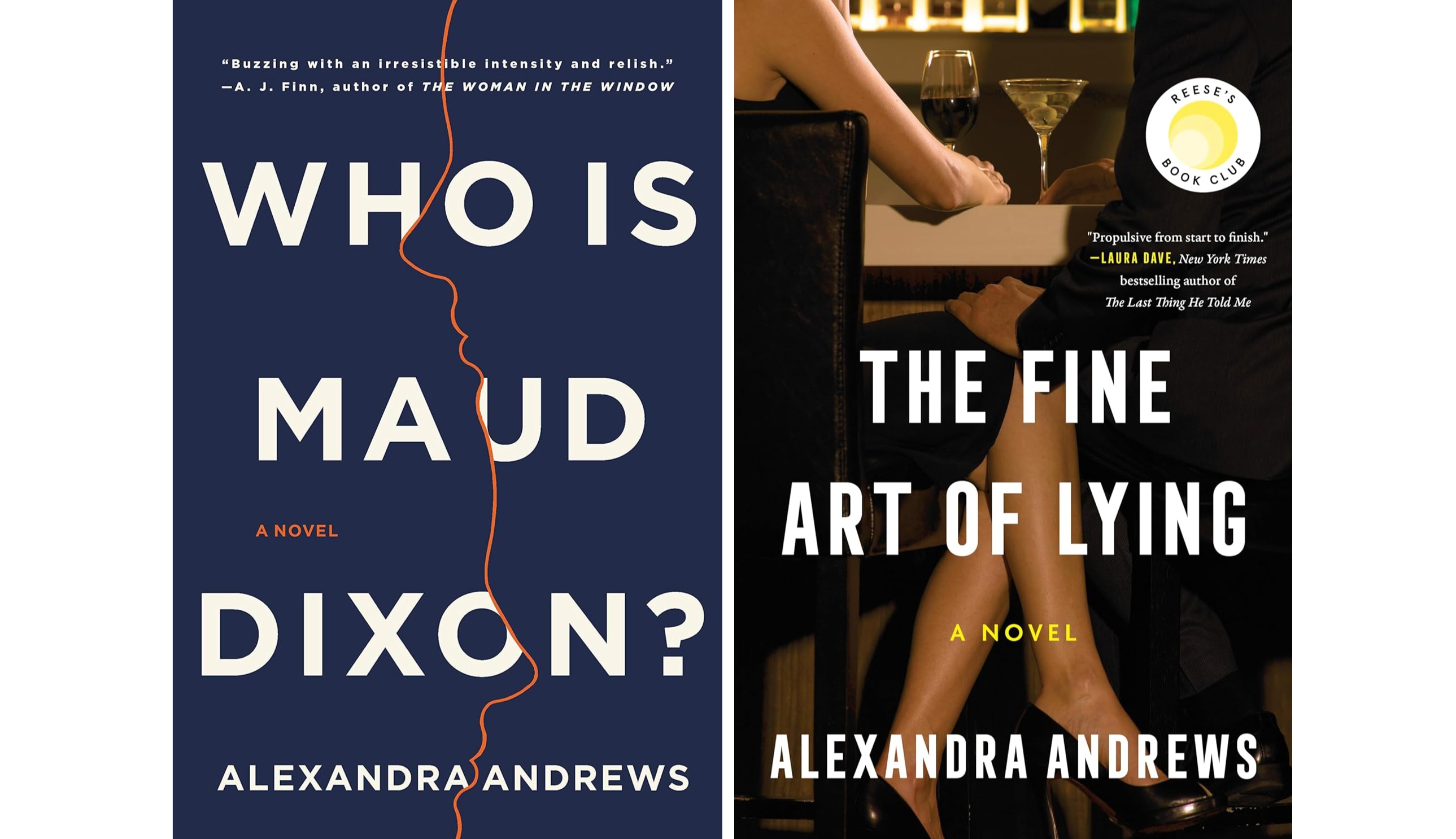

Several times I’ve been confronted with a reader’s list of recent reads and wished I could recommend a good suspense novel like “Who Is Maud Dixon?” by Alexandra Andrews, but I can’t recommend “Who Is Maud Dixon?” because I’d just recommended it to someone else a few weeks ago.
Problem solved. We have a new Alexandra Andrews novel, “The Fine Art of Lying,” that has all the traits that I value in her earlier book: an interesting and complex focal character, lock-tight and suspenseful plotting, a sly sense of humor, all while being set in an interesting and well-illuminated milieu.
Both books feature protagonists who are out of their elements but also possess unique attributes that first get them into trouble before becoming their one slim hope to escape. “Who Is Maud Dixon?” is set in the world of publishing as the talented, but a touch grandiose, Florence Darrow gets entangled with a bestselling, reclusive writer.
“The Fine Art of Lying” is anchored by Clare Bast, a married mom of toddler Sadie, who comes from a working-class background and is a dissertation short of a doctorate in art history. Clare married into the Park Avenue life after falling for Jed, who appears wholly devoted to her.
Jed’s world is comfortable, though Clare can never quite shed her fish-out-of-water feeling, and Jed’s overbearing mom seems to take pleasure in making sure Clare remains uncomfortable.
Jed has a time-consuming, high-pressure job as general counsel at a hedge fund. While she used to feel physically transformed in the presence of art, including the subject of her dissertation, an abstract expressionist named Webley, Clare now feels almost inert. She is desperately infatuated with her child and her husband is beyond reproach, but it is clear that she is also vulnerable to disruption.
Enter Gabriel Prevost, a high-end gallery owner, friend to the power couple (Tasha and Alec) that owns the hedge fund Jed works for, and the temporary holder of an original Webley painting, “Longfin,” that is central to Clare’s stalled dissertation.
We know from the opening pages set deeper into the story that there is a murder for which Clare is present. Who is murdered, why and Clare’s entanglement in the whole deal unfold over the remainder of the novel, featuring much tighter and more plausible plotting than your average suspense story.
In fact, one of my chief complaints about some contemporary thrillers is the feeling that characters are required to do dumb stuff by the unseen hand of the author, just so more crazy twists can happen. I’ve put down a half-dozen novels when I’ve reached the point where I just can’t stand it anymore.
No doubt Clare makes some arguably “bad” choices, but Andrews is careful in her character building and plot shaping to make those bad choices entirely sensible, creating that particularly pleasurable feeling of impending dread for a character that has gotten themselves into some really deep doo-doo.
Some of my guesses about what was going on were right, others were wrong. Like any good suspense writer, Andrews throws some red herrings, but I never felt manipulated, only invested.
“The Fine Art of Lying” has been endorsed by Reese Witherspoon, which isn’t surprising. This would make great fodder for a limited television series, but I hope that people take the time to appreciate the clear extra care that has gone into telling this kind of story in this medium.
It’s been five years since “Who Is Maud Dixon?” I hope it isn’t another five before the next Andrews book, but if that’s how long it takes, it’s worth it.
Book recommendations from the Biblioracle
John Warner tells you what to read based on the last five books you’ve read.
1. “Look Alive Twenty-Five” by Janet Evanovich
2. “On the Clock: What Low-Wage Work Did to Me and How It Drives America Insane” by Emily Guendelsberger
3. “Ghost Mother” by Kelly Dwyer
4. “Frankenstein” by Mary Shelley
5. “This Perfect Day” by Ira Levin
— Jen M., Lincolnwood
For Jen, I’m going to point her toward an all-time classic of the uncanny, “The Haunting of Hill House” by Shirley Jackson.
1. “A Confederacy of Dunces” by John Kennedy Toole
2. “100 Years of Solitude” by Gabriel Garcia Márquez
3. “The Mother Tongue” by Bill Bryson
4. “Lexicon” by Max Barry
5. “The Wide Wide Sea” by Hampton Sides
— Rob M., Kenosha, Wisconsin
For Rob, I’m recommending another book that has a truly one-of-a-kind narrator/main character, “A Fan’s Notes” by Frederick Exley.
1. “Remarkably Bright Creatures” by Shelby Van Pelt
2. “The Extraordinary Life of Sam Hell” by Robert Dugoni
3. “Everything is Tuberculosis” by John Green
4. “Tomorrow, and Tomorrow, and Tomorrow” by Gabrielle Zevin
5. “Heart the Lover” by Lily King
— Deidre T., Chicago
I’m going to go back a few years for a book that was popular, but not at the level of some of the books on this list, so maybe it got by Deidre at the time, “The Age of Miracles” by Karen Thompson Walker.
Get a reading from the Biblioracle
Send a list of the last five books you’ve read and your hometown to biblioracle@gmail.com.
John Warner is the author of books including “More Than Words: How to Think About Writing in the Age of AI.” You can find him at biblioracle.com.


