

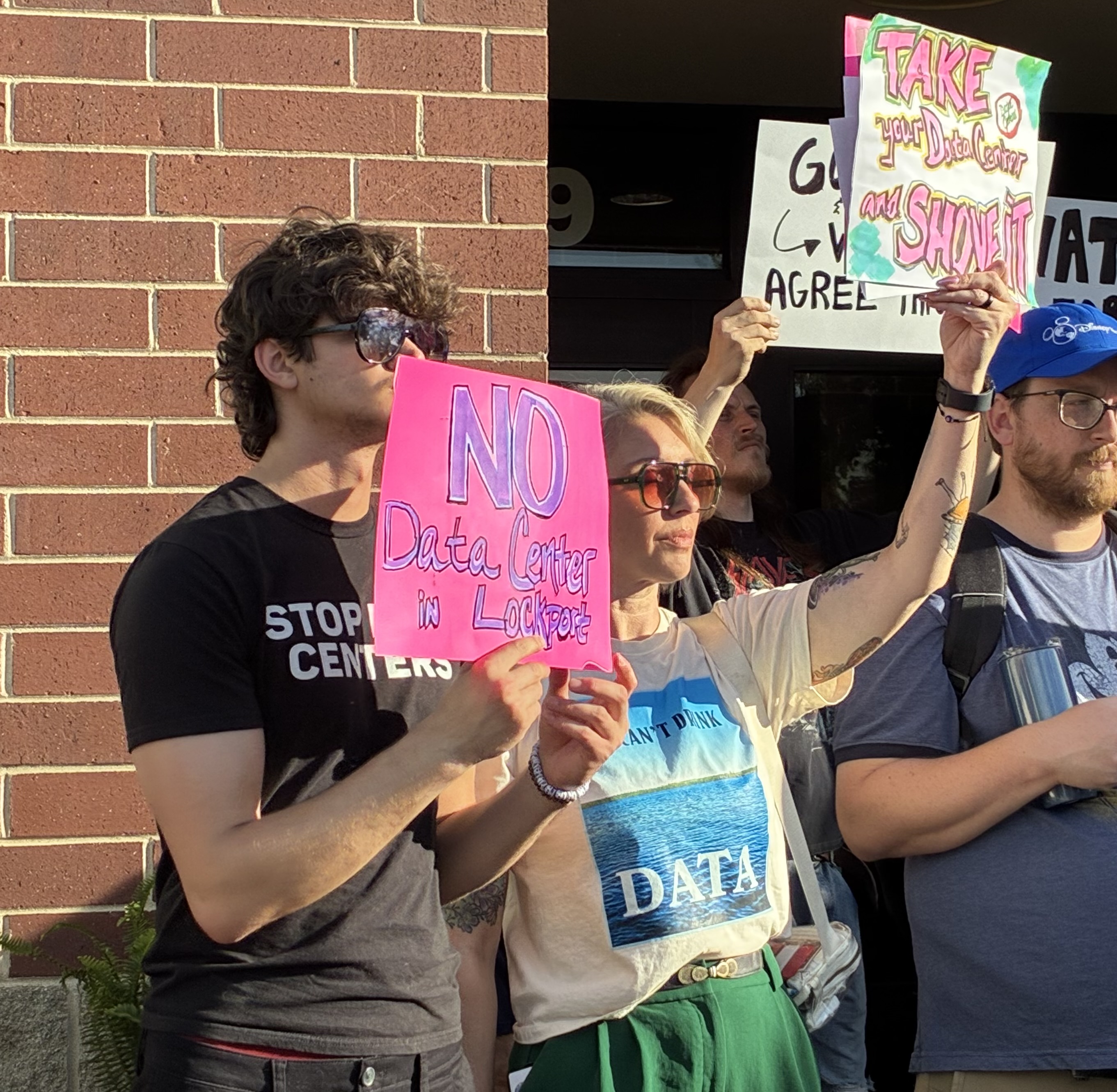

Lockport held the first of three planned meetings to discuss possibilities for a potential data center development in the community Tuesday, but many residents are unilaterally opposed.
Mayor Steven Streit presented the rise of data centers and the AI industry as inevitable, and said that the city had a chance to benefit by meeting the new industry on its terms and imposing restrictions rather than refusing it completely.
“How can we leverage this to make it work?” Streit said. “You can demand full mitigation. We can demand that they use effluent from our wastewater treatment and not our potable water. We can demand that they make reusable, adaptable buildings if the industry dries up and moves on. We can make a lot of demands that we can’t normally make, because it’s our property.”
The potential development would be located on a city-owned parcel of land referred to as the Star Innovation District, formerly part of a shuttered Texaco oil refinery. Streit said because the city owns the property outright, it could make whatever demands it wanted.
The prospect of developing a data center on the property is actually not new, Streit said. It was first raised five years ago when the city was examining different uses for the land, and was approved by members of the public at the time, though he acknowledged the public profile and concerns about data centers have since increased drastically.
However, many in the audience seemed entirely opposed to any data center development, regardless of what restrictions were imposed.
“Some people have said to me, like, you know what, man, this should just be a hard no. We shouldn’t even have this conversation, this is just ridiculous,” Streit started at one point, only to be cut off when the crowd loudly cheered.
Ahead of the meeting, residents and local politicians opposed to any data center development gathered outside Lockport Township High school for a news conference where they made their views clear.
Brent Porfilio, one of the speakers, expressed concern about the water and electric demand created by data centers, as well as noise pollution.
“The average medium-size data center generates 90 decibels within half a mile. 90. As a comparison, a highway generates 80 decibels. So you’re basically living right off a highway,” Porfilio said. “It’s a constant hum, and it’s 24/7, and it’s 365 days a year, right? You can’t escape from it.”


Many residents were upset that the city had signed a letter of intent with broker VME in September 2025, and some accused city officials of not being transparent with the public.
“We’ve been brought into this conversation too late,” said resident Liz Winters. “Why are we hearing about this now?”
Streit said the letter of intent only meant the city agreed not to sell the property while the broker conducted its due diligence, and didn’t represent any further commitment.
“There is no proposal on the table. I can’t even tell you what this data center would look like,” Streit said. “It’s just an idea. And it was at that point that we wanted to come to you.”
If, after the series of workshops, there still isn’t a way to make a data center acceptable to the community, the idea will be dropped, he said.
“If at the end of it we say, you know what, there’s no way to really leverage this, there’s no way to press this into something that could work for us — it just fades away,” Streit said. “There’s no action that has to be taken, because there’s nothing official actually happening right now.”
Streit compared the proliferation of data centers to the spread of warehouse distribution centers and resulting increases in truck traffic following the COVID-19 pandemic.
“Ever since then, the county’s been trying to wrack their brains with, how do we manage this truck traffic?” Streit said. “You have to do it in the beginning, before it steamrolls us.”
The mayor was accompanied by a panel of experts, including Sarah Moskowitz, executive director of the Citizens Utility Board, and Rachel Havrelock, director of The Freshwater Lab at the University of Illinois at Chicago, who spoke respectively about issues of energy and water as they pertained to data centers.
“When you say no, and it goes next door, you also stop having a voice in the situation,” said panelist Meera Raja, of technology nonprofit P33 Chicago.
Sandy Burcenski, founding director of environmental organization Citizens Against Ruining the Environment, disagreed with the mayor’s presentation of the situation as a binary choice.
“Personally, I find it sad that the idea of a false dilemma would lead us to this point,” Burcenski said. “It’s like saying we’re standing on tracks with a train coming, and we can either get run over or climb aboard the train. Those aren’t the only options. Get off the tracks.”
Concerns raised by residents before and during the meeting ranged from heavy metal contamination in the water supply to drops in property values.
“This would absolutely drive down value. I don’t want to say it’d be unlivable, but no one’s going to want to come here anymore,” said resident Sarah Rollins. “And when the AI bubble bursts, we’re going to be left with the mess.”
Resident Matt Long raised the specter of health impacts. He’s the father of a young daughter, he said.
“I also know a family in Lemont, and that little girl is also currently battling leukemia,” Long said. “That little girl is a year older than my daughter. There will be nothing that happens in isolation. You can’t drink money, you can’t eat money, you can’t breathe money.”
The second and third workshops are planned to take place at the Lockport Township High School auditorium at 7 p.m. June 4 and 25.
elewis@chicagotribune.com


