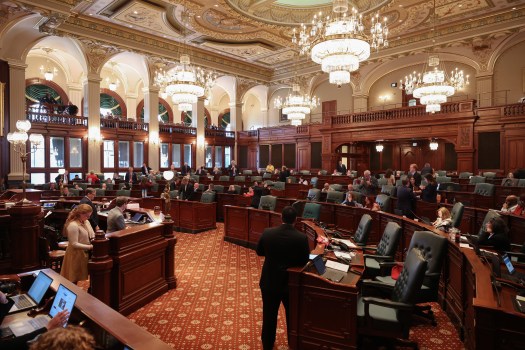
In the waning days of Springfield’s spring session, Cook County leaders appear to have ended a years-long stalemate, brokering legislation to phase out the tax sale industry that has bolstered local budgets while also pocketing millions in interest payments and equity from property owners.
Under a bill that cleared a key committee on Wednesday evening, annual tax sales — the government’s way of dealing with delinquent property tax payments — are in line for a major shakeup statewide, though in Cook County’s most of all. The bill is heading to the full House and Senate for final approval.
In the coming years, Cook County is poised to do away with its tax sale altogether, despite pushback from tax buyers.
If ultimately passed and signed by the governor, Cook would move to a new system where the county alone would acquire liens on overdue property taxes, charging taxpayers .75% a month, or 9% a year in interest. If the taxes go unpaid after three years, the county would auction off the property deed to the highest bidder and the original homeowner can petition to get the post-debt profits.
Tax buyers fret that local governments will miss out on needed revenues if the system is made more burdensome.
“I am concerned this proposal risks weakening participation in Illinois tax sales and ultimately weakening property tax questions throughout the state,” said Andrew Hendrian from the Illinois Tax Purchasers Association, citing data from available counties showing tax buyers “provided over $150 million of private money to counties through Illinois tax sales” in a recent year.
“If private buyers stop showing up to purchase $150 million in delinquent taxes, who exactly replaces them? Because if the system weakens, the losers will ultimately be local governments,” he continued. That’s especially true for downstate and collar counties, which “rely heavily on private tax buyer participation to keep delinquent tax collections functioning.”
The change was championed by Cook County Board President Toni Preckwinkle and Treasurer Maria Pappas’ offices and sponsored by state Sen. Celina Villanueva.

The Illinois Municipal League, the Illinois County Treasurers’ Association and the Illinois State Association of Counties support it. Its committee passage won praise from housing advocates who have long argued counties would be better served ending the “predatory” tax sale process and instead helping debtors stay in their homes with things like payment plans and reduced interest costs.
Currently, if the original property owner fails to pay their property tax debt and interest costs, their debt can be sold to tax buyers.
Governments receive much-needed revenue and private tax buyers can make money by turning around to charge the property owner interest on their debts. If the original property owner hasn’t settled up after 30 months or up to three years, the tax buyer can also eventually get the deed in court, netting whatever equity is left in the property beyond the accrued debts.
While the system has been effective in helping local governments collect some past-due taxes, it has failed at getting properties back on the tax rolls and has hit low-income Black and brown neighborhoods across Cook County the hardest, independent analyses have found. An Injustice Watch investigation found about half of homeowners that lost the deed to their homes between 2019 and 2025 originally owed less than $1,600 in late taxes.
A 2023 U.S. Supreme Court case helped push the debate to center stage. In Tyler v. Hennepin County, the court found Minnesota’s tax sale system unconstitutional. Property owners deserve whatever value is left after the original debt is paid at the tax sale, and the county unfairly took that equity, the court said.
“At a time when so many Illinoisans are struggling to make ends meet – having hard conversation every day about what essentials to skip out on this month or what bills can be paid a little bit late – the last things our residents need to worry about is having their property stripped from them with no recourse,” Villanueva said in a release after the bill cleared the Senate Revenue Committee. “This is about upholding residents’ constitutional right and ensuring our state’s tax sale process places fairness over profit.”
While other states have tweaked similar processes to comply with the ruling, Illinois is the last to reform its system in that decision’s wake.
Adding to the pressure: a local class action case in federal courts making similar allegations to Hennepin. A recent ruling in that case put Cook County on the hook to repay an estimated tens of millions to taxpayers whose homes were lost in the tax sale process in recent years.
But a key hangup in Springfield negotiations has been whether to do away with the tax buying process altogether.
For Cook and other counties, the proposed bill transitions the final step of the tax sale process to an auction system rather than a simple deed transfer in court. Open tax sales would be phased out in Cook County altogether. Other counties have the option of doing the same.
The changes — in conjunction with prior reforms — will make it easier for Cook County to offload chronically delinquent and abandoned properties to the Cook County Land Bank, sell over the counter to individual buyers or hand them back to municipalities, county officials said.
For the next six scheduled tax sale cycles in Cook County, the government would offer the deeds for tax delinquent homes to the highest bidder after a three year redemption cycle. The county would deduct all the taxes, interest and fees owed on the property from the winning bid amount, then refund the surplus equity to the original property owner.
Tax buyers would be required to pay a series of new fees to participate, including a nonrefundable “surplus equity fee” equal to five percent of the total taxes, interest and penalties for each property. The new equity fund is supposed to defray the cost of paying back people that lost their homes in prior tax sales. Other fees would help people who lost their properties improperly because of an error in a prior tax sale.
Negotiators hoped they hit a sweet spot where fees will be high enough to raise money for funds to pay back property owners but not so much that tax buyers won’t participate.
Tax buyers said while they negotiated in good faith, the final proposal might make it too financially risky to bid at all. Hendrian recommended several changes, including for treatment of vacant and abandoned properties to remain unchanged, more transparency around auctions, and rules to make sure larger companies cannot register more than one bid on a property.
“I think everybody here wants a tax system that is fair and constitutionally sound, but we also need a system that actually functions, because a tax sale system without buyers is not a tax sale system at all,” he testified Wednesday.
The bill also mandates improved notice to taxpayers about steps in the process and gives homeowners more time to pay debts by default.
Recent tax sales have been repeatedly delayed amid negotiations, but three sales are slated in quick succession for Cook County this December, next spring and again in the fall. The following three sales will happen annually through 2030.
As part of the bill, other counties could continue to hold tax sales followed by deed auctions.
At the request of legislators, the bill creates a pilot program for Cook County to immediately take on liens for 100 homes with the lowest past due bills. The goal is to allow the county to test things that make it easier for homeowners with delinquent taxes to catch up.
Bob Palmer, the Policy Director for Housing Action Illinois, said groups had repeatedly advocated for lawmakers to fix current and historic inequities in the private tax buying process across the state, and he was heartened lawmakers not only used the “opportunity” created by the Hennepin case to not only come into compliance but improve the system.
“We hope that the county will work with those homeowners to establish payment plans and interest fee waivers and some of the other things allowed through legislation that passed last year,” Palmer said.