
Nearly two decades after five women were shot and killed inside a Tinley Park Lane Bryant store, little is known about the shooter’s identity and motive, despite police receiving thousands of leads and a description from the one surviving witness.
But former NBC local news reporter turned true crime podcaster Delia D’Ambra said she believes the case is just as relevant as it was 18 years ago, and that it is still solvable.
“It’s 2008 that this crime happened, not 1970,” she said.
D’Ambra began investigating the case in early 2025 as part of her true crime podcast CounterClock, a sister podcast to Crime Junkie under the same parent network, Audiochuck.
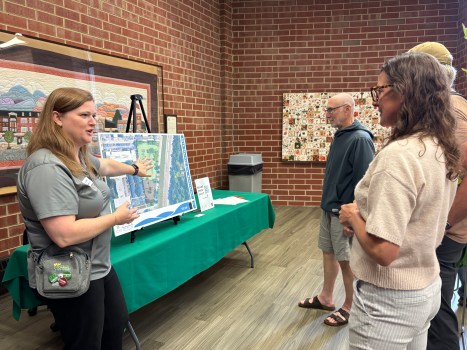
CounterClock released a podcast season investigating the case with some new insights Thursday, after D’Ambra spent months of door-knocking and research in Tinley Park, along with interviewing people linked to the case and examining substantial tips.
Her overall conclusion is that the case is solvable for two reasons: people and advanced technology.
She said she feels confident that someone in the area knows something. She hopes the podcast might encourage someone to speak up.
The Tinley Park Police Department has also offered a $100,000 reward for information leading to the arrest.
“Why they’ve not come forward is a troubling question, but I do believe that there are people still alive who did know him, who have known him for years but there are reasons for keeping quiet, reasons we can’t know,” she said.
In addition, crime-solving technology has evolved and could better sequence DNA, profile and deduce information from the case, she said. The killer is believed to have left his DNA at the scene, and the police have a suspect profile described by the one surviving witness.
“I do believe that the technology now is sensitive enough to at least explore hopefully sequencing DNA from that maybe they weren’t able to before simply because of limitations in technology,” D’Ambra said.

D’Ambra said she first caught wind of the case from Crime Junkie, a popular true crime podcast. She said the Crime Junkie team received a “fire hose” of substantial, specific and credible tips through social media and email, and they asked her to take an in-depth look.
While she said police have disseminated helpful information on the case, she felt a duty to go one step beyond and find people who could come forward and provide the “one little piece” that law enforcement could be missing.
What she found was wide ranging.
The husband of victim Carrie Hudek Chiuso told D’Ambra she was carrying a large amount of cash in her purse from a Super Bowl fantasy football win, money that disappeared.
A brother of victim Rhoda McFarland told D’Ambra that McFarland’s car was parked very oddly that day, and a store employee told her that she and McFarland had missed their usual bank cash run that morning.
D’ambra also examined why a person’s DNA might not be in databases, as some DNA from the scene has not been identified.
“Either this individual has been playing very, very low since 2008 off of the radar since 2008 and their DNA has never been captured, or they died in the years after,” she said.
Throughout her investigations she said she looked for people who were on the inside of the case in 2008 and remained on the inside to understand more context and the things happening behind the scenes.
“I feel like it’s my job to at least try from the public sphere,” D’Ambra said. “There was just a lot of inside information and really just tracking people down…just trying to find people who were either still there or had moved away and going to them.”

She said she spoke with victim family members and other people connected to the victims, such as the brother of Connie Woolfolk, who D’Ambra said had never before spoken publicly about the case.
She said she attempted to reach the one surviving victim but hasn’t had success.
“Ultimately, it is her account,” she said. “It is her decision.”
She said a former commander who worked on the case was an especially important voice, along with the former Tinley Park mayor Ed Zabrocki. She said Zabrocki was good friends with former police chief Mike O’Connell, who worked on the 2008 case up until his death in 2011.
Contrary to another recent public investigation into the case, D’Ambra said Tinley Park police were receptive, and she had cordial and good conversations with officers, where she has passed along new case information.
A documentary released in February by Charlie Minn, filmmaker and former producer for “America’s Most Wanted” sparked pushback from the police and public. He called the police “aloof” in the film and said their lack of cooperation hindered his investigation.
He said he aimed to spark renewed interest in the murders and lead to answers.

D’Ambra said while it’s unclear what moves police have made in recent years, Tinley Park police chief Thomas Tilton told her police are working on something that he feels will lead to the police having a story to tell soon about the case.
“I think what that means, we can’t define, but I do think they are certainly not not working on this case,” she said.
Tinley Park police declined to comment, citing that the investigation is ongoing.
D’Ambra said it’s important to keep investigating the case because there are a lot of victim family members who want answers and closure.
“The Lane Bryant Murders have haunted the Tinsley Park community for 18 years, and these victims and their families deserve answers,” said Ashley Flowers, founder of Audiochuck and host of Crime Junkie.
D’Ambra said the podcast includes calls to action, encouraging people to write to the show if people or places sound familiar.
“Maybe that loosens lips,” she said. “Maybe now people can say, she’s really done a lot of work, maybe I can offer this little bit of information. That is always an ongoing process.”
She plans to continue going over new tips now that the season is released, just like she does for every season. She says she still takes calls for cases from earlier podcast seasons, and she occasionally releases bonus episodes featuring new tips.
“You never know anyone’s life, you never know a community, you never know what you think you know unless you’re willing to go a little bit further,” she said.
awright@chicagotribune.com