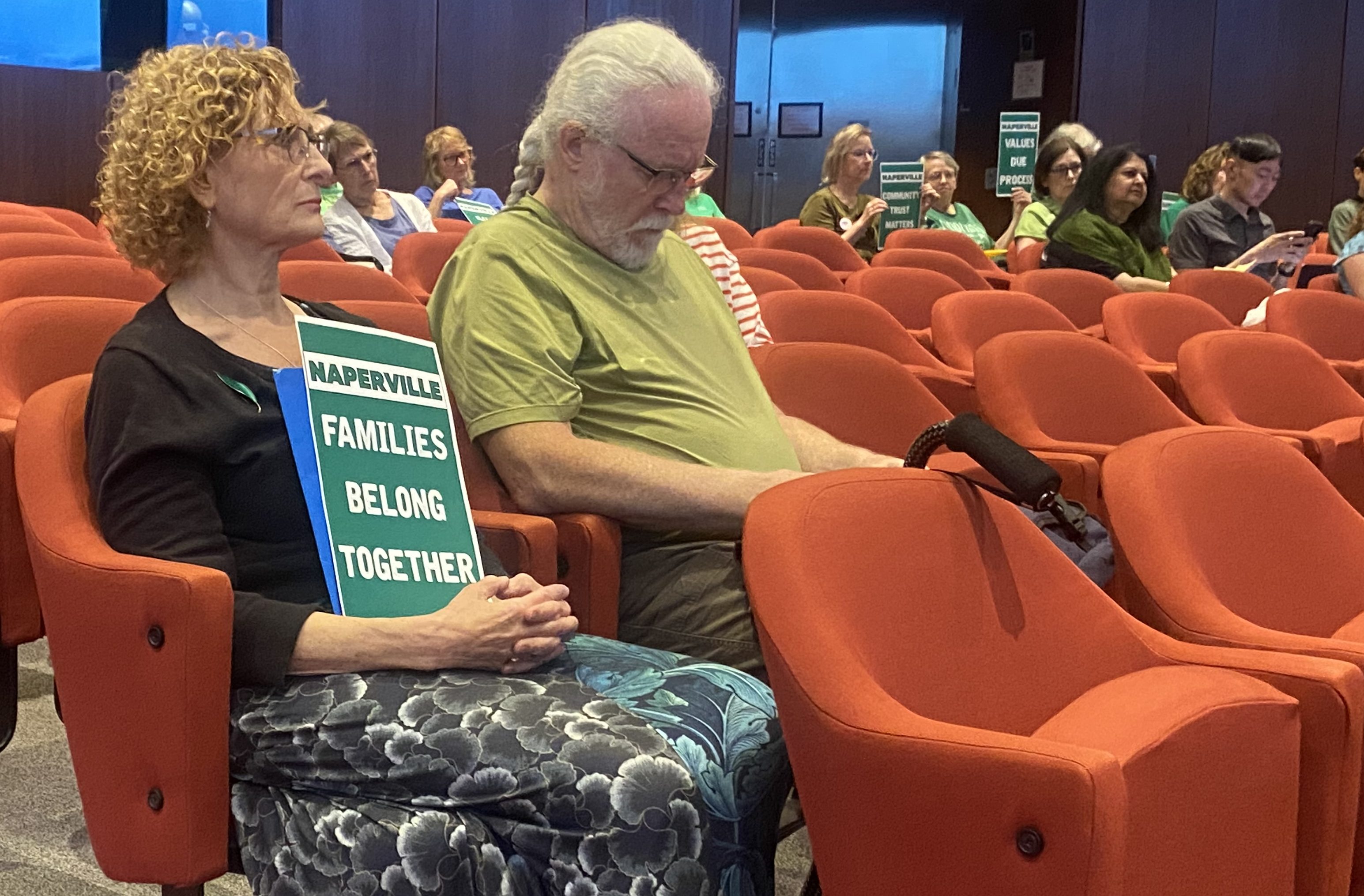

The Naperville City Council passed the “Due Process and Municipal Property Ordinance” Tuesday, limiting city-owned property from being used by federal ICE agents for civil immigration activity and requiring documentation when violations occur.
The decision makes Naperville the latest Illinois-based municipality to implement such a measure in the wake of U.S. Immigration and Customs Enforcement actions in the Chicago area and beyond. Communities such as La Grange, Skokie, Aurora, Evanston and Carpentersville have passed similar laws.
“Our community is telling us they do not feel safe. This ordinance is in response to clearly communicate that they belong,” Councilwoman Supna Jain said.
Under the new ordinance, city-owned or -controlled parking lots, buildings, parks and municipal facilities are not to be used as staging areas, operations bases or processing sites in the execution of ICE civil actions.
However, the law would not prevent access to city property when a valid judicial warrant or court order is presented, when criminal laws are being enforced or when federal or state law requires such access.
City employees cannot assist with federal immigration enforcement unless otherwise required by court order or judicial warrant. All city departments are required to implement procedures for documenting ordinance violations.
The ordinance also includes a formal affirmation saying the city is committed to constitutional rights.
In order for a city staff member to act on a believed violation of the ordinance, there would need to be a “reasonable, good-faith observation” of federal immigration agents using city-owned property, according to City Attorney Michael DiSanto. An individual or a vehicle that merely looks like it could belong to ICE would not rise to that standard.
“What we want people focusing on are facts and not just rumors or innuendo or making any type of subjective judgment that may not be supported with facts,” he said.
The ordinance does not require intervention or confrontation by city staff or local law enforcement; it requires only documentation. City staff will develop a process across all departments for appropriately responding to ordinance violations, DiSanto said.
“While more limited in scope, we believe (the ordinance) still establishes something important: a clear, public, consistent framework for how city property and resources are used and a commitment to documentation and transparency when questions arise,” said Diana Torres Hawken, vice president for Alliance of Latinos Motivating Action in the Suburbs (ALMAS).
The council voted 6-2 in favor of the ordinance, with the no votes cast by Mayor Scott Wehrli and Councilman Josh McBroom. Councilman Nate Wilson was absent.
Discussion on the dais was tense.
In making his statement opposing the ordinance, McBroom brought up the conclusion from a previous city staff memo that the ordinance would be mostly symbolic in nature.
“If you have a legal opinion, you can accept all of it or none of it, but you can’t accept parts of it and not the conclusion, and the conclusion of that legal opinion was that this ordinance is symbolic and declarative,” McBroom said. “So if we’re being honest, that’s what it is. It’s political signaling.”
Councilman Ian Holzhauer immediately fired back, accusing McBroom of previously making similar “symbolic” proposals with regards to immigration that McBroom then went on to discuss on Fox News.
“He has either lost his memory or lost his mind,” Holzhauer said.
“Mayor, that’s, he’s out of line,” McBroom responded.
Mayor Scott Wehrli broke up the fighting.
Wehrli expressed concern over what the ordinance would practically accomplish.
“Our own professional staff told us this week that it doesn’t stop a single federal agent from doing anything. … So what we have in front of us is an ordinance that does almost nothing,” he said.
He elaborated that he felt that approving such an ordinance would make people think the council did something major “when the council didn’t change much of anything.”
“This isn’t about immigration, it isn’t about taking sides. It’s about whether we pass laws that do real things or laws that just make a statement,” Wehrli said. “I’d rather tell our residents the truth and lose the headline than pass something hollow and try to call it leadership.”
Some council members, however, disagreed with the assertion that the ordinance does “almost nothing.”
“You might not perceive this as holding any value if you live a life where this hasn’t threatened your livelihood or your day-to-day living,” Jain said. “However, if you do come from a community where recent behavior has made you question whether you should leave your home …. only then can you truly appreciate the value of this ordinance.”
Jain also emphasized the importance of documentation. She noted that in a previous conversation between her and the Naperville police chief, she learned that ICE used to alert Naperville police when it would be in the area for immigration enforcement. Now, that does not happen.
“It is symbolic. It does reaffirm our commitment to due process and the Constitution. It is sending a clear message that all of our residents are valued and respected and have a right to feel safe, but it is also concrete and based on data and fact,” she said.
cstein@chicagotribune.com