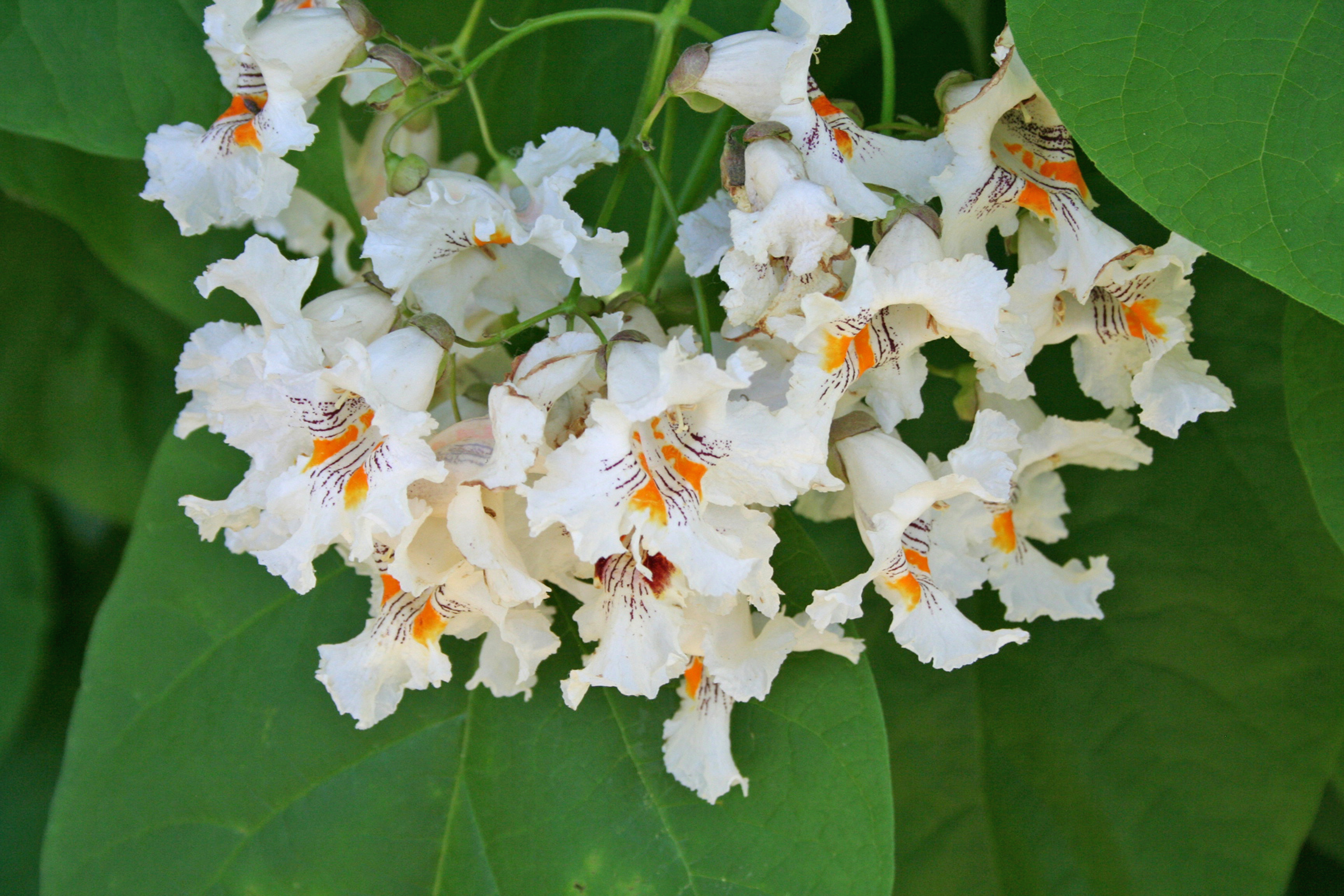

When a northern catalpa tree blooms in early summer, it’s a lovely sight. Impressive clusters of big, white, trumpet-shaped flowers with purple throats appear on a tall tree with huge, heart-shaped leaves.
“It can be a great tree, if you have plenty of space and a certain tolerance for raking,” said Sharon Yiesla, plant knowledge specialist in the Plant Clinic at The Morton Arboretum in Lisle.
Some homeowners consider catalpas to be messy because of the long seed pods full of wing-shaped seeds that fall from autumn to spring. The trees also tend to drop small twigs and branches because their wood is relatively weak. Yet the northern catalpa (Catalpa speciosa) is commonly planted throughout the Chicago area because it can tolerate the dense, alkaline soil common in the city and suburbs.
“It’s very adaptable,” Yiesla said. Native to moist, lowland areas such as river floodplains in the southern parts of the Midwest, the northern catalpa can stand dry or moist soil, although it should not stand in water for long periods of time.
The irregular branching structure of a mature catalpa makes it picturesque even when those branches are bare. You can easily identify a catalpa by its structure in late spring because it is one of the last trees to leaf out.
Northern catalpa is a big tree, growing up to 60 feet high and 40 feet wide. A relative from the American south, the southern catalpa (Catalpa bignoniodes), is a bit smaller, reaching 40 feet high and wide. Its flowers are very similar.
A more compact relative, better suited to yards with limited space, is the Chinese catalpa (Catalpa ovata). “Chinese catalpa can handle a range of soil types, which makes it useful in some difficult sites,” she said. “But its flowers aren’t as showy.” Purple catalpa (Catalpa x erubescens ‘Purpurea’) is a hybrid cultivated variety, a tall tree with leaves that are purple when they unfold and mature to green.
All these trees are fully winter-hardy in USDA Zone 5 (the outer Chicago suburbs) as well as the slightly warmer Zone 6 (the city and most inner suburbs). They are northern members of a huge family of plants that are mostly tropical and subtropical. “If you squint, they do have a bit of a tropical look to them,” she said.
Catalpas are often called “bean trees” or “cigar trees” because of their long brown pods, the playthings of generations of Chicago children. Their frilly flowers provide pollen and nectar to many insects, and a wide range of animals eat the seeds. The large leaves create deep, cool shade.
You can plant a catalpa tree in spring or in early autumn. Because it can quickly start growing new roots after planting, a fall-planted catalpa will have time to start getting established before winter sets in.
“The main drawback is those seed pods,” Yiesla said. “As long as you’re willing to tidy those up from time to time, there’s a lot to enjoy about a catalpa.”
For tree and plant advice, contact the Plant Clinic at The Morton Arboretum (630-719-2424, mortonarb.org/plant-clinic, or plantclinic@mortonarb.org). Beth Botts is a staff writer at the Arboretum.