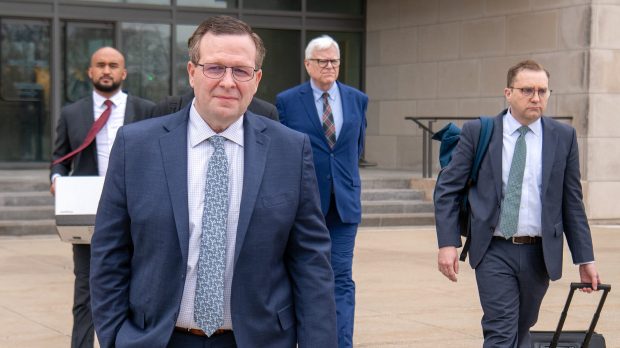

A Chicago federal appeals court on Monday said there was “compelling” evidence against former ComEd CEO Anne Pramaggiore and lobbyist Michael McClain in the “ComEd Four” case and that prosecutors were free to retry it if they saw fit.
The highly anticipated 16-page opinion comes two months after the 7th U.S. Circuit Court of Appeals vacated the convictions of Pramaggiore and McClain in a scheme to influence then-House Speaker Michael Madigan and ordered them released immediately from federal prison.
As expected, the three-judge panel made it official Monday that the convictions for both could not stand given recent rulings by the U.S. Supreme Court curtailing the use of federal statutes involving bribery and making false statements.
But the opinion also was clear the government had presented “significant and compelling evidence” in the case, and rejected arguments from the petitioners that they should be acquitted outright.
“Do not misread our opinion,” the judges said at the conclusion of the ruling. “We are not suggesting that Pramaggiore and McClain are innocent, only that their convictions were flawed and that they have a right to see their sentences vacated.”
The opinion puts the ball squarely in the court of the U.S. attorney’s office, which will have a tough decision to make. A retrial is possible, though it would have to be under different legal theories, or potentially a new indictment that could vastly change the scope of the evidence, legal observers have said.

Prosecutors could also try to negotiate a deal with the defendants that would resolve the case short of trial, such as a plea to lesser counts or deferred prosecution agreement.
Or prosecutors could drop the matter altogether, given the age of the defendants, the costs and court resources that would have to be expended, and the fact that all four of the original defendants have served at least some time in prison.
U.S. Attorney Andrew Boutros said in a statement Monday he was pleased the appellate court agreed there was significant evidence and that a “properly instructed jury” could have decided to convict.
“Because the Seventh Circuit has stated that the government is ‘entitled to retry’ both defendants ‘at its discretion,’ we are weighing our options and will advise the district Court of our decision at the appropriate time,” Boutros said.
Mark Herr, a spokesman for Pramaggiore, said in a statement Monday she was “pleased that the Seventh Circuit has confirmed the dismissal of her bribery conviction and vacated Ms. Pramaggiore’s remaining FCPA and conspiracy convictions.”
Attorneys McClain could not immediately be reached.
Pramaggiore, 67, and McClain, 78, were convicted along with two other colleagues in what became known as the “ComEd Four” case, which grew into one of the biggest political corruption scandals in state history.
Prosecutors alleged a conspiracy to influence Madigan by funneling payments to do-nothing subcontractors and other political perks to the speaker and then washing it from the utility’s books.
Both Pramaggiore, a onetime rising star in Chicago’s corporate world, and McClain, who was a top lobbyist for the utility and one of Madigan’s closest confidants, were sentenced to two years behind bars and had been scheduled for release in August 2027.
The two other defendants, ex-ComEd executive John Hooker and former City Club of Chicago head Jay Doherty, did not appeal their convictions and have already served prison sentences.
The Supreme Court changed the legal landscape a year after the verdict, first with its decision in the bribery case of former Portage, Indiana, Mayor James Snyder, ruling that “gratuities” given to elected officials with no direct tie to official actions are not illegal under the statute known as “666,” its number in the criminal code, which was also used to prosecute the ComEd Four.




Another Supreme Court decision followed in the case against former Chicago Ald. Patrick Daley Thompson, who was convicted of lying to banking regulators. That ruling said the law does not criminalize statements that are misleading but not demonstrably false — which had bearing in the ComEd Four counts involving the alleged falsification of the utility’s books and records.
The case was upended after consolidated arguments for McClain and Pramaggiore before the 7th Circuit, where a three-judge panel had tough questions for a government lawyer about how the conspiracy conviction could stand after the high court said “gratuities” given to elected officials with no direct tie to official actions are not illegal.
Madigan, meanwhile, was convicted in a separate trial of an array of schemes that included the ComEd bribery payments. He was sentenced to 7½ years in prison, and recently lost his appeal before a different 7th Circuit panel.
McClain also stood trial with Madigan but was not convicted on any of the counts against him in that case.
In the 7th Circuit arguments on the ComEd Four case in April, the judges clearly felt there was no way of knowing whether the jury’s verdict would have been within the new boundaries of the law.
“Here’s the problem,” Judge Thomas Kirsch II said to Assistant U.S. Attorney Irene Hickey Sullivan just moments after she stepped to the podium. “When you charge the case and try the case as a bribery case, what’s to say the jury just didn’t consider the illegal bribery object of the conspiracy and stop right there?”
Paul Clement, the lead attorney for Pramaggiore’s appeal, later told the Tribune he had a pretty good feeling things were going his way right out of the gate, when Kirsch had stopped him less than five seconds into his argument to say he understood his position.
“We got a very strong positive signal literally before I finished my first sentence,” Clement, a renowned appeals attorney who has argued dozens of cases before the Supreme Court, said in an interview. “That really did kind of set the tone for the arguments in a very positive way.”
The 7th Circuit ordered both Pramaggiore and McClain released from prison immediately after oral arguments. They will remain free on bond pending the outcome of the case.
jmeisner@chicagotribune.com