
I don’t know what this says about me, but I like a good train wreck.
Not a literal train wreck, those are horrifying, but a metaphorical one, the story of someone bent on self-sabotage and self-destruction, travelling down a spiral that is obvious, and yet impossible to resist.
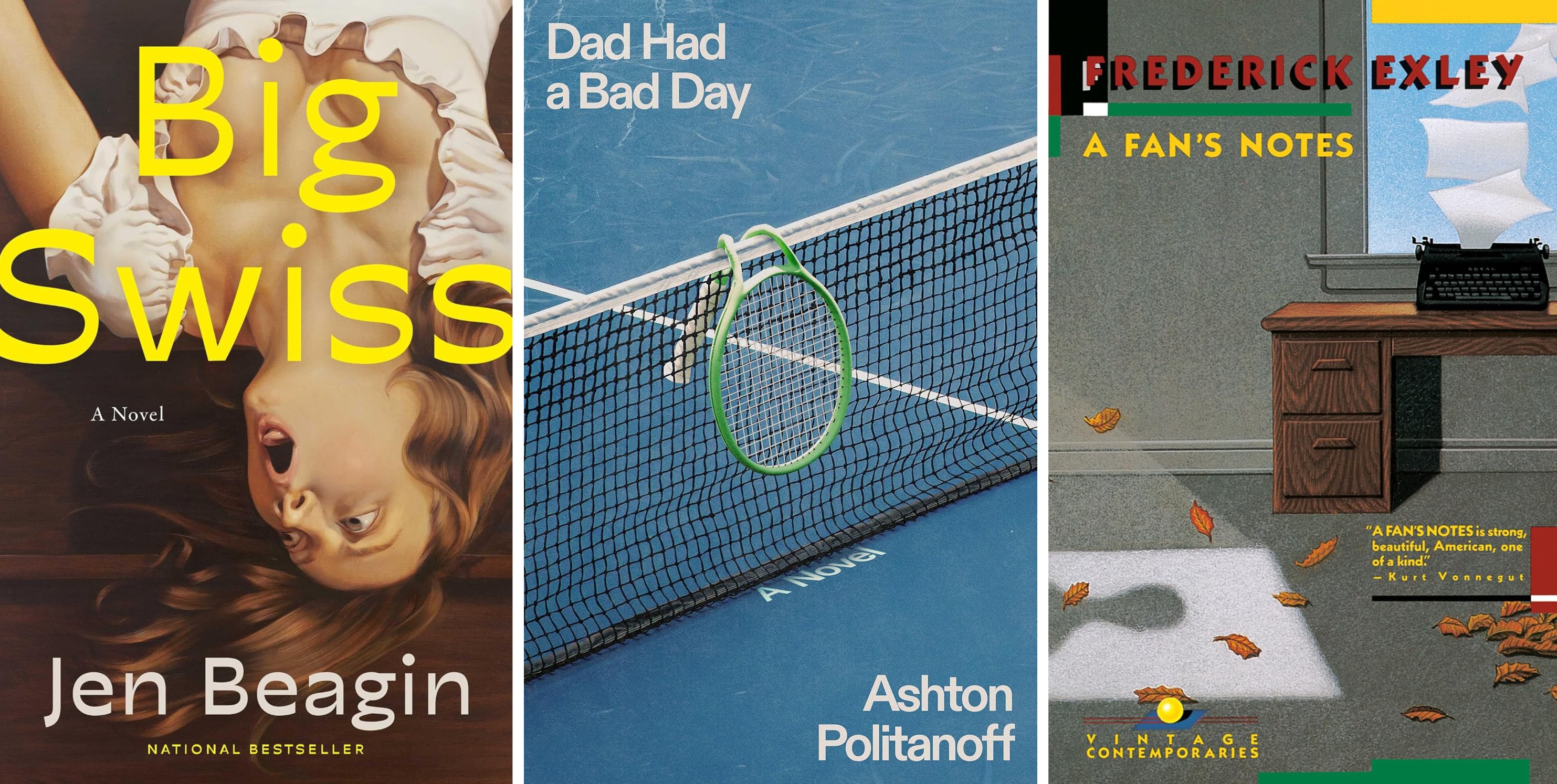
“Dad Had a Bad Day” by Ashton Politanoff is a train wreck novel, and if you enjoy this kind of narrative infused with comedy, as well as insights into human foibles and the degradations of societal expectations, that also manages to ratchet up the tension while infusing a sinister undertones of what it means to captain the adult recreational team for a men’s tennis club, this is the novel for you.
I devoured it.
Told in a series of short vignettes, “Dad Had a Bad Day” is the story of Ned, a married, recently laid-off suburbanite with a young child, who finds himself unmoored not just by unemployment, but by his new role as primary caregiver to his son.
Once upon a time, Ned was a promising junior tennis player who was undone by circumstance and what he perceives to be sabotage, of both the self and via others variety. Tennis has been a no-go zone for Ned, but dragging his racket out of the garage and heading to the club where he stashes his son (Frederick) in daycare, Ned has the internal sense that maybe he’s still got something in the tank as a player.
At the club, he reconnects with Roland, a fellow former junior tennis player at the academy they once attended, and who served as a kind of slightly older peer mentor. Ned admired the boy and the tennis game, believing Roland exemplified a kind of ideal of grace and swagger that Ned strived to imitate.
Buoyed by destroying a couple of fellow club members on the court, Ned volunteers to captain the club team and sets his sights on Roland as a key ingredient, even though Roland has clearly been through some rough times.
Ned is hiding all this activity from his wife (Lorraine), and his schemes for escaping either detection or his parental responsibilities result in some darkly comic adventures and screwups.
Ned loves his son and soon incorporates him into his schemes to climb that ladder at the club and sabotage his team’s opponents, but over the course of the novel, we realize that Frederick is more sensible and wiser than his unraveling father.
For me, the story was reminiscent of another favorite of mine of recent vintage, Jen Beagin’s “Big Swiss,” and also a much earlier trainwreck story, Frederick Exley’s “A Fan’s Notes.” It’s important to approach this novel with the knowledge that there is no redemptive arc coming, a reality that Politanoff signals through occasional — seemingly unsent — letters from Ned to Lorraine that reveal his inner state. This man is cracking up and nothing will stop it.
Finding Ned deeply sympathetic is also going to be a stretch for most readers. Personally, I’m drawn to novels where we are not asked to “like” but instead understand the main character because to me, this shows a commitment to making that character nothing less than human.
Ned is self-pitying. He does stupid, even unforgivable, stuff and cannot seem to come to grips with his own emotional state, which we learn has been warped by events and people from his past. These are not presented as excuses, but simply truths. Ned is what happens when things do not go well.
There is a world where Ned gets the help he needs, but this book is not that world.
It might not be our world either, truth be told.
Book recommendations from the Biblioracle
John Warner tells you what to read based on the last five books you’ve read.
1. “Becoming Myself” by Stasi Eldredge
2. “For One More Day” by Mitch Albom
3. “I Guess I Haven’t Learned That Yet” by Shauna Niequist
4. “So Big” by Edna Ferber
5. “To Kill a Mockingbird” by Harper Lee
— Janice F., Crystal Lake
For Janice, I’m going with a good, satisfying cathartic read, “My Wife Said You May Want to Marry Me” by Jason Rosenthal.
1. “Revenge Prey” by John Sandford
2. “Royal Spin” by Omid Scobie and Robin Benway
3. “Theo of Golden” by Allen Levi
4. “An Inside Job” by Daniel Silva
5. “One Golden Summer” by Carley Fortune
— Dan M., Oak Park
This is out on a bit of limb, but I think Dan may get a kick out of the first installment in Rob Hart’s now three-book series, “Assassins Anonymous.”
1. “Theo of Golden” by Allen Levi
2. “Yesteryear” by Caro Claire Burke
3. “The Calamity Club” by Kathryn Stockett
4. “Strangers” by Belle Burden
5. “Heart the Lover” by Lily King
— Diana P., Chicago
Diana is going to be thoroughly swept up in Dave Eggers’ new one, “Contrapposto.”
Get a reading from the Biblioracle
Send a list of the last five books you’ve read and your hometown to biblioracle@gmail.com.
John Warner is the author of books including “More Than Words: How to Think About Writing in the Age of AI.” You can find him at biblioracle.com.