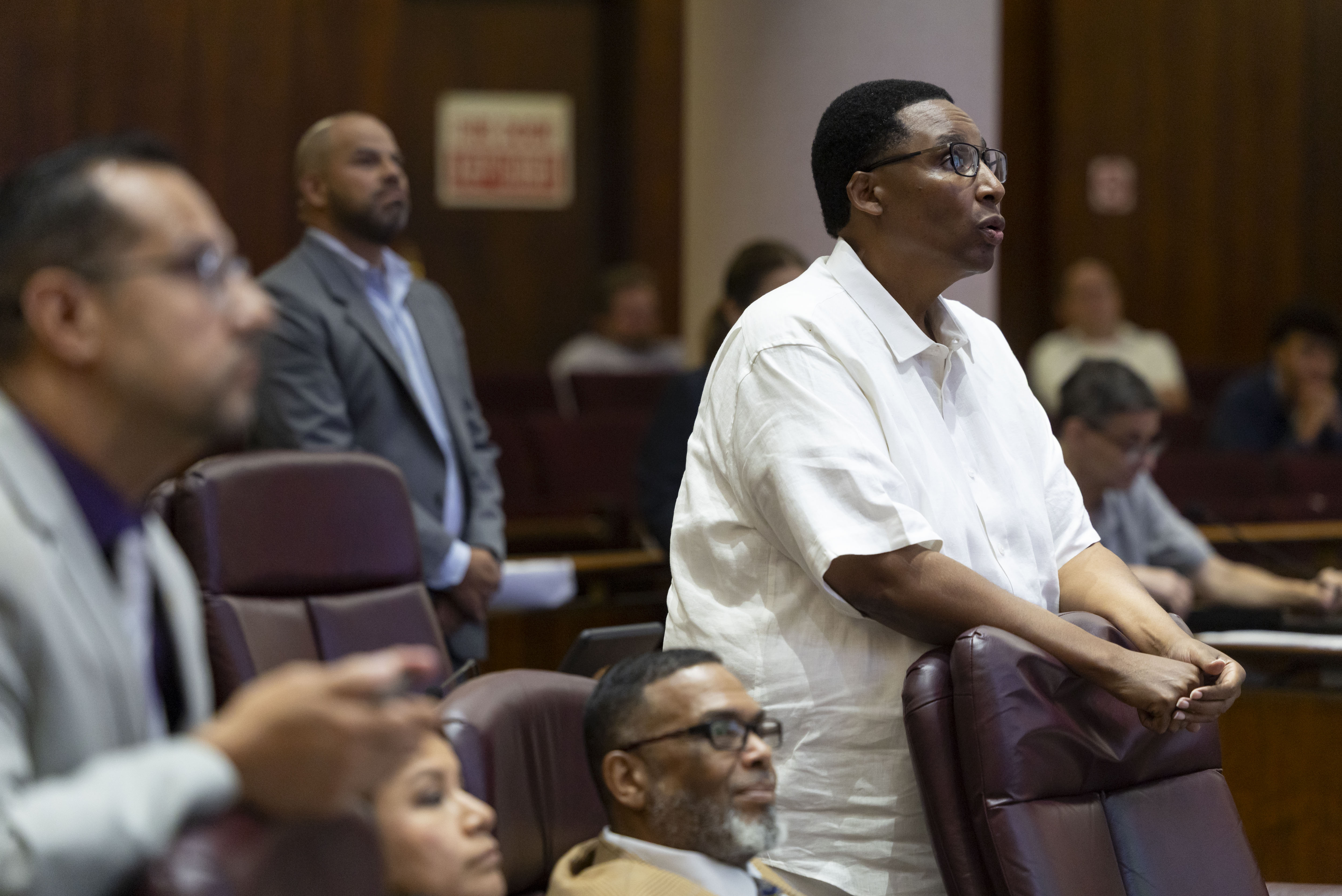

Color us surprised to see 28th Ward Ald. Jason Ervin, an erstwhile ally of Mayor Brandon Johnson, outline in our pages the makings of a plan for Chicago to reacquire the parking meters whose 2008 sale has bedeviled every mayor since Richard M. Daley made the ill-fated decision to unload them for a song.
Pleasantly so.
The city now has some time to consider Ervin’s idea, as owner Chicago Parking Meters LLC and would-be meters purchaser Stonepeak Partners have extended a looming deadline for the City Council to consider their proposed transaction until the end of September. The council should give the plan serious consideration.
There are no guarantees, obviously, that a fiscally stressed city government can come up with the $2.5 billion or a small amount more to seal a deal. And there are many risks, as we will explain below.
But there also might be significant opportunities here.
Ervin hopes next week to introduce an ordinance that would lay out how a city reacquisition would work. There still are details to work out on his end, he tells us, including the governance structure of a city entity that would assume the meter contract, which has another 58 years to run. It’s possible that none of this turns out to be workable.
But the gist of Ervin’s argument is that Chicagoans rather than out-of-town investors ought to benefit from this detested deal. He envisions the city’s four woefully underfunded pension funds (and perhaps the separate Chicago teachers’ pension fund) as investors in and part owners of this public asset.
There’s a straightforward logic to Ervin’s thinking. If a Wall Street private-equity firm, backed in part with money from public pension funds in California, Maryland and elsewhere, thinks Chicago’s meter contract is such a great investment, why shouldn’t Chicago’s own suffering pension funds benefit?
The $2.5 billion that Stonepeak has offered Chicago Parking Meters looks like a great investment based on the $24 billion (inflation-adjusted) that Stonepeak has projected the contract will yield over its remaining life, according to reporting by Bloomberg.
The Johnson administration secretly bid on reacquiring the meters late last year only to conclude that financing would be unfeasible at the $3.2 billion price they offered. Among other things, they reportedly determined that issuing bonds at that level would necessitate pledging other revenue streams beyond what the meters themselves generate as collateral. Needless to say, that would have been unwise for a city with a credit rating perched precariously just above junk status.
If the city takes another run at the meters via Ervin’s proposal, it should go without saying that the earlier $3.2 billion offer no longer is operable and that something along the lines of $2.5 billion (or perhaps a bit more to cement the deal) is what should be on the table. That alone would help make the numbers work.
Ervin would address the bond financing problem by tapping the pension funds to cover part of the buyout. Reducing bond financing to a level where only meter revenues must be pledged is crucial.
Ervin also believes that dollars in tax increment financing districts in parts of the city that happen also to generate the bulk of meter revenues could be part of the financing mosaic. That would likely require the state to pass enabling legislation.
OK, now we’re getting complicated.
But, still. There’s $14 billion stashed in Chicago’s four municipal pension funds at last count. Could several hundreds of millions of dollars in pension equity make the bonds more feasible? It’s worth investigating.
Another issue, of course, is the abysmal state of Chicago’s pension funds, which are among the worst-funded public retirement funds in the nation. The $14 billion in assets in the four funds isn’t close to covering the $51 billion in collective liabilities. That raises significant questions about the wisdom of putting significant pension dollars into an illiquid investment with nearly 60 years left to run.
Another major barrier is the lack of trust a majority of council members have in the Johnson administration. Even if a transaction theoretically pencils out, the execution risk is high. Who will be mayor come next May after the scheduled election in February? The execution risk could rise or fall on that outcome.
Taking back the meters is appealing on a gut level, but there’s political difficulty inherent in this option as well. Ervin makes clear that he is proposing acquiring the contract, and all the onerous provisions of that deal that have driven mayors crazy would remain. He emphasizes that if pension funds are going to participate in the deal, they owe a fiduciary obligation to their beneficiaries to ensure it pays off. That means those true-up payments owed by the city that keep rising likely will continue to do so unless aldermen raise meter rates, which they haven’t done since 2019.
Try explaining to the average Chicago taxpayer that the city is reacquiring its meters but very little will change on the streets.
Yet another hurdle is Chicago Parking Meters itself, which has threatened to sue the city if the council doesn’t approve the Stonepeak deal. Would CPM be open to selling to the city at this late stage?
“All I know is CPM wants out,” Ervin tells us. “They only way they get out is if someone buys them out.”
Theoretically, if the city can match Stonepeak, Chicago Parking Meters should be agnostic. At worst.
And, of course, nothing here can happen unless the city feels sure such a plan wouldn’t result in a credit-ratings downgrade.
We think there’s cautious willingness on the part of aldermen who’ve been opponents of Ervin on other issues to consider his proposal. But they will want outside financial experts (fortunately, this city has many of those) to provide guidance and a reality check, given their lack of trust in the administration. We would insist on the same.
We applaud Ald. Ervin for thinking creatively about this thorniest of issues.
Submit a letter, of no more than 400 words, to the editor here or email letters@chicagotribune.com.