
Now is the time to look out for one of our most conspicuous garden pests: the Japanese beetle. “In recent years they have been showing up in the third week of June,” said Sharon Yiesla, plant knowledge specialist in the Plant Clinic at The Morton Arboretum in Lisle.
Adult Japanese beetles feed on about 300 different species of ornamental plants, but especially favor roses, grapevines and crabapple, cherry and linden trees.
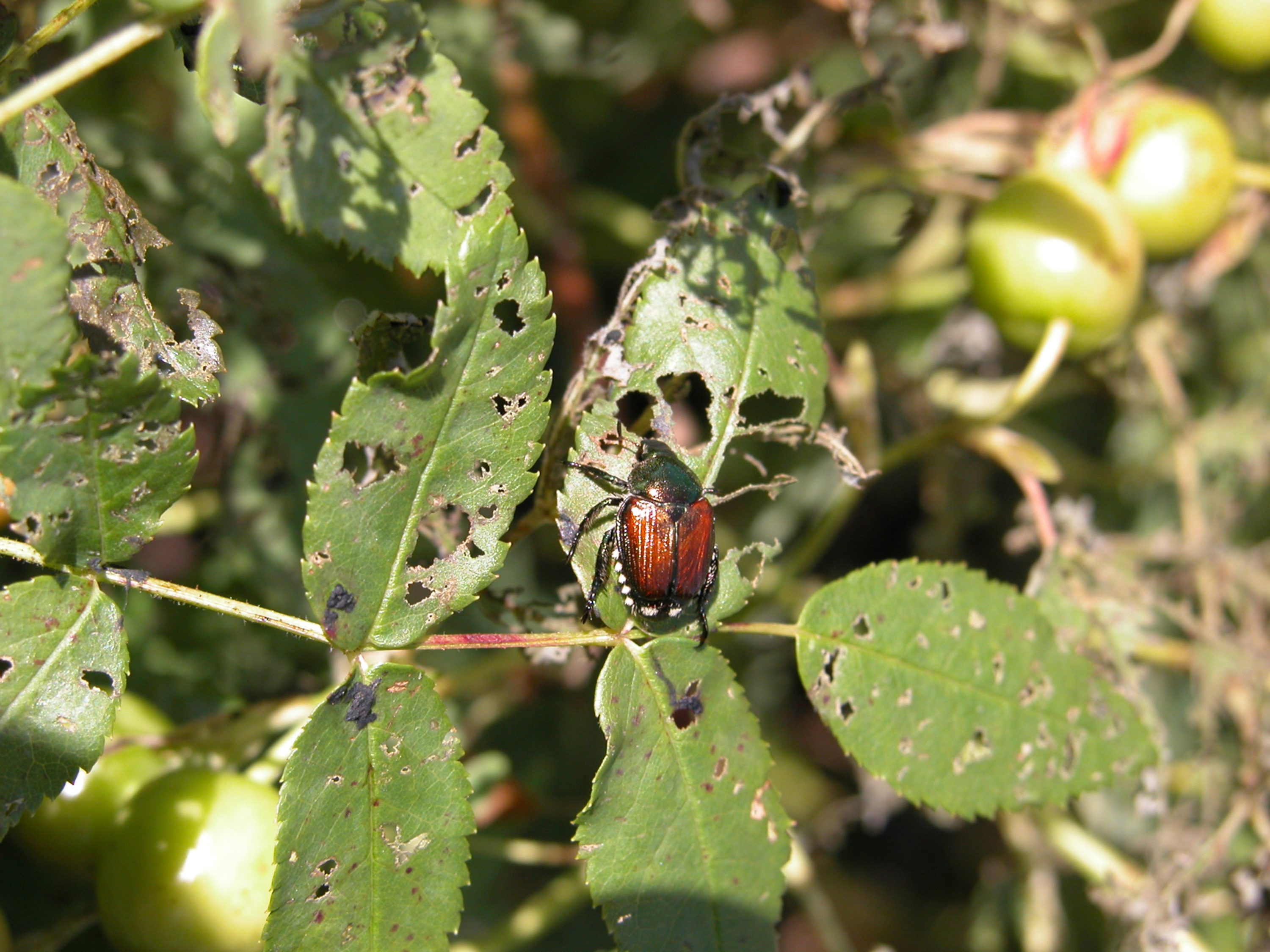
The beetles eat the tissue between the leaf veins, leaving just the skeleton of a leaf. While it’s unattractive, the leaf damage rarely kills plants.
Japanese beetles also do damage in the larval stage of their life cycle, when they live underground as white grubs, usually under turfgrass. “If you have a lot of grubs in your lawn, they can eat so many grass roots that you can peel patches of grass up like a carpet,” she said.
Both the eggs and the grubs thrive in moist soil, so you can make life hard for them if you avoid overwatering your lawn. “Water only when the soil is actually dry,” Yiesla said. “You’ll save water too.”
Adult Japanese beetles have oval, dark metallic green bodies about 1/4 to 1/2 inch long, with coppery-brown wing covers. Originally from Asia, they entered the United States more than a century ago and are now considered an invasive pest.
Here are some tips from the Plant Clinic for coping with Japanese beetles and grubs. Learn more at mortonarb.org/japanese-beetles.
Don’t use traps: Traps use floral scents to lure beetles. “The scents will attract beetles from all over the neighborhood, far more than the trap can hold,” Yiesla said. The rest will feed on your plants.
Handpick or shake beetles from plants: Fill a wide container with soapy water. Pluck the beetles by hand (wear gloves) and drop them in. You may also be able to hold the container under an infested leaf or flower and shake the beetles off into the soapy water.
Take action early: When a beetle finds a good food source, it emits pheromones to attract other beetles. “If you can handpick the beetles when you first see them, before they send up their chemical flag, you’ll have fewer beetles,” Yiesla said. Don’t expect to completely eliminate them; more beetles can always fly in.
Prevent beetles by deterring grubs: The adult beetles are only active for a few weeks until they mate in July and August. Then the female finds a spot, usually under a sunny lawn with moist soil, and digs down to lay her eggs. The eggs soon hatch into grubs that feed on grass roots until summer’s end, lie dormant in winter and resume feeding in spring until they metamorphose into adult beetles. “If you care for your lawn all year in a way that makes life hard for the grubs, it will mean fewer beetles next year,” she said.
Avoid overwatering: “Before you set up a sprinkler, dig down with a trowel to make sure there’s no moisture in the top inch or two of the soil,” Yiesla said. Water as little as possible during July and August when female beetles are seeking out moist soil to lay their eggs. Turn off the timer on an automatic watering system, and manually start the sprinklers only after you’ve checked to make sure the soil is dry.
Choose grub controls carefully: If you have a heavy grub infestation, you may be considering a treatment for the lawn. Be aware that applying insecticides also can kill beneficial organisms in the soil, and that only certain products, applied at the right time, have a chance of being effective. Contact the Plant Clinic (mortonarb.org/plant-clinic) for more guidance.
Research before treating linden trees: It is illegal to use many neonicotinoid pesticides, including imidacloprid, on linden or basswood trees as a spray, soil drench, or in any other way because of the environmental harm they do. If you are considering applying any insecticide, read the label carefully to see if it is appropriate and when and how to apply it. Be aware that no spray can guarantee control and that not all products have a chance of working. It’s wise to contact the Plant Clinic for advice before using any insecticide.
Consider biological control: Biological controls for grubs can work well, but they are not a quick fix. They must be applied in a particular way at a certain time and may take several years to build up enough in the soil to be effective.
One possibility is beneficial nematodes — microscopic wormlike creatures that can infest and kill grubs. They can be hard to find in garden stores but are available through the internet. Other biological products contain a species of grub-killing soil bacteria, Bacillus thuringiensis galleriae, abbreviated Btg. The bacterial treatment marketed as milky spore is not recommended for the Chicago area because its bacteria don’t reliably survive the winter here.
Plant more trees and shrubs: Japanese beetles avoid laying their eggs in the shade, so adding more beautiful, shady plants to your landscape will discourage them.
For tree and plant advice, contact the Plant Clinic at The Morton Arboretum (630-719-2424, mortonarb.org/plant-clinic, or plantclinic@mortonarb.org). Beth Botts is a staff writer at the Arboretum.