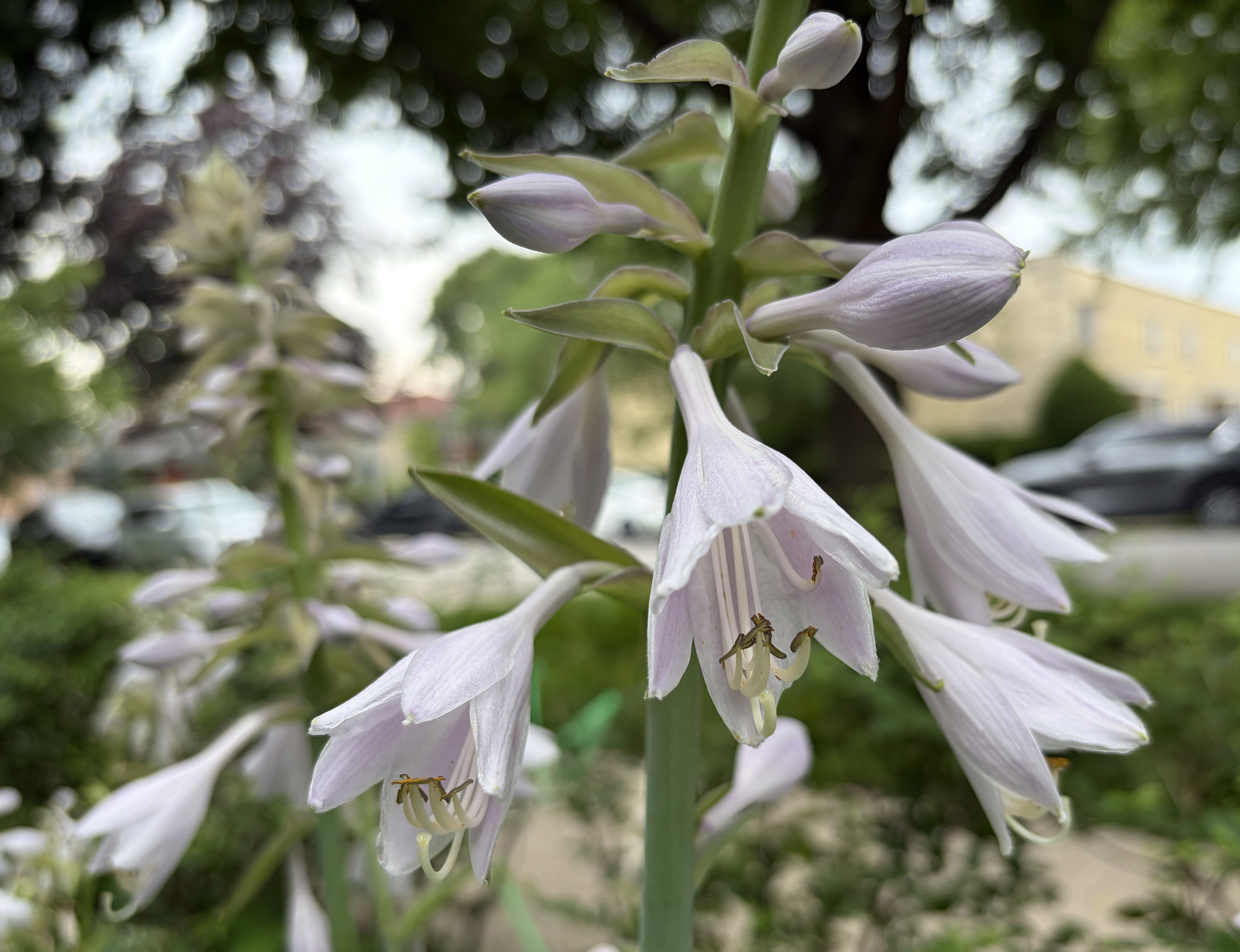

Do you notice when your hostas bloom? “Hostas often don’t get credit for being flowering perennials, but that’s what they are,” said Sharon Yiesla, plant knowledge specialist in the Plant Clinic at The Morton Arboretum in Lisle.
Sometime between June to September, depending on the species and variety, a hosta plant will send up a tall stalk that opens into a cluster of bell-shaped blooms in shades from white to purple, which add a particular charm to the summer garden.
Most gardeners choose hostas not for their flowers but for their foliage, a tidy tuft of leaves that lasts all season. They are shade-tolerant, winter-hardy, easygoing, resilient plants that can live for decades.
That’s one reason they are good companions for trees. “If you plant hostas around a tree, it will likely be the last time you need to disturb that tree’s roots for a long time,” Yiesla said. “The hostas will thrive in the shade, and their roots and the tree’s roots will co-exist quite happily.”
The Arboretum’s Ground Cover Garden shows off the effect with sweeps of hostas below basswoods and other mature trees. Unlike many creeping ground covers, hostas do not spread and are not known to become invasive.
Given their popularity, it’s not surprising that more than 11,000 cultivated varieties of hosta have been developed from a handful of species native to East Asia. Hostas may have leaves that are broad and rounded or narrow and spear-shaped; deeply veined, wavy-edged or crinkled; and any shade of green from pine-dark to blue-green to startling chartreuse.
They come in a wide range of sizes. “When you have an awkward space in your yard, like a few square feet between the steps and the sidewalk, a hosta of just the right size can be an easy way to fill it,” she said.
A single shady garden may contain the demure Blue Mouse Ears, less than a foot wide with little purple flowers in July, and the commanding Empress Wu, 6 feet wide and 3 feet high, with leaves more than a foot long and tall stalks of lavender blooms.
Blue-tinted hostas like both of these varieties actually have a waxy coating on their green leaves that absorbs certain light frequencies to make them appear blue. Blue hostas often turn more green toward September as the wax wears off or melts away in summer’s heat.
Varieties in plain green or chartreuse hues are better for sites in part sun, although hostas in general are not full-sun plants. Gardeners may face a problem when a tree is pruned or removed, throwing the hostas it once shaded into full sun that soon scorches them. “The best solution is to transplant those hostas into a shadier area,” Yiesla said.
In general, hostas are easy to care for. They appreciate soil rich in organic matter, but they need no fertilizing. Like all perennials, they need to be watered when the soil feels dry an inch or two below the surface.
It’s best to water them at soil level. The broad, overlapping leaves of a large hosta can intercept water droplets like an umbrella, so water from a sprinkler or light rain may not reach the soil where it could soak down to their roots. Water that lingers on leaves through the night also can encourage disease.
In moist, shady gardens, slugs that nibble hosta leaves can be a problem; simply remove the damaged leaves at the base. Hostas also are not a good choice where deer are present: “They are deer candy,” she said.
After the week or two of their bloom, the tall flower stalks, called scapes, will dry on the plant. For a tidier look, snip each scape off at the base or just above a leaf, and the mound of leaves will remain handsome until it is killed by frost.
“Hostas are so widely planted that it’s easy to take them for granted,” Yiesla said. “The time when they bloom is an opportunity to appreciate them a little more.”
For tree and plant advice, contact the Plant Clinic at The Morton Arboretum (630-719-2424, mortonarb.org/plant-clinic or plantclinic@mortonarb.org). Beth Botts is a staff writer at the Arboretum.