
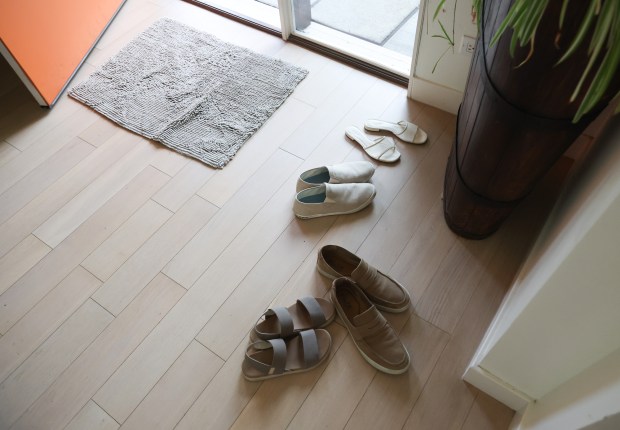
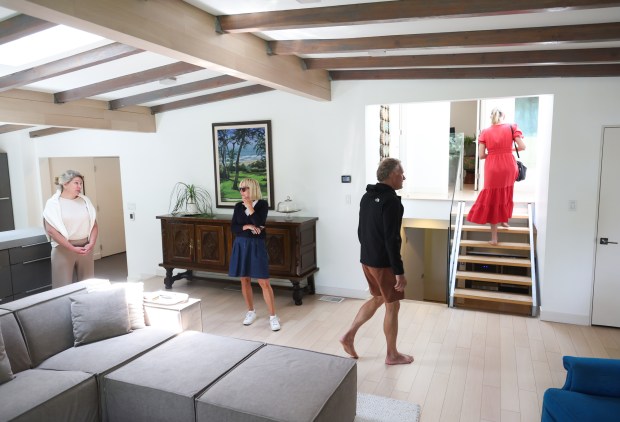
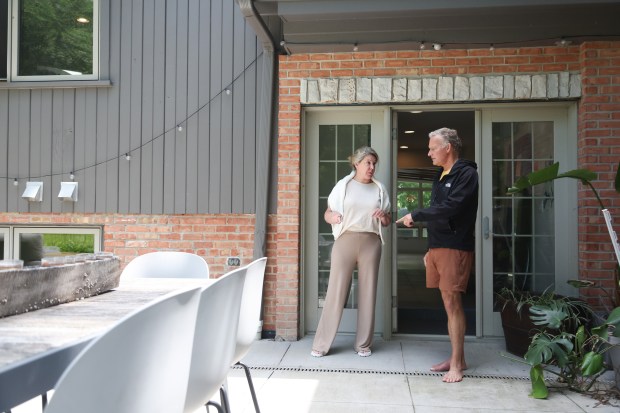
To paint a picture of the Chicago-area housing market, visit an open house and look for the pile of shoes at the front door. That’s where potential buyers — who frequently remove their shoes before walking through the home — start sizing up the competition.
Real estate agents and brokers say the Chicagoland market continues to be defined by intense buyer demand for a limited number of homes for sale. It’s a market where homes are sometimes listed and then sold within days, if not hours, and where potential buyers often need to make offers that are above the asking price in order to be successful.
Tommy Choi, co-founder and realtor at Keller Williams ONEChicago, says the Chicago housing market was unusually “aggressive,” in the first half of the year. And agents say home prices — and competition — are expected to heat up even further this summer.
While the national housing market shows signs of cooling, the Chicago area, by all accounts, appears to be defying gravity.
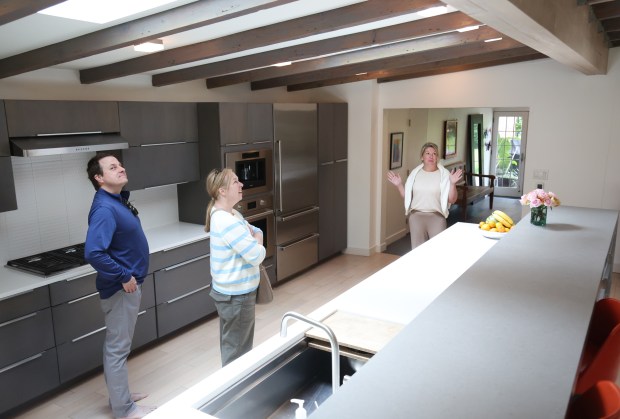
“The Chicago narrative is pretty different from what we’re hearing from around the country, in places like Florida or Arizona,” says David Bracy, vice president at Berkshire Hathaway HomeServices Chicago, attributing the region’s extreme seller’s market to simple laws of supply and demand. “[There are] 20 to 40 people coming through an Open House. The amount of demand is insatiable.”
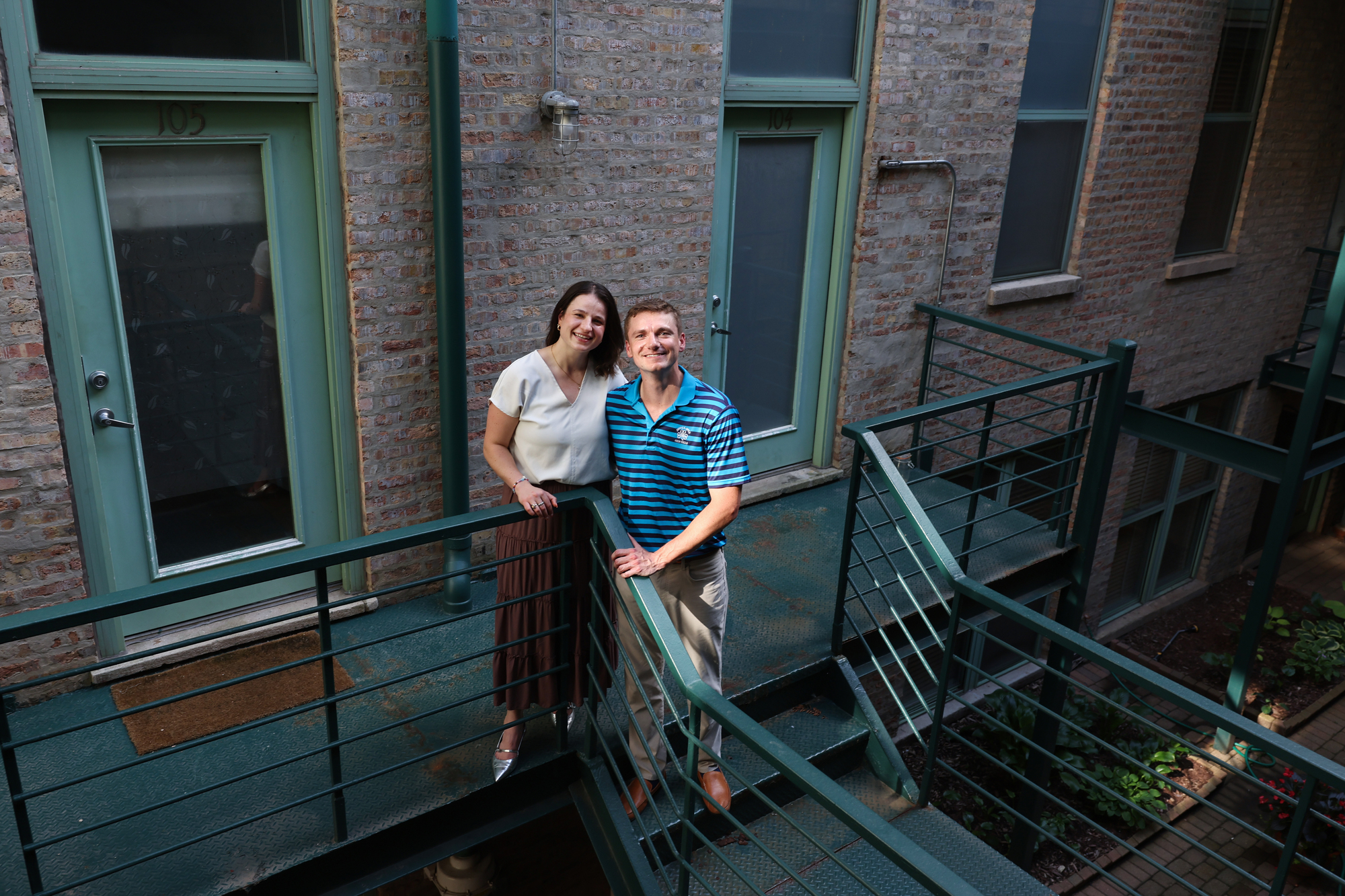
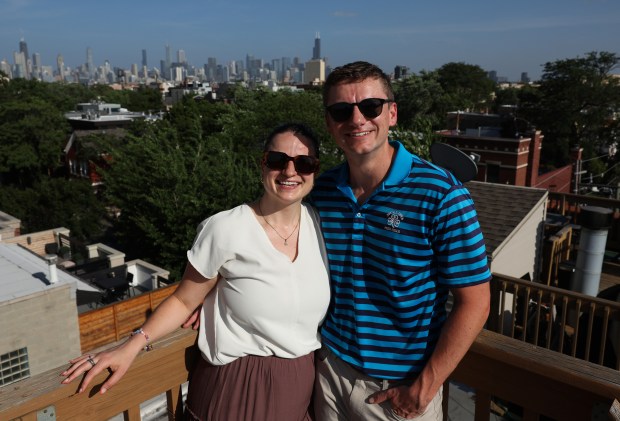
First-time homebuyers Sam Gainer and his fiancee Grace Gumbiner, both 29, say they were unprepared for the cutthroat nature of Chicago real estate. The couple jumped into the market to escape the rental cycle before turning 30, and to avoid the yearly rental increases that nearly priced them out of their beloved neighborhood of Bucktown.
“We went to nearly 25 open houses,” Gainer explained, adding that they temporarily paused their search to reassess their budget and approach. “It was a very intimidating process. You would walk in and there would be 80 pairs of shoes at the front door, and then three or four offers by the end of the day.”
In May, the median price of a home in the Chicago Metro Area rose to $399,990, an increase of 5.5% over May 2025, according to the latest data from Illinois Realtors. One factor driving up prices, brokers say, was the limited number of homes for sale. Within the nine-county area, there were just 12,408 homes for sale, marking a 14.6% decrease from the prior year.
In the city of Chicago, prices climbed even higher, and the number of available homes for sale got even tighter. The median sales price rose 7.7% in May to $420,000, with roughly 3,337 homes listed for sale, a significant 30% drop from one year ago.
Part of the current housing shortage can be attributed to the lack of new construction and development. Bracy and others say the inventory of available homes is further constrained by sellers who earlier took advantage of historically low interest rates a few years ago. Because interest rates — and therefore the cost of a new mortgage — are now higher, many of those buyers are staying in place and not listing their homes.
“Once interest rates went up in 2022, [homeowners] no longer had the incentive to sell,” Bracy explains. “They have a 3% interest rate and to buy was as high as 7 to 7.5% at the time. Even with 5% interest rates, they maybe couldn’t afford a new property like they thought they could.”
As of June 25, the 30-year fixed rate mortgage averaged 6.49%, compared with one year ago, when it averaged 6.77%, according to Freddie Mac data.
Add in higher homeowners’ insurance and maintenance costs, and some buyers realize that once they’ve set themselves up in a new home, they’ll be spending more each month on housing than they did previously.
The fact that fewer houses are being listed has also given sellers unprecedented leverage.
Recently, Lawrence Yun, chief economist for the National Association of Realtors, predicted that the median single-family home price could reach $1 million by 2050, though modest gains of 3% to 4% per year are expected for now.
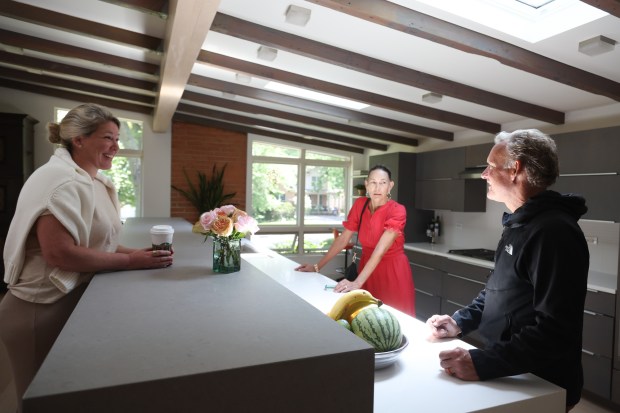
In Chicago, home prices in July are expected to be nearly 6 percent higher than last year, according to recent projections from the Institute for Housing Studies at DePaul University.
“Even with limited demand in other parts of the country, we’re still seeing restricted supply,” says the Institute’s Executive Director, Geoff Smith. “There is still a lot of economic uncertainty and inflation, however, which could potentially impact demand.”
Brokers and agents both say purchasing a home in greater Chicago rarely goes according to plan — or according to the listing price. In fact, buying a home has become a bit like playing a competitive sport.
In the luxury market, where homes typically sell for $1.5 million and higher, Bracy says it’s not uncommon for buyers to offer up to $300,000 over a home’s asking price, and some make all-cash offers.
“There are a lot of people who have resources, and who still can’t find a property,” he adds. “In the end, there’s only one buyer. They might pay 10 to 20% over asking, waving appraisals, all the things necessary to get that property.”
It’s a phenomenon that extends from downtown to the suburbs, agents say, and even buyers with more moderate incomes make offers over the asking price.
The market is so competitive that some potential buyers almost hate to fall in love with a home, because there’s no guarantee they’ll be able to close the deal.
“If my client tours a home and they love it, sometimes they aren’t even excited — they look like they are going to cry,” said Stephanie Cutter, a real estate broker with Coldwell Banker Real Estate. “The list price almost doesn’t matter. It’s really hard for buyers when they really can’t afford it. We just have to do all that we can to make the best offer.”
Cutter said agents are strongly advising clients to consider less expensive homes so that they have room in their budget to make offers that are above the asking price. Cutter also advises clients to be flexible on neighborhoods, property updates or move-in timelines.
Buyers still come with their Pinterest boards and can be picky about finishes, but those who are willing to compromise are more likely to pull ahead.
“That might be a hard adjustment,” Cutter adds. “There are a lot of obstacles. I’m hearing frustration from buyers.”
It’s also been frustrating for real estate professionals. Cutter says she meets with a group of brokers weekly, where they often lament over lost bids. In one instance last spring, Cutter says she wrote four offers in a single day. All four failed to get past the finish line.
“Sometimes it takes seven or eight times to ‘win,’” she adds. “In the end, buyers are happy. We all want our clients to win.”
Sam Gainer and Grace Gumbiner ultimately closed on a Bucktown condo in late spring, not because they believed they had the highest offer, but because they were willing to push their move-in date until August.
“It was pretty bleak there for a while,” Gainer says. “It was a six to eight month process of thinking this may not ever happen.”
Following an inheritance from her late grandparents, Heather Klain, 33, says she and her husband started looking at homes in December. After their ninth showing and one lost bid, they eventually closed on a condo in Jackson Park Highlands.
During the process, Klain says the couple became consumed by endless scrolling through real estate apps such as Redfin and Zillow.
“It can be addictive, but not necessarily in a rewarding way,” jokes Klain. “You think, ‘Maybe I missed something, I should check again. ‘Oh, here’s a lovely place on the lake.’ But the HOA is $4,000 a month. There were points that were discouraging. Somehow we didn’t give up.”
Both Gainer and Klain say their recent home purchases remain an anomaly among their peers.
“I don’t think homeownership is really on their mind,” Klain says of friends and family. “Some are still living at home. Some are working three jobs. They want to buy a home, but … The system isn’t always working for people.”
The National Association of Realtors reports that the average age of a first-time homebuyer is now 40, an all-time high.
Choi says it’s unsurprising that younger generations, including those who have witnessed the housing volatility over the past two decades, have shifting ideals around homeownership — including those same young people paying rents as high as $4,000 a month to live in a full-amenity high rise.
That mindset often changes when life changes: a promotion, a new relationship, having a child.
The greatest influence on homeownership often comes down to culture and lifestyle.
Choi says he was motivated to become a real estate agent, in part, after seeing the pride his Korean immigrant grandfather took in homeownership. Today, many people still desire to build wealth through homeownership, even if it takes longer to reach that milestone, he says.
But even with a buzzing housing market, it’s hard to ignore the complex reality that exists between the gap of higher- and moderate-income buyers zapping up properties around greater Chicago, and the stagnation experienced by lower-income buyers.
Many in the latter group are putting their homebuying ambitions on hold, floating further and further away from a market largely priced out of reach, either due to ongoing affordability constraints, shifting ideals around the American Dream, or both.
“We need more affordability around the city in general, and that’s the tough part,” Choi says. “Part of what’s missing is what typically makes a neighborhood desirable: commercial corridors, retail. That’s where the city has to come in and invest and attract more business.”
As Chicago continues to attract a swarm of buyers, Choi fully expects the market to remain hot and the number of offers to multiply.
“We’re by a major body of water, we have beaches, we have a thriving industry, we have diversity and a lot of culture,” Choi says. “When compared to the coasts, our affordability is still a big draw.”