
More than two years after the Tinley Park-Park District purchased the former Tinley Park Mental Health Center at Harlem Avenue and 183rd Street, officials expect to finish cleanup at the site by the end of the year or sooner.
But before beginning development, the district is working to complete the Illinois Site Remediation Program, which it began in September 2025. The district plans to begin soil sampling this fall, and the entire remediation process could take at least a year from then, according to Renee Cipriano, the former Illinois Environmental Protection Agency director who is overseeing the property cleanup.
While property cleanup included removing asbestos and other hazardous materials from the inside of buildings and demolishing those buildings, the remediation process investigates and removes any remaining contaminants to make the site safe for recreational use.
The remediation could be lengthy, as recreational use is one of the most protected IEPA approvals, Cipriano said. But district officials plan to keep their promise to the state and residents to develop the property for recreation.
In the meantime, Park District board President Lisa O’Donovan said the district remains unsure about specific development plans, projected cost of any development and how it would be funded as officials focus on finishing cleanup.
She said just what kind of recreational use the property will be put to also is contingent on community feedback.
“At this point, we’re not just quite there yet, in terms of funding it,” O’Donovan said. “That’s always been our main focus — making sure that it’s cleaned up in a proper way so that it was safe for all of our community.”
Tinley Park village officials have raised concerns about the environmental clean-up efforts, funding, potential development plans and the district’s oversight of work at the property.
The village of Tinley Park had also eyed acquiring the property from the state, with ideas to redevelop it for commercial uses. When the Park District acquired it in 2023, village manager Pat Carr said village officials were disappointed and believed they were in a better position to develop the property with participation from private investors.
The Park District announced its vision for 90 acres of the property in 2025, a plan that included five baseball fields, six multipurpose athletic fields, a domed soccer field, stadium with running track, accessible playground and a pond.
O’Donovan said the district plans to develop that portion of the property first. Situated on the west end of the property along 80th Avenue, the district’s plan would make the area an extension of Freedom Park.
“Those two facilities could work together hand in hand to really open up the possibilities over there,” she said.
O’Donovan said she has also received some suggestions from enthusiastic residents, along with offers from private developers, including implementing pickleball courts, community gardens and open space.
She said the district has denied offers from private developers, telling them to inquire after cleanup is finished.

While a funding plan for development of the property is not yet in place, O’Donovan said possible options include public and private partnerships, state funding and using the district’s budgeting process.
In the time since the Park District bought the property from the state for $1, the district has received two major state grants for cleanup — one for $15 million in 2023 and another for $18 million in June 2025.
As of June, around $61,812 remained from the first grant, along with all of the second grant. Cipriano said the district aims to use the second grant to complete the abatement and demolition of existing structures and the remediation process.
Regardless of funding and feedback, the property can only be developed for public recreational use. Once a site for a proposed casino or racetrack and casino facility, a 2023 state law prohibits its use for gambling facilities, and also restricts the district from selling the property. The district can lease the property, but even then, the tenant can not run any sort of gambling operation on the site. If the district violates these state laws, the property would return to state ownership.
“So we really want to be mindful of what the parameters are that the state put on the property so that we can make sure that we follow that to uphold what their expectations were of us in the transfer of the property,” O’Donovan said.
State Rep. Bob Rita, who has long supported the Park District’s ownership and work on the property, said the district is making good progress.
“Seeing this long-neglected property finally undergo a proper environmental cleanup is a major win for Tinley Park,” he said.
The district finished abatement for the properties this May, meaning issues like asbestos and standing storm water were resolved, and buildings were cleared for demolition. Features such as lime pits and a reservoir were removed, and three old underground storage tanks were safely removed, according to a statement from the district.

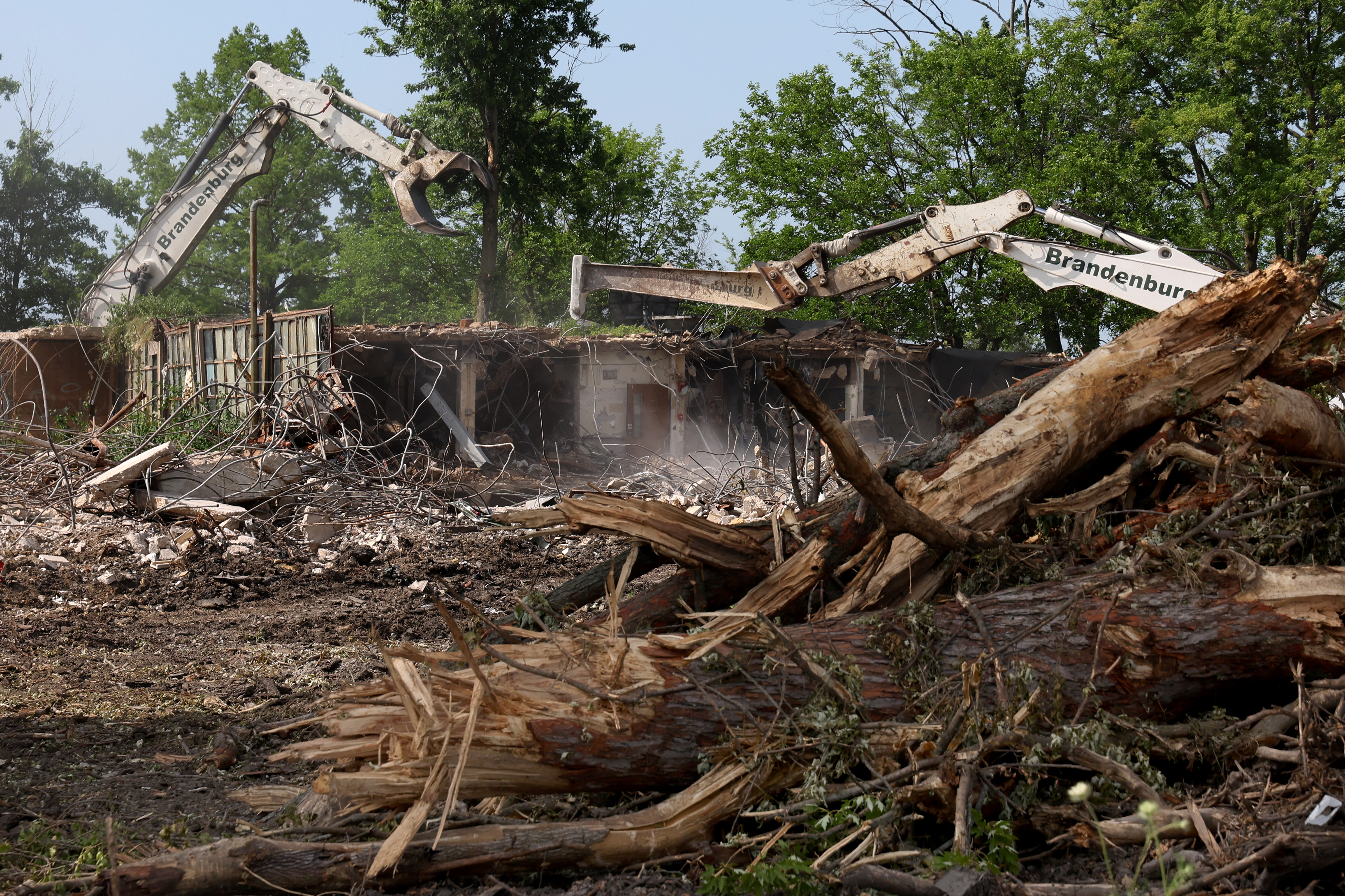
Of the 53 buildings to be demolished, 13 remain as of late June. They are set to be demolished by the end of this year, according to a district statement.
The only factors that could delay the completion of demolition would be if buildings have a deeper concrete footing in the ground or if storm water collects and causes problems, Cipriano said.
She said a tunnel system underneath the property, over 5,600 linear feet long, has presented a unique challenge in the demolition work. Around 2,500 feet of the tunnel had been removed as of mid-June.
“It’s a lot of concrete, there’s storm water that has to be managed,” she said.
Other structures are scheduled for demolition in the coming weeks, including the powerhouse, with work tentatively to start on July 6, then a water tower shortly afterwards.
The work also includes removal and proper disposal of demolition debris from the site, district officials said in the statement. They said they were conducting air monitoring to ensure the work complies with regulations and permit requirements and to ensure the safety of the surrounding community, as well as routine property upkeep.
If the district’s cleanup schedule holds, Cipriano said soil collection for the remediation of the first 90 acres could begin this Fall, and the entire process could take a year or longer.
She said the district has already received comments from the IEPA on their proposed process for remediation, which includes drilling holes and sampling soil and groundwater for contaminants. This district plans to put a bid out for this work, she said.

Though the process seems lengthy, Cipriano said the remediation program allows the district to investigate and clean up the site with the oversight of the IEPA. The program also allows the IEPA to address contaminated properties voluntarily without having to force companies later on to do the cleanup.
“It’s a process, but it’s a necessary one, and it’s one that’s designed to provide the community with the safety assurances,” she said.
O’Donovan said residents can expect a community engagement campaign to begin after cleanup is finished, during which residents and other stakeholders can submit ideas for the space through surveys, in-person and online community meetings and other methods.
Stakeholders include residents, affiliated groups such as the Tinley Park Bobcats and Bulldogs youth programs, school districts, village officials, special recreation associations, area historical societies and others, said O’Donovan.
Once that feedback has been collected, the Park District’s commissioners would have the final vote on development, along with the Remediate 280 committee, she said.
awright@chicagotribune.com