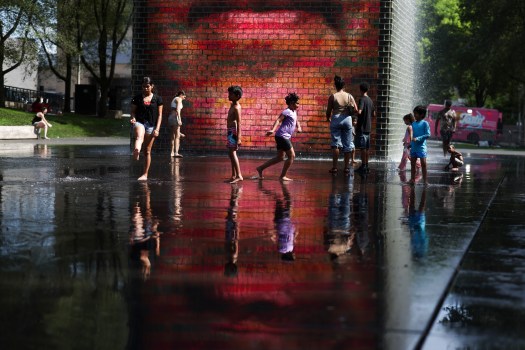
When my children and I walked into the newly opened Obama Presidential Center, a three‑story mural map of Chicago greeted us. We stood to take it in — “City of the Big Shoulders,” painted by Mark Bradford, one of many original works displayed at the center. We absorbed the colors marking the lakeshore, landmarks and neighborhoods; the train tracks that looked like stitches holding the city together.
It reminded me of Barack Obama’s words from his first inaugural address as president: “Our patchwork heritage is a strength, not a weakness.” In that moment, the mural felt less like a map and more like a mirror — reflecting the city that shaped him and the pluralistic promise he spent a lifetime urging us to fulfill.
In one of the most powerful sections of the center, the exhibits place the Obamas’ personal stories alongside the long arc of American social movements. We walked through galleries tracing the journey from slavery to emancipation, from Jim Crow to the Civil Rights Movement, from redlining to the fight for voting rights. These rooms did not treat history as distant; they braided it directly into the lives of Barack and Michelle Obama — a reminder that their rise was not an isolated miracle but part of a continuum of struggle, resilience and progress.
By placing the Obamas’ story within this lineage, the center makes clear that their journey belonged to a much larger American narrative shaped by generations of leaders and ordinary citizens who came before them. And for this South Side family, we saw how it belongs to us.
A quote there from the president’s 2008 campaign reads: “We rise or fall as one nation, as one people.” It is the kind of line that could sound aspirational — that is, until we stood in a room filled with the stories of people who believed it enough to act on it. It brings home the realization that our country’s current polarization is a stranglehold on our collective humanity — and that perhaps the only way out is when we can all breathe freely.
The first lady’s presence is felt throughout the center, which highlights her journey from a South Side girl to the White House. A video plays her words: “When they go low, we go high.” My daughter watched, and I wondered whether the first lady’s lessons on dignity, resilience and staying true to one’s values in the face of challenge resonated with her — whether she connected them to the trials she was facing in middle school, the archetypal questions of belonging and beauty that have filled our home conversations.

On the eighth floor, the Sky Room offers a panoramic view of the South Side — Hyde Park, Woodlawn, South Shore — neighborhoods that shaped the Obamas and continue to shape the city’s future. My children pressed their faces to the glass, pointing out places they knew: the Griffin Museum of Science and Industry, the lakefront and the South Side YMCA where we go for our Eid prayers.
Etched on the ceiling is Barack Obama’s speech from the 50th anniversary of the protest marches from Selma to Montgomery in Alabama. In that speech, he said, “The arc of the moral universe may bend toward justice, but it does not bend on its own.” The center invites visitors to trace that arc themselves — from Reconstruction to the Civil Rights Movement to the present — and to consider the unfinished work ahead.
Standing among these words, I hoped my children began to understand that pluralism is not simply about diversity; it is about shared destiny. Building a pluralistic America requires us to work together to actualize the values of the nation’s foundational promise. The center’s design makes clear that we are not passive observers of history; we are part of the larger story, and our individual actions etch pathways into our collective imaginations.
We ended our visit exploring the grounds and the park. Walking back toward our car, I asked my children what their favorite part of the center was. “The Oval Office and the big slide,” my son said — a reminder that he was 10, and a moment of gratitude that his life circumstances allowed him to enjoy carefree play while also imagining himself at the Resolute desk.
For my daughter, the “Yes We Can” chant screen — interspersed with images from the campaign trail and major moments from the Obama administration — was particularly inspiring.
I told them that my favorite part was all the stories we witnessed, showing us that our future is built not by extraordinary people but by ordinary people choosing, again and again, to show up for one another.
And that the story of America — the story this center enshrines — is still being written, one act of community at a time.
Jenan Mohajir is vice president of external affairs at Interfaith America, a Chicago-based nonprofit that equips leaders with the tools to respect, relate and cooperate across differences.
Submit a letter, of no more than 400 words, to the editor here or email letters@chicagotribune.com.