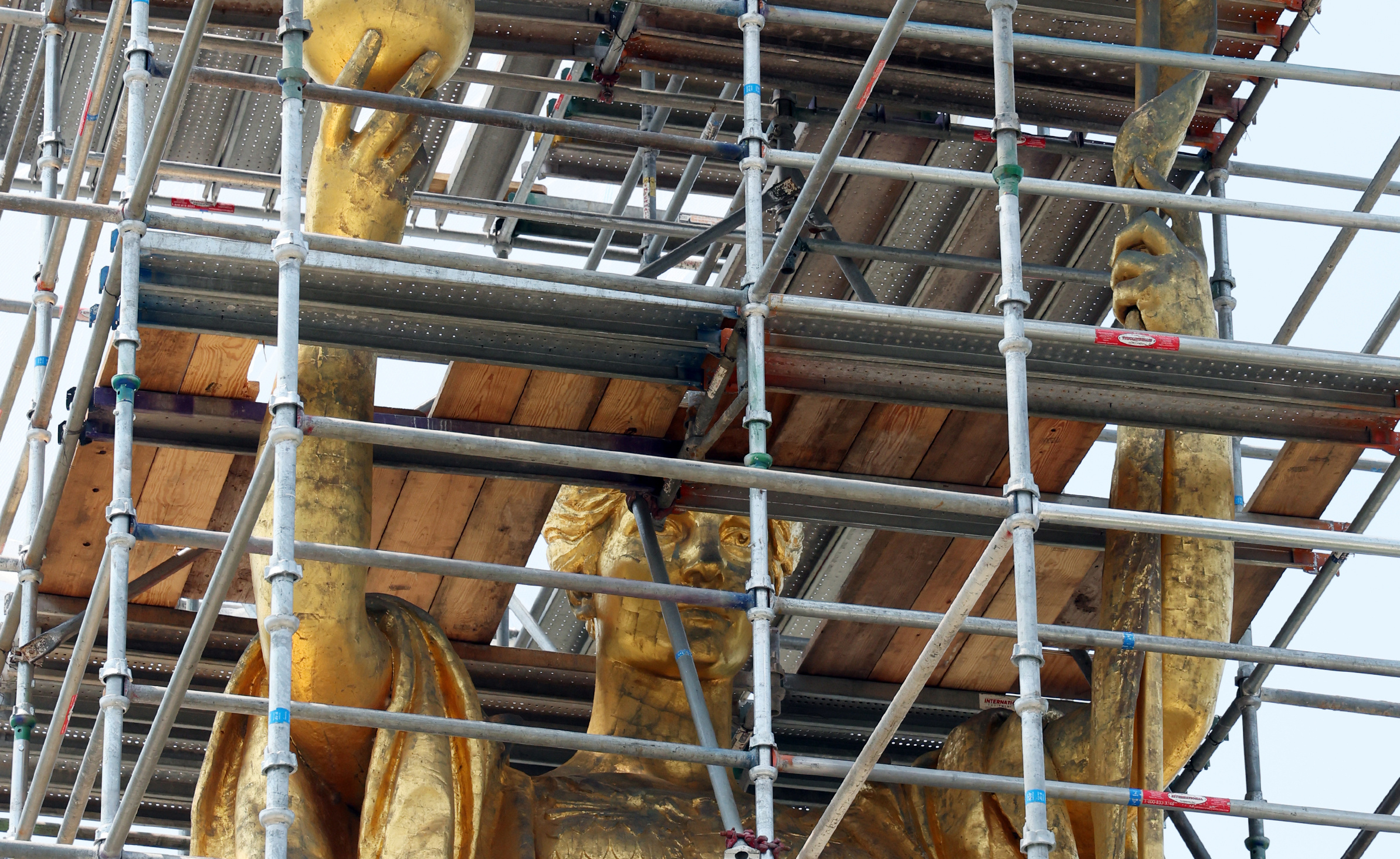

Jackson Park’s “Gold Lady” will soon shine again after a $1 million regilding and repair job.
The 24-foot-tall Statue of the Republic, which was built in 1918 to honor both the 25th anniversary of the World’s Columbian Exhibition and Illinois’ centennial, will be cleaned, repaired and regilded over the next several months, Chicago Park District officials said.
Scaffolding was installed last week, Park District spokesperson Irene Tostado said. Next, crews will strip the old gilding, laser clean and repair the sculpture. An epoxy primer, base layer, polymer base and adhesive will be applied before the new gold leaf is applied by hand.
Tostado said a second phase, including cleaning the statue’s plinth and reconstructing the surrounding plaza, is planned but not yet scheduled. The total cost for both phases will be $2.46 million.
The project fulfills one of the conditions set by a 2020 memorandum of agreement following a federal review of the Obama Presidential Center’s impact on Jackson Park and the Midway Plaisance. Along with the statue’s restoration, the agreement required the rehabilitation of the park’s English Stone Comfort Station and the planting of native trees.
The statue is a smaller, modified version of a 65-foot-tall sculpture of the same name that overlooked the World Columbian Exposition’s Court of Honor. Designed by Daniel Chester French, the original statue wore a crown of electric lightbulbs that glowed at night. In her hands, she held a globe topped with an eagle and a staff with a Phrygian cap draped over it.
French’s statue was intended to serve as a symbol of the 1893 fair, Hyde Park historian Patricia Morse said. It became a favorite attraction and some park-goers affectionately christened the statue “Big Mary.” After the exposition, some even wanted the park to keep the sculpture.
“It was this magical thing that they wanted remembered,” Morse said.
The statue, which was made of wood and plaster, rapidly deteriorated after the festival. In 1896, it was destroyed by the city’s South Park Commission.
The replica stands on the former site of the fair’s Administration Building, now the intersection of East Hayes and South Richards drives. Unlike its temporary predecessor, the statue is made of gilded bronze and is approximately one-third of the height of French’s sculpture.
The statue was last regilded in 1993 to commemorate the exposition’s centennial. Experts used knives and brushes made of squirrel’s hair to apply around 25,000 leaves of 23.5-karat gold imported from Florence, Italy.
Morse said she looks forward to seeing the refreshed statue again.
“When the sun hit her, it was kind of blinding,” she said. “It’ll be nice to have her back in that sparkling condition.”