
Chicago Public Schools’ earnest attempts to address its $732 million budget shortfall, through its proposed layoffs and midyear hiring freeze, will not keep the district from raising property taxes to the maximum again and the mayor once again raiding tax increment financing funds. It also will not end the district’s chronic annual financial crisis. Meanwhile, don’t look to the state to come to the rescue through its evidence-based funding (EBF) formula.
Illinois had its own budget gap of roughly $2.2 billion for fiscal year 2027 before passing the most recent budget. It is highly unlikely that Gov. JB Pritzker and the state legislature will rush to help close CPS’ budget shortfall, let alone fully fund the state’s formula, which the Chicago Teachers Union, CPS and Mayor Brandon Johnson are demanding.
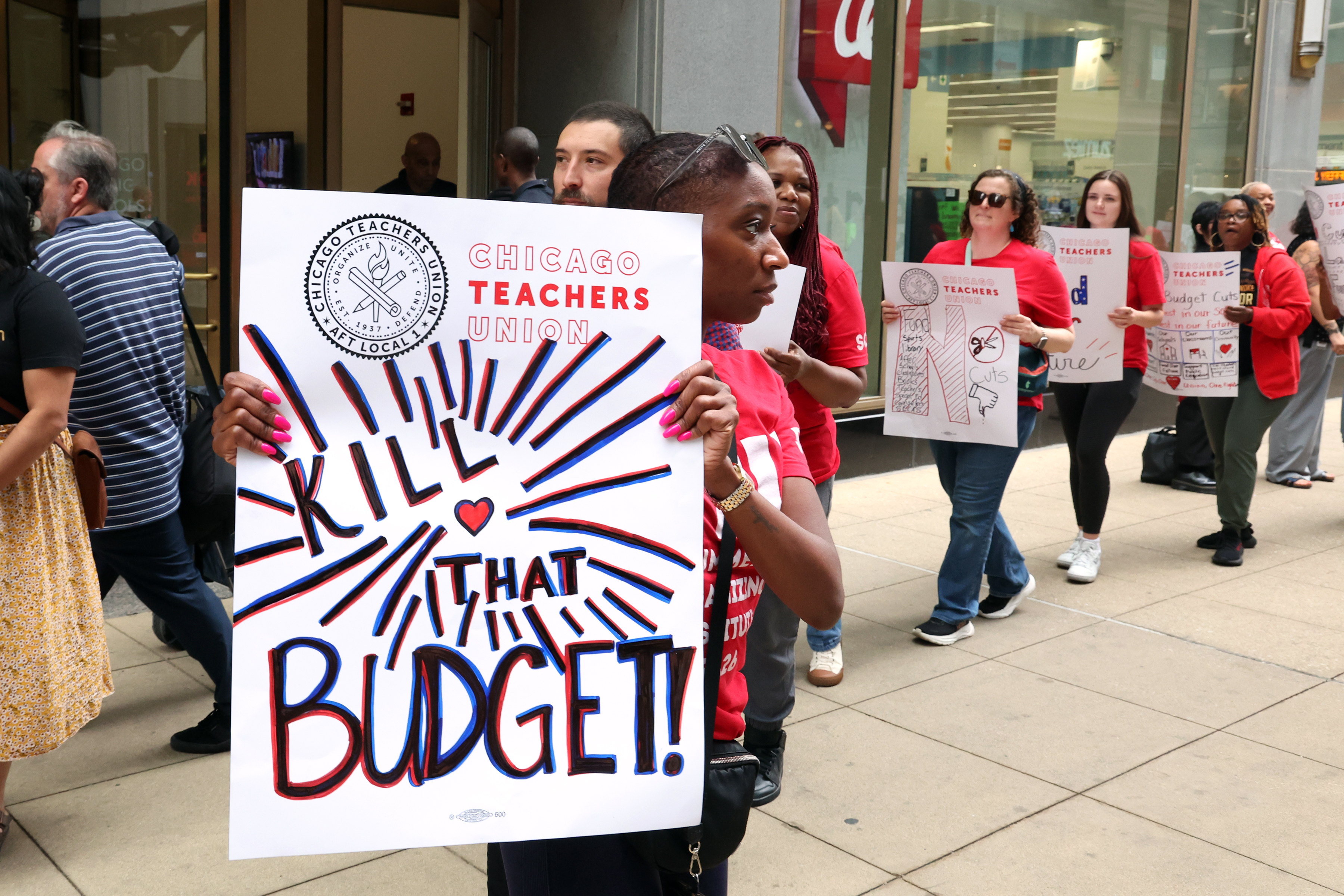
CTU President Stacy Davis Gates, now also executive vice president of the Illinois Federation of Teachers, and Johnson argue the state shorted Chicago by at least $1.6 billion under EBF. Pritzker has rejected that claim, saying fulfilling the demand would require billions in additional K‑12 funding statewide. CTU recently elevated its claim of underfunding to nearly $2 billion. That would lift CPS aggregate per-pupil spending from roughly $33,000 to nearly $39,000 per pupil.
While a state bailout through EBF is unlikely, the state can help the district in a way that is fair and does not require a corresponding investment in other school districts, by addressing the Chicago Teachers’ Pension Fund funding-equity issue. The state currently covers only about 32% of CTPF employer pension costs, while it covers roughly 98% of employer pension costs for all other Illinois districts (through the Teachers’ Retirement System, or TRS), leaving those districts responsible for only about 2%.
The state should bring its funding of CTPF into parity with what it provides to TRS-covered districts. Doing so would allow the special property-tax levy dedicated to Chicago teacher pensions — roughly $600 million annually — to be redirected to help the city’s employee retirement systems, pay the school district’s annual $175 million municipal employee pension fund payment and pay the remaining annual teacher pension contribution.
There is nonetheless an opportunity to balance CPS’ budget requiring other actions that are not unprecedented and would actually improve the quality of choices.
• Decentralize CPS’ central and regional offices — currently only about 54% of district funding reaches the schools — and return district full-time nonteaching staffing to pre-COVID-19 levels. Much of this could be accomplished through attrition.
• Embrace student-based budgeting, allocating dollars directly to schools based on enrollment and student needs, providing principals broad autonomy while holding schools accountable for spending in ways that support performance metrics and student achievement goals.
• Reject the CTU-backed “Sustainable Community Schools” model, which prioritizes keeping underenrolled and often failing schools open. Instead close, consolidate or repurpose near-empty schools.
• Expand public school choice to improve retention and attract new students by converting failing schools to quality public charter and magnet schools and expand school-based magnet programs. Charters operate at roughly a third less cost than traditional schools.
• Take advantage of state authorization to open alternative schools to reclaim those who have dropped out and are too old to return to neighborhood high schools. This would boost enrollment and state and federal financial support.
Mayor Richard M. Daley’s first schools leadership team, of which I was a part, took this approach after the Illinois General Assembly passed the Chicago School Reform Amendatory Act of 1995 to avert district bankruptcy and avoid a state financial bailout. Not only was bankruptcy avoided, but by 2002, the district had experienced 12 bond rating upgrades and had almost $1 billion in cash balances, and pensions were fully funded.
This period saw enrollment growth of almost 35,000 students after the previous 15 years had seen enrollment fall from its historic peak of 514,000 in 1979 to 404,000 in 1995. It was a period of financial stability, labor peace and academic improvement. The district received unprecedented national and international recognition. Current CTU leaders ignore this period’s considerable successes, misleading its members.
There is also an opportunity to expand district resources by taking full advantage of breakthroughs in artificial intelligence and opting into the new federal scholarship program — two initiatives that will face CTU resistance.
Meanwhile, Illinois participation in the federal tax credit scholarship program could generate hundreds of millions of dollars for families — not only for private school tuition but also for tutoring, special education, transportation and many other school-related support expenses. Some estimates suggest such a program could potentially generate hundreds of millions of dollars in resources to both public and private school families statewide.
Real financial accountability is unlikely while CPS leadership and CTU continue doing business as usual. CPS bureaucrats maintain central control, and the CTU relies on that centralized structure to enforce expansive contracts. Pritzker should reestablish the Chicago School Finance Authority, which from 1980 to 1996 provided independent fiscal oversight, ensured fiscal discipline and helped stabilize CPS during a prior financial crisis.
Meanwhile, there is a real possibility that the CTU may lose its dominance over the new school board.
As of early this year, the union’s popularity had fallen to a record low, with just 27.5% of Chicago voters holding a favorable opinion. At the same time, CTU’s heavy-handedness caused a souring of its relationship with its strongest union ally, the Service Employees International Union. This shift would make it easier to craft more responsible budgets and might prompt Pritzker to opt into the federal tax credit program.
Paul Vallas is an adviser for the Illinois Policy Institute. He ran for Chicago mayor in 2023 and was previously budget director for the city and CEO of Chicago Public Schools.
Submit a letter, of no more than 400 words, to the editor here or email letters@chicagotribune.com.