
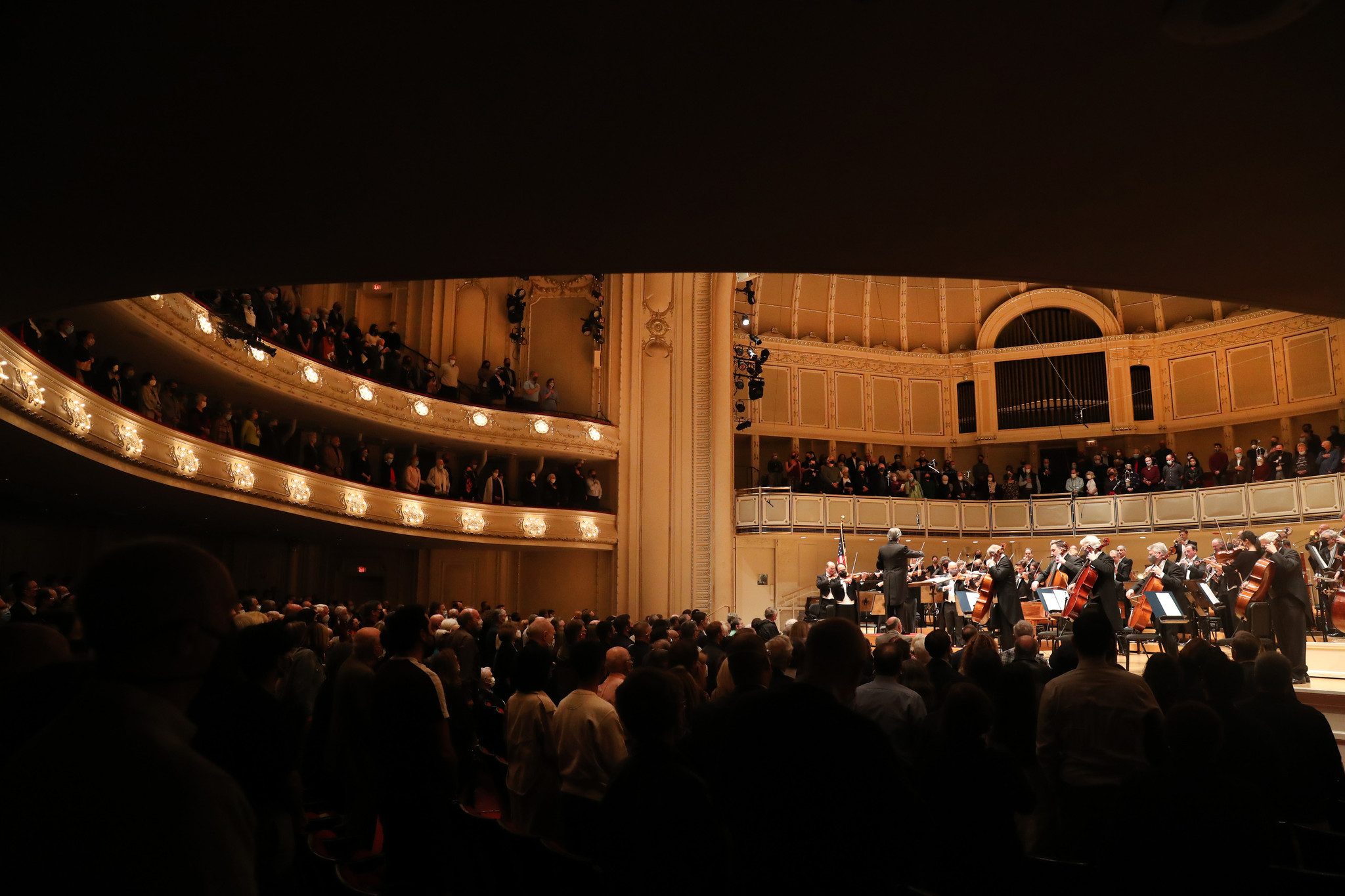


Dickens’ specters would have been right at home at the Chicago Symphony Orchestra’s 2021-22 season opener.
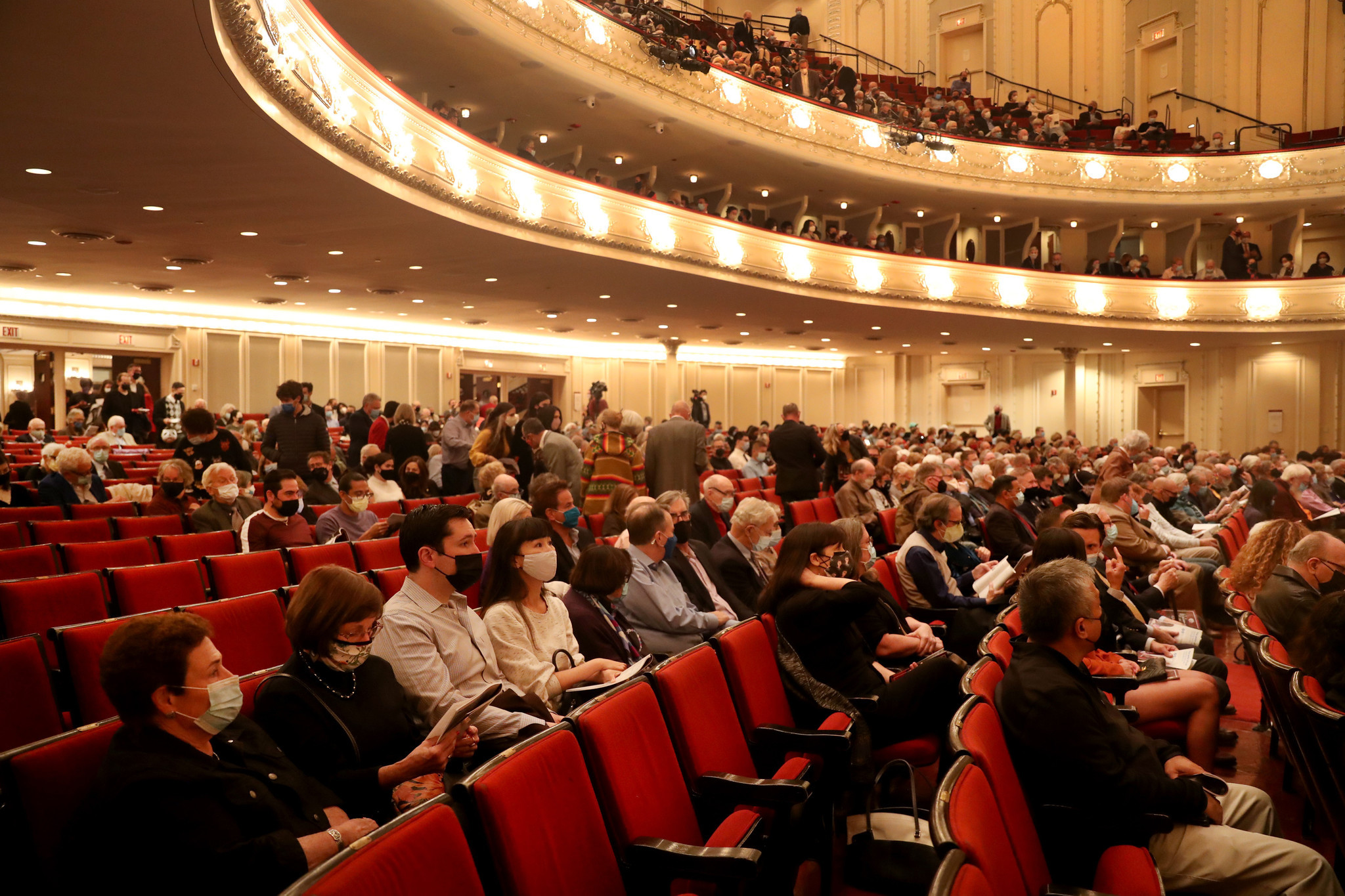
With a full orchestra and even fuller house, Thursday night’s concert felt more in the spirit of a proper opening night than the brass-only comeback the orchestra wrangled back in May. Even so, looming over the festivities were the ghosts of a traumatic past and an uncertain future — the CSO very much included, its season programming largely plotted only through the end of the year.
At the juncture of those crisscrossed eras is CSO music director Riccardo Muti, taking the podium that night for the first time since February 2020. Just hours before, the CSO had confirmed what many suspected: The conductor, who turned 80 in July, would recoup a season lost to the pandemic but no more, making this still-sketchy season his penultimate with the orchestra.
Which leaves the present. How on Earth to begin to address that?
Even Muti, usually unreserved in his speeches to audiences, acknowledged how difficult it was to find words for what had transpired since the last time he’d stood in Orchestra Hall. He dedicated that evening’s performance of Beethoven’s Symphony No. 3, “Eroica” to his heroes of the pandemic — that is, all artists who “couldn’t communicate the richness of their lives” during lockdown.
“You’re not here tonight because you didn’t know what to do with your evening,” Muti remarked with droll understatement. “You came here because you needed to hear music.”

Some things don’t change, even if we do. That’s the hero’s journey, after all — one “Eroica” renders through mercurial struggle and disorienting shifts. As the evening’s program notes pointed out, the widely embraced story behind the symphony’s title (that Beethoven originally dedicated it to Napoleon but angrily changed his mind once the tyrant showed his true colors) is a little more complicated than some idealists might hope. But after some equivocation, Beethoven roundly rejected Napoleon soon enough. “It’s a pity I do not understand the art of war as well as I do the art of music. I would conquer him!” he reportedly grumbled in 1806, three years after completing the “Eroica.”
That pugnacious Beethoven certainly wasn’t the protagonist of Muti’s reading on Thursday night. This was an “Eroica” with a slower burn, wading in reservoirs of coiled energy for much of its hourlong duration. In some ways, then, Muti’s preamble showed his hand: This was an “Eroica” that reflected the last year rather than redeemed it. No wonder it most took root in the funeral march, even at a tempo more excruciatingly dirgelike than Muti’s previously recorded takes with the Philadelphia Orchestra and Filarmonica Della Scala. The moment triplet figures churn in the low strings as brass wails overhead — an uncanny collision of climax and transition — landed on the ears as a shared cry.

Emphasis on the “shared”: If there was a protagonist in this interpretation, it was Muti’s next-to-telekinetic rapport with the CSO musicians. It’s been just two years since orchestra and director last united to perform “Eroica,” in September 2019, but what a long two years it’s been. For its mixed interpretive results, Thursday’s concert collapsed that span like an accordion file.
Speaking of silenced heroes: Works by 18th century virtuoso Joseph Bologne, Chevalier de Saint-Georges and symphonist Florence Price — two Black composers belatedly getting their due on the programs of major American orchestras — preceded the evening’s “Eroica” and often eclipsed it. A tight band of CSO musicians performed the overture to “L’amant anonyme,” Saint-Georges’s only complete surviving opera, with velvety plushness, even if Muti’s stately interpretation stood to buff the work’s most gleaming moments a little more.
But of the two preludes, Muti seemed most at home in the sumptuous soundworld of Florence Price, whose Symphony No. 1 in E minor became the first symphony by a Black woman to be performed by a major American orchestra when the CSO premiered it in 1933. Despite the milestone, Price has been celebrated inconsistently at best in the intervening years, though a 2009 discovery of a cache of her manuscripts at a house in Downstate St. Anne helped kick-start a new wave of performances of her work.
Less directly acknowledged by the CSO is its own contribution to the decades-long oversight — at least until recently. Muti was to lead the CSO in Price’s Symphony No. 3 in April 2020 but for the pandemic; the program book noted tentative plans for Muti to make up that performance next May, the first time a Price symphony will be performed in full by the orchestra since, well, 1933.
Price’s Andante moderato — a string orchestra arrangement of the latter movement of her String Quartet in G — was similarly new to the orchestra. The movement could have had all the hallmarks of an awkwardly excerpted inclusion, but Muti imbued Price’s Andante with all the gravity of a stand-alone work — a hitch of breath at the end of the first phrase, the mysterious mists of a nottorno-like middle section, a poignant return of the first theme, then the achingly delayed catharsis of the strings’ final murmur. Were only that it lasted longer, and that May could come sooner.
Yes, the CSO is back — with all the requisite asterisks and crossed fingers that our present moment demands of us. But beyond the momentousness of the occasion, by arranging these works side by side, Thursday’s concert touched on something potent — namely, that the past is a terror, but also a beacon. Just ask Saint-Georges and Price, who speak as boldly now as they did in their respective centuries.
And the “Eroica,” that most canonical of works? Embedded in the turbulence is some bittersweet solace: We can always change, even if we loathe the person we were yesterday. May we keep transforming.
The program is repeated 8 p.m. Sept. 25 in Orchestra Hall at Symphony Center, 220 S. Michigan Ave.; 312-294-3000 and cso.org
Hannah Edgar is a freelance writer.
The Rubin Institute for Music Criticism helps fund our classical music coverage. The Chicago Tribune maintains complete editorial control over assignments and content.


