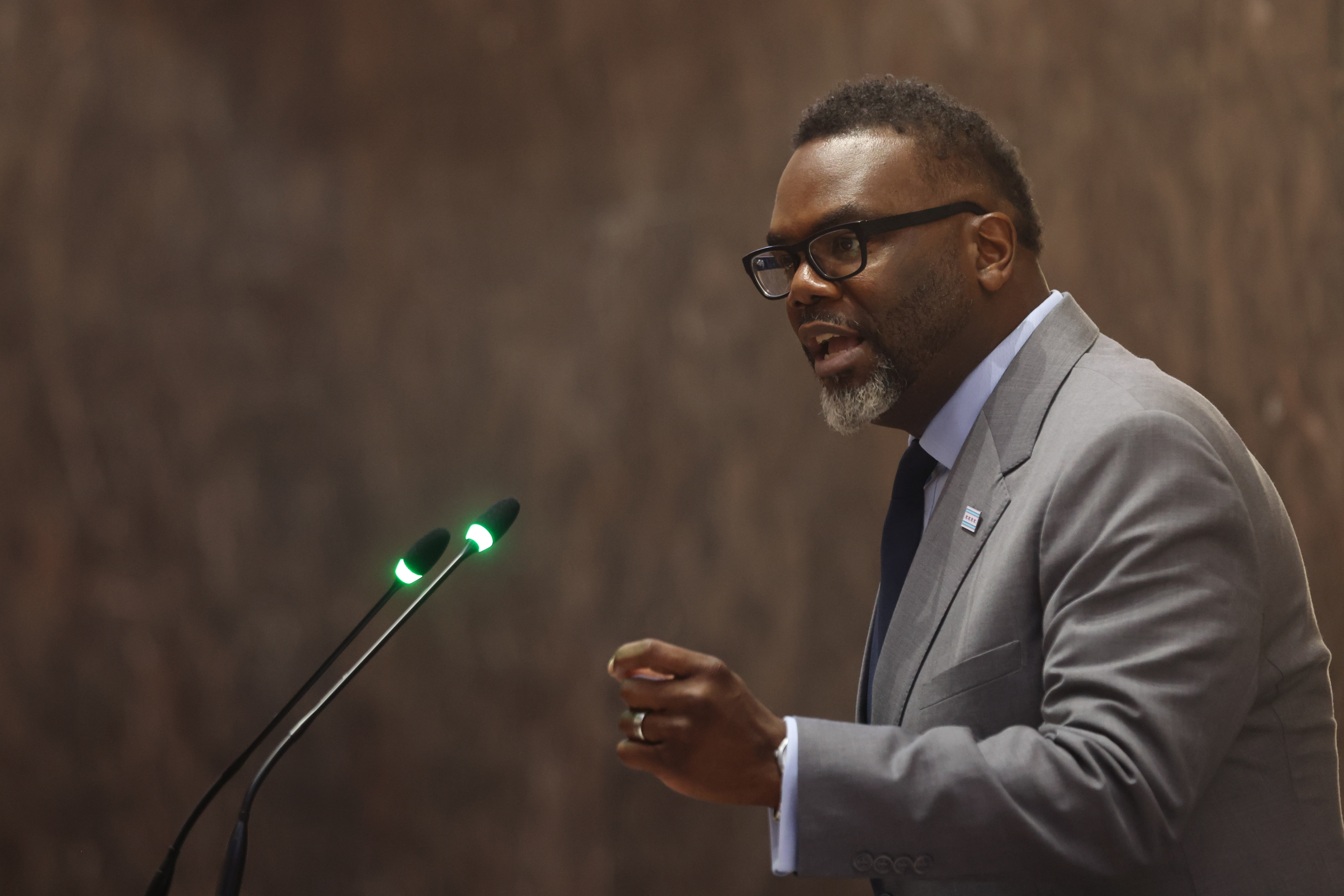


Mayor Brandon Johnson announced Monday he is not attending his administration’s trip to the U.S.-Mexico border later this week, a reversal he said stems from having to address the “urgency” of the growing migrant population in Chicago.
Instead of Johnson heading the group, Beatriz Ponce de León, Chicago deputy mayor of immigration, will lead a delegation, which is scheduled to leave Tuesday for the Texas cities of El Paso, San Antonio, McAllen and Brownsville, according to a statement from the mayor’s office.
The announcement came as another discussion about asylum-seekers unfolded in City Council chambers, with increasingly frustrated aldermen discussing Johnson’s budget plan for next year and noting the pressures the new migrants have placed on the city’s social safety net.
“The Mayor, along with senior aides and key operations personnel, will stay in Chicago to address the immediate urgency of adding shelter space to house thousands of new arrivals sleeping in police stations, airports or outside,” the statement on the border trip read.
Johnson had said he would visit the border himself during previous remarks to reporters but declined to say when, noting he had a busy schedule as mayor.
“I am going to the border as soon as possible,” he said two weeks ago in a post-City Council news conference. As recently as last week, his deputy chief of staff, Cristina Pacione-Zayas said the mayor’s trip was still on, with the No. 1 goal to clinch tighter bus coordination with Texas officials.
“It wouldn’t be right if we did not let folks know the limitations that we have when we do not receive information in advance,” she told reporters in a briefing last Thursday. “That’s our objective, is to say to them: ‘Look, here’s what we’re managing up here.'”
Chicago has welcomed more than 18,500 migrants since August 2022, when the first bus of asylum-seekers from Texas arrived in the city after they made the dangerous trek across Central America.
Since then, with the support of Republican Gov. Greg Abbott, along with other officials in Texas and southern border states, more than 400 buses of migrants have arrived in Chicago. Chicago police stations are bursting with more than 3,300 of asylum-seekers sleeping in their lobbies, with another 550 at O’Hare International Airport, as well as many outside.
Johnson is in a race against time before temperatures drop significantly to prop up tents across the city as part of his strategy of establishing giant base camps to house new arrivals instead of the police station and airport floors. One spot on the Southwest Side is now being prepped to as a possible location. Meanwhile, the city is fast running out of funding to keep up with the escalating crisis while state and federal partners have not provided more quick access to funds.
Besides Ponce de León, a small group of “city, state, faith and philanthropic leaders” will join her to learn more about the sites where migrants are being sent to Chicago and hold talks on how the burden on Chicago can be lifted.
The mayor’s senior aides will stay behind, however. Some facts the delegation plans to share include the extreme housing and weather conditions, as well as the challengers of getting a verified sponsor.
“A point of emphasis will be establishing better lines of communication and collecting migrant data to expedite work authorization processing and the transition to self-sufficiency,” the statement read.
Meanwhile, questions about the cost to mitigate the migrant crisis dominated the first day of hearings on Johnson’s proposed 2024 budget, where the mayor’s top finance officials seemed to acknowledge a high unlikelihood about extra state funding being approved during the fall veto session.
As it stands, Johnson’s proposed $150 million budget for migrant services spending in 2024 will be paid for with money from the city’s corporate fund. Budget director Annette Guzman said the plan is to continue lobbying state and federal officials for more money and other resources. They expect the full spend on migrant services by the end of this year to top at least $300 million.
“We are still going after both state funds and federal funds. We’re actually in contact with the federal government right now for additional funding this year,” Guzman said, a request they plan to continue to make “into next year.”
“Since buses began to arrive from the border to Chicago last year until August of this year, we have spent over $150 million in aid of this mission, with over $130 million of that spent in this year alone. But the majority of the costs have been reimbursed through funding received from other sources to date,” Guzman said. “This year, the city has received resources totaling just over $170 million to cover costs associated with the new arrivals mission.”
“My concern and a lot of my colleagues’ concern is, really, what will we do if we don’t have the funds? I think we’ve been fortunate thus far to be able to get reimbursed for some of the stuff that we’ve already been spending. It doesn’t feel very responsible of us to continue to do that,” said Ald. Nicole Lee, 11th, noting there were 200 to 300 people sleeping at the 9th District police station near her home.
Ald. Emma Mitts, 37th, asked more bluntly: “What’s the plan?”
“To continually go after additional resources at the federal and state level,” Guzman replied.
Representatives from the city’s Council Office of Financial Analysis and some aldermen asked that the city create a dedicated migrant services fund to allow the public to track spending.
“All this new arrivals stuff is in lots of different places, right?” asked Ald. Pat Dowell, 3rd, and chairwoman of the Finance Committee. “I want you to give us a new arrival budget. I want to know the program, I want to know the amount, I want to know staffing, and the source funding, so it’s all in one place and we’re not searching under rocks to find where all this money is.”
Guzman pledged to provide those details.
Ald. Walter Burnett, 27th, said he worried the 13 new positions created to work on the new arrivals mission in the Department of Family and Support Services were coming at the expense of positions dedicated to helping residents returning from prison or jail.
“How are you going to put 13 permanent positions in for new arrivals and no permanent positions in for returning residents?” he asked, noting the staffing for the latter would be paid for with federal American Rescue Plan Act money, which will run out by 2026.
Guzman said there were two budgeted positions for returning residents and “a lot of funding” going to delegate agencies. The new arrivals positions will report to the managing deputy of homeless services “to build capacity across the board, not just for new arrivals but for all of our services that are provided to the unhoused,” she said.
“We need some positions for returning residents so we can have a full operation to be able to help deal with these people and help them to get reincorporated into our society, more so than these new people coming to our society who haven’t been here, right?” Burnett said, threatening to withhold a yes vote if more wasn’t dedicated to returning residents. “We need to help ours too.”