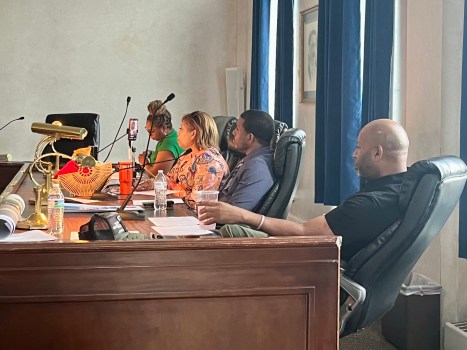


Less than a year on the job, Darren Bryant, the 30-year-old mayor of economically struggling Robbins, wants to mend fences with the village’s police along with mending a crumbling infrastructure.
Streets and sewers are in poor condition, as they have been for years, and the high school teacher, elected mayor last spring, knows there is not enough money coming into from property taxes and sales taxes to fix everything.
While residents of many south and southwest suburbs take a grocery store in their community for granted, that’s not the case in Robbins.
“Having a grocery store is a high priority here in town,” Bryant said. “It’s a food desert.”
And it’s not just groceries that make Robbins residents go elsewhere, such as neighboring Crestwood or Alsip, to do their shopping.

About $28 million a year is spent by village residents at stores outside of Robbins, according to the Chicago Metropolitan Agency for Planning.
But along with groceries, another basic necessity people in any community expect to have is adequate public safety, and relationships between Robbins’ police and the village’s administration have been strained, including before the new mayor took office.
Last October, for a brief period, Cook County sheriff’s police were called to patrol Robbins after officers walked off the job over issues including pay.
Robbins starts officers, all of whom are classified as part-time employees, at $11.50 to $12.50 an hour with no benefits. The village has offered to increase starting pay to $15.25 an hour.
Patrol officers, sergeants and commanders are represented by the Illinois Council of Police, and negotiations have been on and off since the union’s prior contract lapsed in 2020.
The union is awaiting the village’s final contract offer, which the members will vote on. If it is rejected, the union can ask for arbitration or mediation, according to Detective Cmdr. Hurman Mathus, who is also a union representative for the police.
Bryant said he believes both sides are close to coming to terms.
“They are coming to work each day, morale is strong,” the mayor said. “They’ve serving and protecting.”
Mathus disagrees that morale has improved, but said officers continue to report out of a sense of duty.
“We all do it because we love the job, we love being police,” Mathus said.
Bryant said Robbins will tap into $360,000 in federal COVID-19 stimulus money to provide the pay increase to officers, but those funds won’t help in the long term.
“It’s a cushion for us, it will help get us started,” Bryant said. “We are nowhere near the amount of pay where we should be (compared) with other communities.”
In the past, the department had as many as 30 officers on the street, but that has dwindled to about 20, Mathus said. Because of their part-time status, virtually all of Robbins’ patrol officers work other jobs, either with other departments or as hired security officers, he said.
“We’ve got people jumping ship, and rightfully so,” he said.
Mathus said he is one of three detectives who have been pressed into doing regular patrol of village streets, at the expense of has investigating outstanding cases.
“If we’re working patrol we can’t work cases,” Mathus said. “We can’t do both.”
Although the village is crying poor in contract talks, Mathus said he believes salaries can be boosted beyond what has been offered.
“We all believe there is more money that can be given,” he said. “You don’t have to pay us millions, but at least pay us what we’re worth.”
Looking to 2022
Bryant, who teaches physical education and health at Eisenhower High School in Blue Island, said he is juggling many different priorities, including shoring up relations with police, repairing crumbling infrastructure such as streets and sewer lines, and bringing in more retail.
“We need economic development, we need people coming into town,” he said.
Bryant said the village has secured $4 million in grants to help rebuild water lines and is talking with a developer about commercial development, including a grocery store.
“We are on the brink of an economic boom,” he told residents in a Jan. 20 state of the village address, calling 2022 “a historic year” for the village.
“We have to establish a well-oiled government first to effectively serve the people,” he said in the address, calling village trustees the “most united board that Robbins has seen in at least 20 years.”
Robbins’ 2020 population was a bit more than 4,600, down about 13% from 2010 and down by nearly a third compared with 2000, according to the Chicago Metropolitan Agency for Planning, citing sources including the U.S. Census Bureau.
The median household income in the village is $27,209, compared with a median of $64,660 in Cook County and more than $73,500 in the seven-county area the agency serves.
Bryant said the village’s property tax levy is about $800,000, but the village collects about half that.
He said there are about 1,200 village-owned and tax exempt parcels Robbins has been working to offload, but many other homes are off the tax rolls due to exemptions.
In 2017, the Illinois General Assembly approved tax breaks that boosted the homestead and senior homestead exemptions.
While beneficial for many homeowners, the beefier exemptions resulted in dropping the value of homes to less than they’re worth, based on equalized assessed valuations used to calculate tax bills. The 2008 recession didn’t help, as it had already resulted in sharply lower home values, particularly in the south suburbs, a study by Cook County Treasurer Maria Pappas showed.
Homeowners benefiting from the increased exemptions ended up not having to pay anything in property taxes or in some cases got a refund of what they had paid, with hundreds of properties in the south suburbs essentially dropping off the tax rolls, according to Pappas’ study.

Another challenge, Bryant said, is working to resolve an outstanding $14 million debt to Chicago for Lake Michigan water.
“Currently, I don’t know that resolution,” he said in his address, but the village is in talks with Chicago on the issue.
Spurring development
On the economic development front, a company, Sustainable BioWorks, is looking to use the hulking and dormant trash-to-energy incinerator in Robbins to convert expired and recalled food into sellable products such as renewable natural gas and fertilizer.
The property, 13400 Kedzie Ave., operated for about three years as an incinerator converting garbage into power, shutting in September 2000.
The project is expected to create about 250 temporary construction jobs and 135 permanent positions in areas including engineering, operation and management, according to the company. The company estimates, once the plant is operating, it will generate about $700,000 in property taxes for Robbins.
Bryant said he has not had recent discussions with the developer about the plans, which were presented last year.
The village fully endorses a $12 million project being headed by CMAP and the Water Reclamation District of Greater Chicago to create what is being called “Robbins Park,” Bryant said.
The twofold project aims to reduce flooding that has plagued homeowners by creating a large retention pond, while at the same time opening up land now in the Calumet-Sag Channel flood plain for recreational use and redevelopment.
Part of the project aims at spurring transit-oriented development near the village’s Metra station on 139th Street east of Kedzie Avenue, on Metra’s Rock Island Line.
Other south and southwest suburbs have embarked on similar developments near commuter rail stations, mixing apartments with commercial uses. The idea is that people will live within walking or biking distance of a rail station to commute downtown, which is feasible for only so many months of a year due to change in seasons.
However, CMAP noted in a study of village transportation assets, many streets near the Robbins train station lack sidewalks.
Separately, Bryant and Robbins police Chief David Sheppard said Friday they are banning a suburban newspaper publisher, Cornel Darden, from Village Hall following an incident Tuesday in which he allegedly threw a cup of coffee at a wall in the mayor’s office.
Darden, accompanied by his wife, Erica, entered Village Hall demanding that the village approve a work permit for a developer with questionable past dealings, according to the village. Darden is owner of The Southland Journal.
Bryant was contacted and came to Village Hall, where he was “aggressively confronted by Darden who yelled numerous expletives towards the mayor” and other village employees, according to a village news release.
Darden and his wife disputed some of the allegations, and vehemently denied he threw a cup of coffee.
They said they are trying to get a permit for a developer to build a house for the couple and their four children on property in Robbins, but that the permit has been denied.
“I know the conversation got heated,” Cornel Darden said.
Erica Darden said that the meeting with Bryant “lasted maybe two minutes,” and that “there were no expletives thrown until the very end off the meeting.”
“He is embellishing the story a lot,” she said.
She and her husband said they planned to attend the next Village Board meeting.
“I don’t know how you can bar someone from a public meeting without a court order,” he said.
mnolan@tribpub.com