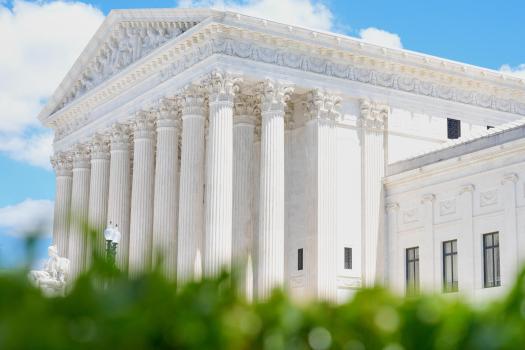
After 17 years as Chief Justice of the United States, a position notable for its intellectual demands and often brutalizing workload, Warren E. Burger has stepped down to take on what may be an even tougher job–getting Americans to think more deeply about the fading five-page document that has immeasurably shaped their lives.
That document, the U.S. Constitution, is about to celebrate its 200th birthday, an event that has crept up on us the way birthdays will when the honoree is someone whose magnificent services are obscured by a quiet, unassuming nature. For the nearly two centuries that the Constitution has been on the job protecting personal liberties, it has done its work so well, yet so unobtrusively, that we have tended to overlook it.
Now, having already partied long and hard to mark the 200th anniversary of the Declaration of Independence and the 100th anniversary of the Statue of Liberty, we Americans are being asked to get the good china out one more time to pay tribute to the Constitution. The response has been somewhat lethargic, a fact that saddens Burger, who since September has been full-time chairman of the Commission on the Bicentennial of the United States Constitution, which is overseeing the upcoming celebration.
”There`s something to the argument that the country is getting a little burned out with historic festivities,” admits Burger, who was interviewed recently in the sumptuous chambers in the Supreme Court building that he occupies as a retired Chief Justice. ”One of the reasons this enterprise has had such a slow start is that we couldn`t get out from under the shadow of the dramatic business of rebuilding the Statue of Liberty.
”Of course, the statue had a very concrete meaning,” Burger said. ”Lee Iacocca told me when we were visiting together last July 4th that 41 percent of the citizenry are either themselves immigrants or their parents or grandparents were. I`m in that category myself. My grandfather Burger came from Austria. That gives the Statue of Liberty and Ellis Island quite a pull on people`s imaginations and emotions.
”There`s no real pull on the imagination and not much on the emotions with the Constitution. Piece of paper is all it is,” Burger concedes.
And yet, that`s the challenge that excites Burger. To make people feel passionate about this abstraction, this bit of ink inscribed on parchment that has managed to hold an incredibly diverse society together for two centuries on the strength of common consent and nothing more.
”It troubles me that the average citizen has very little conception of what the Constitution is all about,” says Burger. ”And I wouldn`t just say the average citizen. I`m astonished sometimes at how little we all have thought about it. As a practical matter, as a lawyer in general practice for 20 years I had only one case in all that time involving the federal Constitution. So it`s a little like good weather, or good health. You take it for granted.
”Of course, that`s a tribute to how well it works. When your car is working, you take it for granted. But when the carburetor gets too lean and it stops in traffic, or you get a punctured tire, then you suddenly discover this is a mortal machine.”
In Burger`s view, just as it is hard to be an atheist in a foxhole, so it is difficult to be indifferent to the Constitution when your human rights are being trampled. He cites as a case in point American newsman Nicholas Daniloff. Daniloff, Moscow correspondent for U.S. News & World Report, was arrested last August by the Soviet KGB on what most people believe were trumped-up espionage charges, apparently in retaliation for the FBI`s arrest of a member of the Soviet mission to the United Nations on spying charges. Daniloff spent two weeks in Moscow`s notorious Lefortovo prison while the world gaped at the Kremlin`s cynical distortion of criminal procedure and the right of due process.
Not long after Daniloff was released last September, he and Burger appeared on the same lecture platform. ”You could see he hadn`t gotten over the strain yet,” Burger recalls. ”It showed in his face. He knew from his experience as a journalist over there how some people never left the prisons. But how they could do the same thing to an American was harder to comprehend. Anyway, he said to me that he had never really paid much attention to the U.S. Constitution over the years, except the First Amendment, which guarantees freedom of the press. But when he was lying on that hard bench in that Soviet prison, trying to sleep without a blanket, he began to think very profoundly about the rest of it.”
Seeing Daniloff reminded Burger of an incident that had occurred a number of years before when he was introduced to the late Soviet Premier Leonid Brezhnev during a visit to the Soviet Union. Beaming proudly, Brezhnev presented Burger with a copy of the newly revised Soviet constitution.
”It was as thick as the Washington, D.C., telephone book,” recalls Burger with a chuckle. ”As Brezhnev handed it to me, he kept saying, `Just like yours, just like yours.` And it`s true, it had all kinds of things in it about freedom. But, of course, you know what they do with it.”
It was the memory of that occasion that caused Burger to give Daniloff a copy of the bicentennial edition of the Constitution with the following inscription: ”For Nicholas Daniloff. You have seen and felt the difference.” Most of us, on the other hand, will never spend a day in Lefortovo, will never have the extra incentive that Daniloff had to reflect more thoroughly on the democratic heritage of the American people. It is at us that the bicentennial is aimed.
”I`ve been asked several times, `Why have bicentennials at all?`
” confides Burger. ”I answer that if a free people doesn`t stop and look back from time to time and find out where they came from and how they got where they are, they take a risk of losing everything. That`s what these occasions are. It`s a little bit like what people do on Sundays. They go back and repeat a lot of things that they`ve said many times before.”
Burger`s philosophy of how properly to commemorate the Constitution differs considerably from the conduct of previous centennials and
bicentennials, which emphasiextravaganza, including fireworks, Tall Ships and, in the case of the Statue of Liberty, a stageful of Elvis Presley impersonators.
”I want to see us emphasize cerebration rather than celebration,” he says. That means the keystone will be education, what Burger calls ”a history and civics lesson for all of us about a living document that affects the way we live and govern ourselves today.” Throughout the next several years, therefore, there will be such events as a National Bicentennial Writing Competition for high school students on the subject of ”The Constitution: How Does the Separation of Powers Help Make it Work?”; a traveling exhibit that will include one of the four originals of the 13th Century Magna Carta and copies of the Mayflower Compact, the Northwest Ordinance and the U.S. Constitution; a series of constitutional exhibits sponsored by the National Archives; a ”Blessings of Liberty” poster series sponsored by the American Historical Society and the American Political Science Society; a series of commemorative stamps by the U.S. Postal Service; and a mock trial program and college seminars sponsored by the American Bar Association.
We hope these things will get people thinking about these matters a little bit more,” says Burger. ”The traveling trailer truck, for example. We hope as it goes into each town the local press will pay some attention to it and local TV and radio will have people on the air talking or even arguing about what it means. All to the good.”
Burger, for his part, is maintaining a speaking schedule that would tax a far younger man (he is 79). He has criss-crossed the country speaking on behalf of the bicentennial. In one two-week period last December, he spoke to Chicago`s Commercial Club, the Economics Club in Washington and the International Association of Radio and Television Artists, and he participated in a national teleconference before 17,000 schoolteachers in which he and three other members of the bicentennial commission were interviewed on stage by public broadcasting`s William Moyers. The travel severely ate into Burger`s Christmas holiday.
All of these activities are in addition to this year`s main event, the special ceremonies on Sept. 17 in Philadelphia that will mark the 200th anniversary of the signing of the Constitution by the Constitutional Convention, which spent the spring and summer of 1787 hammering out the document that British Prime Minister Gladstone once called ”the most wonderful work ever struck off at a given time by the brain and purpose of man.”
Similar special events will follow over the next several years. The bicentennial celebration has been divided into four parts: 1987 covers the writing and signing of the Constitution; 1988 the 200th anniversary of the Constitution`s ratification by the 13 original states; 1989 the formation of the federal government under the new Constitution and passage by Congress of the Bill of Rights, events that took place in 1789; and 1990-91, the 200th anniversary of the ratification of the Bill of Rights by the states.
Burger is convinced that the 55 men who gathered in Philadelphia that May two centuries ago were giants such as the world had never seen assembled in one place before.
”There never was a body of 55 men who were more extraordinarily gifted. I`d challenge anybody to find such a group, especially when you consider that they were drawn from only 2 or 3 million people living in the U.S. then. A lot of them had dubious literacy. There were a number of recent immigrants, as well as people who were fourth-generation descendants of the first settlers, but all of them, to have had that kind of brilliance and foresight. . . .
”At least a half-dozen or more of these delegates were people who knew thoroughly the history of Greece and Rome, and the ancient philosophers and their thinking, and they knew the French thinkers and philosophers, and they knew what had occurred in England during the Enlightenment, particularly the Scottish Enlightenment. These are things we don`t pay as much attention to today, I`m afraid. But they were well acquainted with it all.
”And yet,” says Burger, ”the system that they came up with, our Constitution, was absolutely and totally unique. There had never been anything like it before.
”It`s been suggested to me that it was synthesis of prior ideas, that it was a little like an artist combining prior art. There is a little bit to that analogy, but it`s limited. There was no prior art in terms of governing a whole country. There was prior art in a limited sense, since some of these ideas of separation of powers had been talked about, but they hadn`t been worked out on the scale that they were contemplating at Philadelphia.”
Nor would they have perhaps been put into practice, Burger notes, had it not been for the strained political situation among the 13 former colonies, brought on by the failure of the Articles of Confederation.
”At the end of the Revolutionary War,” says the former Chief Justice,
”when the Battle of Yorktown was all over and our British friends had surrendered with the encouragement of the French fleet offshore, what happened to our alliance under the Articles of Confederation was just what has happened to every other alliance after every other war in history. The allies began to go their own ways.
”The Articles of Confederation didn`t give us a nation. If you look at those articles, you`ll find that the language really is cast in terms of a multilateral treaty, using phrases like `a firm league of friendship,` with each state preserving its sovereignty and independence. So what we had was 13 allies fighting a war against England, and they began to fall apart very quickly.
For example, cites Burger, ”trouble between Maryland and Virginia began in 1784, within only a year of the Battle of Yorktown. They were having a terrific battle over commercial use of the Potomac and Chesapeake Bay. They weren`t about to enter war with each other, but they had one big row. There were some other states that were treating citizens of other states as aliens, as though they had come from France or whatever. Each of the states had its own currency system. The states were free to set up tariff barriers, so we could have had a whole protectionist system; in fact, we partly did.
”So George Washington finally got these hotheads from Maryland and Virginia down to Mt. Vernon and cooled them off. But all these fellows who had been involved in the war, from Washington on down through Hamilton, who had been his principal aide, agreed on the need for a strong central government. Madison agreed as well, though he disagreed with Hamilton on a great many other things. They shared the belief that there would never be any industrial and manufacturing development in this country if you had the 13 states competing with each other, with tariff barriers and whatnot.
”In this respect, Madison was somewhat at odds with his friend and mentor, Thomas Jefferson. Jefferson, as you know, wanted to preserve this agrarian society that existed. In those days about 90 percent of the people were engaged in agriculture, compared to about 5 percent now. Incidentally, that 5 percent grows all the food we need and enough to send around the world, an agricultural efficiency that stems largely from the industrial development that could not have occurred, simply could not have occurred, if they hadn`t pulled this act together in Philadelphia.
”Anyway, Jefferson approved the Constitution with a lot of reservations. He was in Paris at the time as ambassador, but his letters show that he believed people should vote for it with all its flaws because we had to start somewhere. It always brings up Winston Churchill`s famous dictum that democracy is a terrible form of government, but all the others are worse.”
Burger is of the opinion that the Consti-