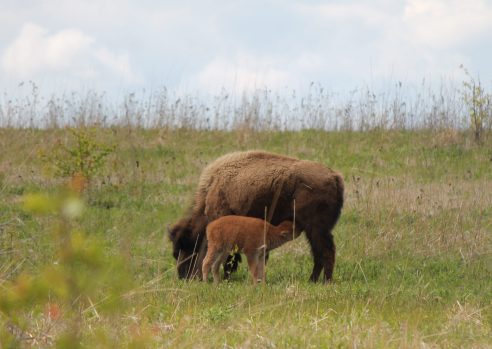

Just in time for Mother’s Day, a bison calf was born last weekend to the herd at Kane County’s Burlington Prairie Forest Preserve.
The herd welcomed the birth of the new calf on May 9, according to the American Indian Center of Chicago, which owns the animals as part of a collaborative conservation effort. It’s the first calf born to the herd recently reintroduced to the Kane County prairie.
Burlington Prairie Forest Preserve lies on the border of Kane and DeKalb counties, 60 miles northwest of downtown Chicago.
In December, a small herd of six American buffalo were brought to Kane County, and now roam on more than 30 acres of prairie restored by the county’s Forest Preserve District.
The move is the result of a partnership between the Kane County Forest Preserve District and the American Indian Center of Chicago. The bison are cared for by Ruhter Bison, a family-owned business dedicated to the conservation of bison and tallgrass prairies.
On May 1, the gates at Burlington Prairie were opened, meaning the public can now visit the recently settled herd — including its newest member — from sunrise to sunset.
The birth of the calf was somewhat unexpected, according to the Kane County Forest Preserve District. The animals are all between 1 and 2 years old, so district officials weren’t expecting calves, also called “red dogs,” anytime soon, officials said in a statement to The Beacon-News. But then, one of the herd’s members started showing signs it was expecting weeks back.
From there, the news spread through the Forest Preserve District quickly.
“It’s all been gratifying to witness,” the statement from the Forest Preserve District said. “This is new for us, but having bison in the preserve is something the Forest Preserve District of Kane County wanted to accomplish for a long time, to restore the prairie at a higher level.”
The Forest Preserve District pointed to the important roles bison play on the prairie: creating microhabitats, improving soil health and increasing plant diversity and allowing wildflowers to flourish.
Their reintroduction to the prairie has also led to a steady stream of visitors to the site, according to the Forest Preserve District, which said Kane County residents have thus far been “ecstatic about their new neighbors.”
And, for the American Indian Center of Chicago, the birth of the Kane County herd’s first calf represents more than just an increase in the herd, it said in a statement on Facebook: it provides Chicago’s Native American community with “a living connection to land and culture and makes restoration something that can be witnessed in the present, not only understood through history.”
“It is one thing to talk about restoring relationships with land and relatives,” Jay Young, co-executive director of the American Indian Center, said in the statement. “It is another thing to see new life come from that work. For Chicago’s Native community, especially our young people, this birth gives us a chance to know bison not just as something from history, but as living relatives on the land.”
Bison hold cultural, ecological and spiritual significance for many Native American nations, the statement from the American Indian Center said. Center officials said the near destruction of bison “is inseparable from the history of harm done to Native nations, foodways and land-based lifeways.”
The American Indian Center will be offering community programming related to the herd later this summer, its statement said, creating opportunities for Native community members, children and families to visit the site.
These efforts also reflect the partnership between the American Indian Center and the Kane County Forest Preserve District, the center said in the statement, a collaboration in which “Native people (help) shape what care looks like on this land.”
mmorrow@chicagotribune.com