Soldiers loyal to President Corazon C. Aquino regained control of two important military camps Saturday, ending the last significant resistance by renegade troops who staged a bloody mutiny that left dozens dead and more than 200 wounded.
An armed forces spokesman said pro-Aquino troops regained control of Camp Olivas near San Fernando, 40 miles north of Manila. And officials on the central island of Cebu, 350 miles south of Manila, said renegade soldiers there had agreed to end the takeover of another military camp.
Both provincial garrisons had been seized Friday by troops sympathetic to a bid by 800 rebel soldiers in Manila to disrupt the government by occupying the presidential palace, several broadcast stations and the headquarters of the Philippine armed forces.
All of those takeover attempts were put down in a day of bitter fighting. Aquino, whose only son was seriously wounded in the fighting, went on television and called the rebels ”monsters” and ”traitors.” She ordered a fierce counterattack that led to the heaviest fighting in Manila since World War II.
The full might of the Philippine military was unleashed on her orders. Helicopter gunships, fighter airplanes, armored personnel carriers, mortars and field cannon were thrown into the battle.
At least 25 people were killed and 275 were wounded. Many of those casualties were civilians caught in the cross fire. Two of the dead were press photographers, one a Filipino and one a New Zealander working for an Australian magazine.
A potentially explosive situation lasted overnight in Cebu City, the country`s second most populous metropolitan area, where Brig. Gen. Edgardo Abenina split with the government.
Abenina put the mayor of Cebu City and the provincial governor of the island of Cebu under house arrest. He also ordered banks and government buildings closed and left just one radio station on the air to isolate the island.
But by Saturday morning Abenina freed the mayor from house arrest and said he would surrender formally later in the day to a colonel who had been his subordinate at the Cebu garrison. The mayor said he assumed the governor had been freed as well.
Cebu is the Philippines` air and shipping center. The island is 350 miles south of Manila and has a population of 3.5 million.
The rebels` surrender at Camp Olivas was peaceful, officials said, without a shot being fired.
The rebels had entered the camp easily before dawn Friday. Aquino had been scheduled to visit there later in the day, and security guards let the rebels through the gates, thinking they were part of her advance party.
The battle for Manila began before dawn Friday and lasted much of the day. Thirteen hours after it began, Aquino went on national television and said: ”There will be no terms (of surrender). I have nothing to say to these traitors. . . . If we are united, we can defeat these monsters.”
Aquino also told the nation that her only son, Benigno ”Noynoy” Aquino III, 27, was shot three times, once in the neck and twice in the shoulder, when rebels attacked his car near the presidential palace. Aquino, a civilian, was on his way home.
The president said three of her son`s companions were killed and a fourth was seriously wounded. A presidential spokesman said the wounded man shielded Aquino with his own body.
Within hours of the president`s speech, Philippine air force planes and helicopters were called in to attack 200 rebel troops holed up inside Camp Aguinaldo, suburban Manila headquarters of the armed forces and the Defense Ministry.
Armored personnel carriers rolled up to the gates of the camp and artillery shells were lobbed over the walls.
The clearest sign that Aquino`s supporters meant business came when two World War II-vintage propeller planes circled Camp Aguinaldo and then banked into a swift dive.
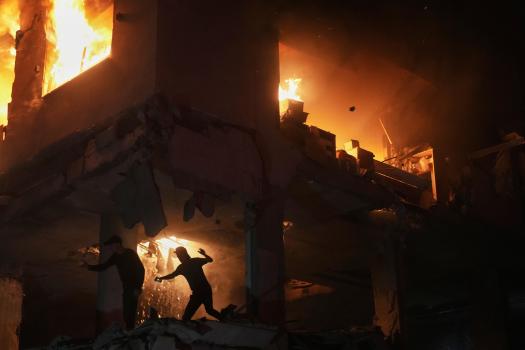
Crowds of civilians gathered outside the camp shrieked when the first plane let loose two rockets with a whoosh that sounded like a giant bedsheet suddenly being ripped apart. The missiles slammed into the armed forces general headquarters building on the edge of a neatly manicured parade ground. Windows rattled for blocks around when the missiles hit. Then, within minutes, the white brick headquarters building was ablaze. Bright orange flames leaped from nearly every top-floor window in one wing. A helicopter gunship joined the attack.
Gen. Fidel Ramos, the military chief of staff, said Saturday that after the rockets hit, the rebels inside the armed forces headquarters doused the building with gasoline and set it afire with grenades. The building was burned-out hulk Saturday morning.
After the air attack, the rebels, vastly outgunned and growing weary, began to surrender. Small groups of soldiers sprinted into the open holding their rifles over their heads with white flags or handkerchiefs tied to the barrels.
Defense Minister Rafael Ileto said 395 rebel soldiers had surrendered by dusk. Nearly 100 more gave up at Camp Aguinaldo Saturday morning.
Rebel units had knocked four of Manila`s five television stations off the air at one point Friday before being forced to surrender each of them to counterattacking government troops.
Fighting was heaviest around the studios of Channel 4, the government station, which was knocked off the air for six hours.
Late Friday night, a few rebels continued to hold out in an old hotel near one of the television studios. The hotel had been strafed repeatedly at dusk by helicopter gunships, but the rebels continued to hold out under the thunderous attack.
The sound of machine-gun fire from the helicopter could be heard for miles and the muzzle flash twinkled in the twilight sky as hundreds of civilians gathered in the streets to watch the attack.
The mutiny was the fifth coup attempt against Aquino since she came to power 18 months ago.
This one was led by Col. Gregorio ”Gringo” Honasan, a former aide to Juan Ponce Enrile. Enrile, whom Aquino sacked as defense minister, is now an opposition senator. He was nowhere to be seen Friday or Saturday.
Honasan, 37, was unaccounted for after the bulk of rebels surrendered Friday night. Armed forces spokesman Col. Honesto Isleta said Honasan might have escaped by helicopter as the attack on the military headquarters began.
In February, 1986, Honasan had been a hero and prime organizer with Enrile of the civilian-backed military uprising that ousted President Ferdinand Marcos and put Aquino in office.
Ramos, the chief of staff, had only scorn for Honasen at a news conference Saturday morning. ”Why is Gringo so glorified (by news media)
?” the general demanded. ”He is responsible for the death and destruction that you see. He lied to his officers, his men and his country and he abandoned his men.”
White House spokesman Marlin Fitzwater said there was no evidence that former President Ferdinand Marcos was involved in Friday`s uprising.
The spokesman could not confirm reports, however, that Justice Department officials had called Marcos in Hawaii to renew the U.S. warning against his meddling in the internal affairs of the Philippines.
Marcos denied from his exile home in Honolulu Friday that he had anything to do with the latest coup. But he said he would be willing to take a role in any new government that might be formed in his homeland.
”If people there would want me to make a new regime legitimate, I am willing to return,” he told reporters at his secluded $6,000-a-month rented home.
But Marcos said he would not leave Hawaii without the permission of the Reagan administraton.
Marcos said he had not known in advance of the attempted coup and had promised the U.S. government he would not take part in any attempt to overthrow Aquino.
Sources involved in watching Marcos said FBI agents warned airlines Thursday that he might try to leave Hawaii, apparently for Manila.
In Los Angeles, Fitzwater said President Reagan had sent a message of support to Aquino. Reagan maintained his ”complete commitment” to her government.
A Pentagon official said that American military bases in the Philippines have been ”buttoned up” but U.S. forces were not ordered onto alert.
The United States has 16,290 military personnel in the Philippines. The two main bases are the Subic Bay Naval Base and Clark Air Force Base.
In Washington, the State Department set up a task force to monitor the rebellion in the Philippines and prepared a warning to Americans to stay away from Manila.
The State Department said there were no reports of any American casualties or injuries in the fighting so far. The U.S. Embassy in Manila advised Americans there to remain in their homes or hotels.
Sen. Richard Lugar (R., Ind.) said the coup attempt underscores a need to consider increasing U.S. economic aid to a fledgling democracy plagued by poverty.
Lugar, who headed a team of observers during the 1986 Philippine elections, said he was encouraged by reports that there was no evidence of popular support for the mutineers.
For the United States, he said during a Washington news conference, the Reagan administration and Congress should take another look at the situation in the Philippines to determine if more can be done to help by way of a ”much more high-profile U.S. effort.”
The United States is committed to giving the Philippines $900 million over five years under an agreement allowing the United States to use the strategic Philippine military bases.
An additional $200 million in aid was approved after Aquino was elected president.