When a partner loses a job, couples often gain insight.
“Crises reveal who we are to ourselves, and to those around us,” says Laurie Anderson, an Oak Park-based licensed clinical psychologist who has done couples and career counseling.
Anderson names money, self-esteem, routine and identity as four primary areas that unemployment affects, and emphasizes the importance of communication about these issues.
“Plan on having regular check-ins about feelings, questions and concerns, with no judgments,” she says.
Tom, 34, and Ellie, 35, a married couple who had bought a house in Chicago four months before he lost his job, had to have a frank talk about their money. “I melt down about finances a lot faster than he does,” Ellie says.
By cutting back on expenses, they’ve been able to get by on Ellie’s salary as an editor and Tom’s unemployment compensation. “You understand how little money you actually need; nobody’s starving here,” he says.
Those sacrifices also helped put Ellie’s mind at ease. “Finances have always been kind of an issue in the marriage, but he has bent over backwards to make me feel comfortable.”
That psychological relief often can be as important as the practicalities of making ends meet. “A job loss creates a sense of financial insecurity, even when a couple has sufficient assets and additional income sources to remain solvent,” Anderson says. “It’s not necessarily a rational calibration of what’s in the bank account, it’s the emotional disorientation of not getting more on Friday.”
Of course, the loss of income also can affect self-esteem. “With the loss of a job status, it completely unmasks how we feel about ourselves separate from circumstances, and that’s a tough one,” Anderson says. “How we feel about ourselves influences how we deal with others. Couples bicker more.”
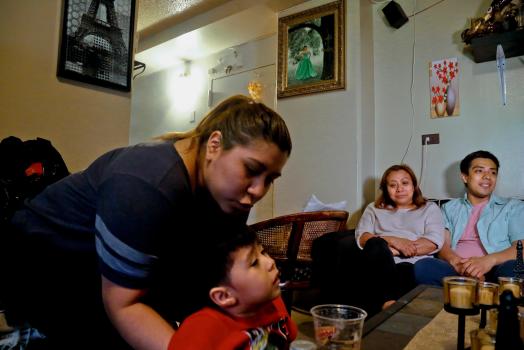
Some couples discover that unemployment has its advantages. When she lost her marketing job last June, Marsha Herring started working from her home as a consultant. The change meant she spent more time with her husband, Cedric, a college professor who also does much of his work at home, and with their two children in the south Chicago suburbs. “The time she spends with our children, and the ability to go to our son’s baseball games or our daughter’s dance activities, it’s night and day in terms of how much more she’s able to do those things,” Cedric says. “She now can structure her work around other activities.”
Such changes in routine often are accompanied by a change in roles.
“Because he’s the one that’s not working, there’ll be times when it’s’ `can you go to the grocery store, can you go to the Laundromat,’ ” says Krista Carlson, a 29-year-old public relations executive in San Francisco whose boyfriend lost his job three months ago.
And when Jim lost his job as a creative director for a consulting firm in mid-October, his wife, Kay, who had been working part-time in social services, quickly found a full-time job.
With her job providing benefits and income, Jim has been pursuing freelance design work and looking after their two children. “It sort of turned around the way we were working here,” he says.
“I feel in my mind equal to him more than I have since the kids were born,” Kay says. (She and Jim, both 38, live in the western suburbs and have been married 11 years). “That’s not due to him, it’s me. I think part of my self-esteem was boosted that someone would hire me again and that I could help out.”
Jim now is assessing whether to return to a full-time job or stick with freelancing. “I think it’s a good fit for him,” Kay says. “He seems more relaxed.”
This ability to find opportunity in the changes forced by unemployment is a key for couples to manage the situation successfully, Anderson says.
“Envisioning and planning means we’re going to be the architects of this experience,” she says, “instead of letting it run us.”