Israeli tanks and armored vehicles, backed by helicopters, fired at Palestinian houses in the Gaza Strip early Wednesday, hours after Israel’s Supreme Court gave the army approval to destroy without notice the homes of 43 families related to alleged suicide bombers.
Between 15 and 30 Israeli tanks and armored personnel carriers moved from areas near the Erez crossing with Israel toward Beit Lahiya and the Jebalya refugee camp north of Gaza City, security officials said.
The armor stayed about a half-mile from the camp, firing shells and machine guns at houses. Two helicopters flew overhead, the officials said, as troops stormed several Palestinian homes. It was not clear whether arrests were made. A Palestinian police officer was reported killed.
Tanks began pulling back from the area about 2 1/2 hours after they entered.
The latest incursion came after Israeli forces killed the suspected mastermind of a Tel Aviv suicide bombing and another militiaman in a firefight near the northern West Bank town of Jenin, residents said.
On Monday, Israeli helicopter gunships fired three missiles at a suspected weapons factory in Gaza City, injuring four people.
Families sought ruling
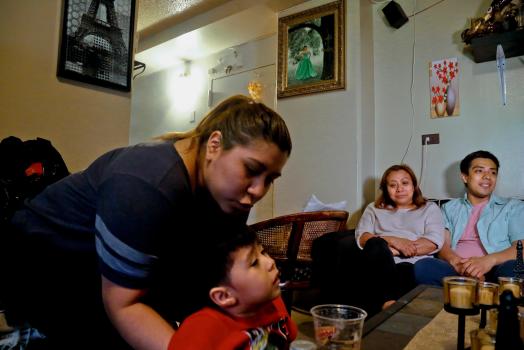
Nearly three dozen Palestinian families, who feared that their homes would be slated for demolition, had asked the court to delay the destruction and to allow them 48 hours notice.
The attack in Gaza occurred after a day in which Israel intensified its efforts to stamp out militancy. Prime Minister Ariel Sharon voiced strong support Tuesday for a controversial plan to revoke the citizenship of three Israeli Arabs connected to what officials in Jerusalem defined as terrorist groups.
Sharon, in a statement released Tuesday, called the plan by Interior Minister Eli Yishai a “correct, considered and balanced decision” made in severe cases of terrorist activity. “Israel, which finds itself in a bitter battle against murderous terror, has to take measures to protect itself as a democracy,” Sharon’s statement said.
Earlier Tuesday, Yishai announced his intention to move forward with citizenship revocations. On Israeli Army Radio, Yishai defended the move as “an unprecedented step, but the situation we find ourselves in is unprecedented. … Someone can’t have citizenship and enjoy all the benefits and at the same time be a threat to the existence of Israel.”
“We are now involved in a war for our existence,” Yishai said. He added that he was aiming at preventing attacks altogether.
Two weeks ago, Yishai sent letters to two Israeli citizens and a third Arab with permanent residency, notifying them that he was attempting to revoke their status. On Tuesday, Yishai announced he would pursue the policy for all three men–Nihad Abu Kishak, Kais Hassan Kamal Obeid and Shadi Shurfa–because each, he alleged, had links to terror groups and “breached the trust” of the state of Israel.
According to media reports, Abu Kishak, an Israeli citizen now in prison, is suspected of helping plan Hamas suicide attacks inside Israel; Obeid, an Israeli citizen who reportedly has been living in Lebanon for the past two years, is suspected of a leading role in Hezbollah; and Shurfa, a permanent resident also imprisoned, is suspected of having close links to the militant Popular Front for the Liberation of Palestine.
Yishai’s plan has caused a heated debate among the political elite in Israel and triggered deep criticism from its Arab community and human-rights organizations. Defense Minister Benjamin Ben Eliezer said Tuesday he “vehemently opposed revoking the citizenship of any Israeli citizen, regardless of religion, race or sex.”
Internal challenge
“The revoking of citizenship does not go hand in hand with the democratic value of the state of Israel,” Ben Eliezer was quoted as saying in the daily newspaper Ha’aretz. Foreign Minister Shimon Peres also was critical of the plan, adding that he did not believe it would survive scrutiny by the High Court of Justice.
“I would be very, very careful,” Peres said on Army Radio when asked about Yishai’s plan. “People should be tried and punished [in the courts], but their citizenship should not be stripped.”