Mary Ellen Hogan isn’t about to close Urban Harvest, her food shop in Arlington Heights. Yet some of her customers keep jumping to that conclusion — all because of the “for lease” sign next door.
“They see that sign and they think that’s us,” Hogan said. “It’s a perception thing.”
Over the last year, many northwest suburbs have seen plenty of those signs. Many have reported office and retail vacancy rates well above percentages usually seen in a healthy market — 10 percent for office space, 6 percent or 7 percent for retail, experts say.
But in recent months, there have been small indicators that those rates might be on the decline as communities aggressively market their office and retail space on Web sites and commercial listings and at trade shows, both officials and store owners say.
Here’s a look at the vacancy picture in some of the larger communities in this area:
EVANSTON
Residential density and the presence of Northwestern University have helped keep the commercial vacancy rate of the city center fairly stable, said Carolyn Dellutri, executive director of Downtown Evanston, a nonprofit corporation that works in partnership with the city.
“We have been pretty much holding our own,” she said. “I am seeing more activity and requests, but it’s not how it was five years ago.”
Currently, about 14 percent of downtown stores are empty, compared with about 8 percent 18 months ago, she said. The office vacancy rate is now at 9 percent.
Dellutri said Downtown Evanston launched a new online program last month to combat rising vacancies. The group’s site now lists available properties, and people can submit new listings or detailed requests.
“I do have some brokers who are telling me they are close to signing leases,” she said.
Pascal Berthoumieux hadn’t expected to open his new restaurant, Bistro Bordeaux, so soon, but he couldn’t pass up the location in a space that had sat vacant for more than a year.
With no direct competition, the French restaurant, which opened in December has been a success, Berthoumieux said. By the second month, it was selling out every weekend, he said.
“I was prepared for the worst,” he said, adding, “but it’s been the opposite. It’s been great right away.”
SCHAUMBURG
Whenever vacancies pop up near the Olive Oil Place at the Streets of Woodfield, they usually get filled quickly, store owner Shannon Gagliardo said.
But she’s still hopeful for the day every storefront is filled. “Any foot traffic is good foot traffic,” she said.
The retail vacancy rate for the village, a regional shopping hub, jumped from 7 percent in early 2008 to 11.4 percent in two years, said Matt Frank, Schaumburg’s economic development coordinator. “There’s been a sharp increase in vacancy rates in all different sectors, including commercial, which has been our stronghold,” he said.
Two big-box stores have remained empty for more than two years: The Great Indoors and Expo Design Center.
But turnaround continues. Recent months have seen Hobby Lobby, Michaels and Ashley Furniture move into spaces vacated by World Market, Circuit City and Linens-N-Things, Frank said. A new Whole Foods grocery store is set to open May 5 on the site of a long-shuttered furniture store near Woodfield Mall.
The office vacancy rate is showing improvement, he said, falling from 22 percent to 19.4 percent in a year.
That could drop further later this year when the Federal Deposit Insurance Corp. and Career Education Corp. take over two vacant spaces totaling a half-million square feet.
ELGIN
In early 2009, Burlington Coat Factory and World Gym opened in the same renovated shopping center, said Michael O’Kelley, vice president of economic development for the Elgin Area Chamber of Commerce. A call center also has plans to move into a 75,000-square-foot office space in September.
Still, in late 2009, 26.8 percent of office space was empty, according to data provided to O’Kelley by CoStar Group, a commercial real estate information firm.
The retail vacancy rate was at 9 percent in late 2009, down slightly from a year earlier, O’Kelley said.
Businesses are finally starting to fill the glut left by the construction boom, he said.
“There is a lot of pent-up demand that is out there,” he said. “My biggest concern is, will I have enough when things turn around?”
George Stefely, owner of Artistic Framing & Supplies, paints a different picture for downtown, where he says there are a number of empty stores near his business on North Grove Ave. And when they’re filled, it tends to be with attorney and real estate offices that aren’t going to draw shoppers, he said.
The city is redoing downtown-area streets, which Stefely said is an impediment to traffic, even though the improvements might be beneficial in the long run.
“There are a lot of shops here struggling, trying to make a go of it,” he said. “There is some positive. They’re still there and they’re still trying.”
DES PLAINES
The new Dotombori Japanese restaurant in Des Plaines is pretty much breaking even, co-owner Jay Park said.
Determined to locate in his hometown, Park found the perfect location in a former Subway shop on Miner Street that had been vacant for a couple of years.
“This is right at the corner of a major street and right in front of a Metra station,” Park said. “That’s why we picked this place.”
The city’s retail vacancy rate stands at 11 percent, according to CoStar Group data provided to Jennifer Ganser, the city’s economic development coordinator. A quarter of the office spaces are vacant.
Ganser said she talks regularly to brokers looking to fill individual properties. To speed that up, the city updates information on available spaces on an interactive online map.
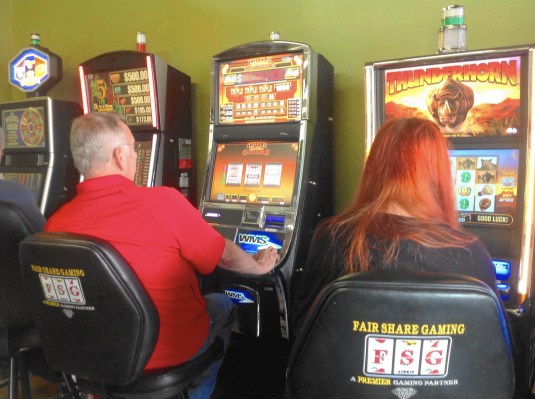
One major project almost certain to make a big difference is Des Plaines’ casino. Slated to break ground Friday and open in 2011, it will replace several office buildings at River Road and Devon Avenue.
ARLINGTON HEIGHTS
Among other stores, Arlington Heights lost a Sports Authority, a Circuit City and a Gap in 2009.
The village’s store vacancy jumped from 7.5 percent in late 2007 to 13 percent by the end of 2009, according village data. The amount of empty office space rose from 10 percent to 17 percent in the same period. Business and development coordinator John Melaniphy III attributes that to consumers spending less and eating out less.
“We have fared pretty well given the dramatic decline in retail sales nationally over the last two years,” he said.
The village is doing its best to fill empty commercial spaces, he said. In July, it upgraded its Web site to give prospective businesses more information about moving into town. The village also places ads in several business development magazines.
One empty spot — the former Circuit City location — was filled by Furniture Values earlier in the year, Melaniphy said.
Businesses near vacancies can’t help but be affected, because both foot traffic and energy are depleted, said Urban Harvest owner Mary Ellen Hogan. She recently learned that a new coffee shop is going to take over an empty storefront a couple of doors down.
“Thank God,” she said. “When you have business neighbors, you can have synergy.”