



After owning a vacation home in Florida for five years, Jill Nolan was looking forward to spending her first entire winter there after recently retiring.
“I hope I have a house to go to now,” said Nolan, a Bridgeport resident who owns a townhouse minutes from Fort Myers Beach.
Nolan, like other snowbirds in the Chicago area, is keeping close watch on weather reports, hoping Hurricane Irma — which is expected to make landfall in Florida over the weekend — spares her property.
“It’s out of my hands now,” she said. “Just say your prayers and keep your fingers crossed.”
Hurricane Irma, the most potent Atlantic Ocean hurricane in recorded history, weakened only slightly Thursday and remained a powerful Category 5 storm with winds of 175 mph, according to the National Hurricane Center.
It was on a track that could lead to a catastrophic strike on Florida, after cutting a path of devastation across the northern Caribbean that left several people dead and thousands homeless.
The storm was increasingly likely to rip into heavily populated South Florida early Sunday, prompting the governor to declare an emergency and officials to impose mandatory evacuation orders for parts of the Miami metro area and the Florida Keys. Forecasters said the storm could punish the entire Atlantic coast of Florida and rage on into Georgia and South Carolina. The Keys and parts of South Florida were placed under a hurricane watch Thursday.
Irma blacked out much of Puerto Rico, raking the U.S. territory with heavy wind and rain, while staying just out to sea as it headed early Thursday toward the Dominican Republic and Haiti. At least one person was reported killed in Puerto Rico.
In Chicago, the Puerto Rican community expressed concern about the storm’s long-term impact on the island and whether it would exacerbate economic problems. Although Puerto Rico was spared a direct hit from the storm, roughly 1 million people were without power Thursday and 50,000 were without drinking water, officials reported. Isabel Dieppa, spokeswoman for the Puerto Rican Cultural Center in Humboldt Park, said the worst may be yet to come — the storm’s aftermath.
“A lot of the fear is this could be a perfect storm … that could destroy the economy,” Dieppa said, adding that activists are working to connect with relief organizations to raise money and find out how they can help. Those efforts were at an early stage.
Chicago resident Samuel J. Vega said he received a text message from his mother, who lives in Camuy on the northern part of the island, on Thursday, after the storm. She said the streetlights were mostly out, and school and government offices were closed. But their lives were saved “one more time from a bad hurricane,” she said.
“Unbelievable but true,” Vega’s mother, Leila Vega, wrote in the text. “I slept with my front door open just locked my screen door. (N)o wind no rain. (W)oke up to a normal day.”
In Illinois, some residents with homes or relatives in Florida anxiously waited as the storm cut a path toward the U.S. mainland.
Nolan, of Chicago, said her husband changed plans he had made to fly to Florida on Monday, delaying his trip a few days to make sure he’s out of harm’s way.
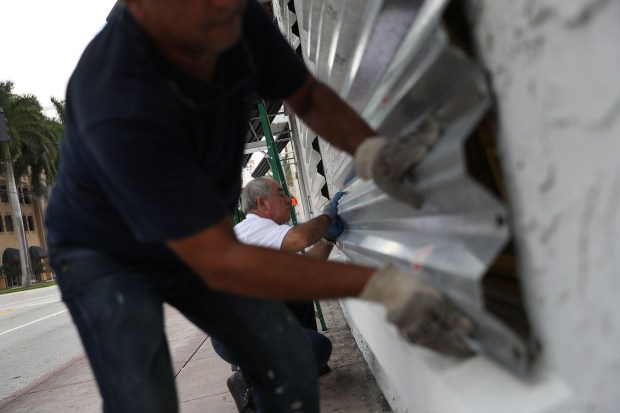
Although their townhouse has permanent hurricane shutters on the back of the home, the couple scrambled to find someone to install more on the front, Nolan said. They were expected to be up by Friday, she said.
Bill Jerpe, of Naperville, also has a home in Fort Myers. Jerpe, who is retired, typically lives at his second home from October through May or June, except for Christmastime, he said.
“It’s a little unsettling,” said Jerpe, adding that he was frantically calling companies Thursday to install his hurricane shutters. “It’s difficult. You’re here, it’s there.”
Jerpe and his wife have owned a home in Fort Myers for 20 years and have been through big storms, he said, but none this serious. He said Irma now makes him concerned about being a Florida homeowner, fearing the potential cost of repairs. He plans to visit his Florida home after the storm subsides to assess any damage.
Just over a year ago, Graeme Jack, of Chicago, bought a house in Naples, Fla., where his extended family could vacation and for his parents to live in during the winter.
On Thursday, Jack was waiting to see if his house-checking service could put up shutters on his home, but he was doubtful the swamped business would have time.
If it can’t, Jack said he and his father were planning to fly to the Florida home early Friday, put up shutters, then immediately drive home to Chicago. Still, Jack said he worried about traffic and gasoline.
While he has flood insurance, Jack said the family has “fallen in love” with the home as it is and is hoping damage is minimal.
“This is a fun thing for the family,” he said. “It’s something Mom and Dad deserve after 50 years of hard work.”
Still, he noted he has less to worry about than Floridians whose lives may be in danger fleeing or riding out the storm.
“At the end of the day, it’s only a house,” Jack added. “We’ll get it fixed up.”
Others in the Chicago area with connections to locations in Irma’s path also are on edge, waiting for information from the islands it has already struck.
Jacques Leblanc, president of the Haitian American Community Association on Chicago’s North Side, said he and other members of the organization have been monitoring the storm, and exchanging text messages and videos with friends and loved ones in Haiti. He did not have any details yet about lives that may have been lost.
Leblanc said another concern is flooding. “Whenever there is rain, there will be a lot of flood. We saw that in Houston. It doesn’t matter what kind of infrastructure you have — if you have too much rain, the ground can’t absorb it.”
Associated Press contributed.