
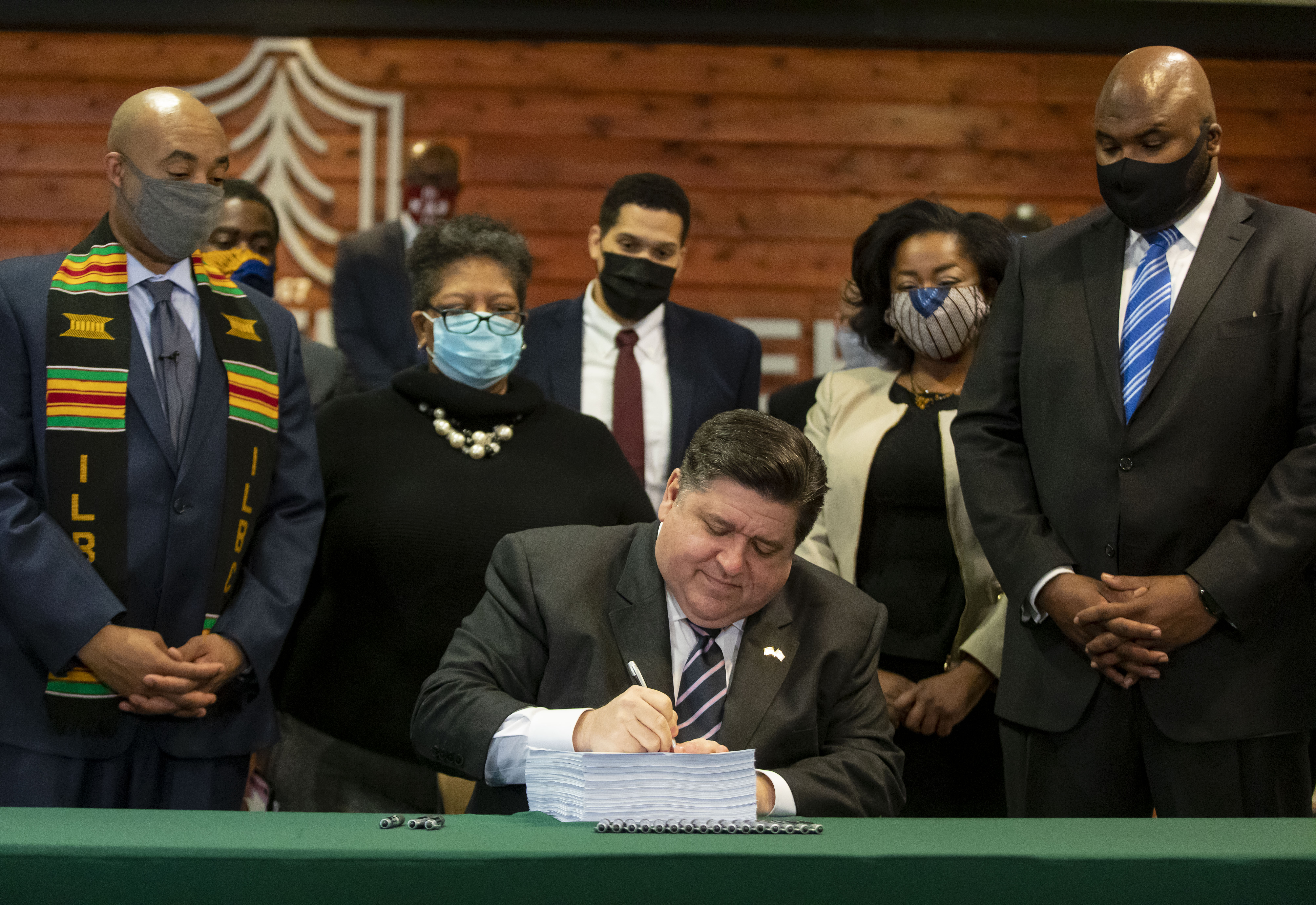

The SAFE-T Act has become synonymous with the end of cash bail. But this 764-page piece of legislation does a myriad of other things, including creating a statewide system to decertify police officers who engage in serious misconduct.
The law itself has become a favorite punching bag of conservative candidates, and every Republican gubernatorial candidate this cycle told us they would slash it. We, too, have questioned the culture SAFE-T, and the movement that spawned it, has cultivated in the courts; we’ve argued numerous times that the act should be opened up and improved in the wake of high-profile tragedies involving people out on pretrial release, and with a string of other crimes on their record, to boot.
Yet there’s more than meets the eye when it comes to this act, including plenty of provisions we suspect even conservatives would like, if they knew these things existed. One of them entails changes to police decertification, a little-known but consequential effort to ensure officers who engage in serious professional misconduct cannot simply move from one department to another.
In 2014, before SAFE-T was a twinkle in Gov. JB Pritzker’s eye, Chicago had to reckon with the nation’s most high-profile police killing at the time, after Officer Jason Van Dyke shot and killed Laquan McDonald. This sparked not just the federal consent decree and the firing of Chicago police Superintendent Garry McCarthy, but a widespread conversation about the legitimate need to fix the system so bad actors couldn’t hang around.
Most reasonable people would agree that departments shouldn’t employ or retain officers who repeatedly exhibit bad — or dangerous — behavior.
To that end, the SAFE-T Act created a statewide decertification framework, which is meant to act as a catch-all method of preventing department-hopping by bad actors. While the Chicago Police Department gets an outsized amount of attention, Illinois has more than 800 law enforcement agencies.
Before the SAFE-T Act, officers could already be decertified — meaning, they would lose their state license — for criminal misconduct. After SAFE-T, decertification now operates on two separate tracks: automatic revocation for certain criminal convictions, as before, and a new, separate, discretionary process for professional misconduct, such as excessive use of force, which has not resulted in a criminal conviction.
When serious violations are proven under that second track — such as those involving dishonesty, bias or excessive force — departments now must report them to the state, where they are logged. But the SAFE-T Act draws a careful line: only certain findings must be reported, and even then, decertification is handled case by case.
That discretion is appropriate. Complaints alone are not proof, and many are unsubstantiated. But once serious misconduct is reported, it should not simply sit in a database. The state should determine, in a timely and transparent way, whether that conduct also rises to the level of decertification.
When the SAFE-T Act took effect in 2022, decertification was still tied to criminal convictions, as we noted, and the system for handling professional misconduct was new. By 2023, complaints surged to nearly 500 as the state opened a new pipeline for both agencies and the public to report misconduct, according to data from the Illinois Law Enforcement Training and Standards Board. By 2025, the system was processing cases, but hundreds of investigations still remained pending each year; relatively few have yet resulted in discretionary decertification. Most decertifications are still tied to criminal convictions, not discretionary misconduct cases.
The next step is not simply building the system, but using it: ensuring that cases move, decisions are made and officers and the public alike understand the outcomes.
A recent report released by the Illinois Justice Project, or ILJP, contained a list of decertification recommendations from hundreds of stakeholders that focus on turning a paper system into a working one. These include requiring clean, standardized intake so cases don’t stall at the starting line; giving officers clear, plain-language road maps of what happens next and how long it should take if a complaint is filed; and imposing predictable timelines so cases actually move. At the same time, they’re pushing for visibility without sacrificing that crucial due process, including establishing a public dashboard, clearer lookup tools and regular updates so people can see whether the system is being used.
All of which seems reasonable in our view. ILJP noted that hearings on cases that include discretionary decertification cases are already underway, a signal, they say, that things are moving in the right direction.
All to the good. Better systems protect good officers by ensuring misconduct doesn’t undermine trust in the profession as a whole. The vast majority of officers do their jobs well and deserve systems that distinguish them clearly from those who do not.
Submit a letter, of no more than 400 words, to the editor here or email letters@chicagotribune.com.


