
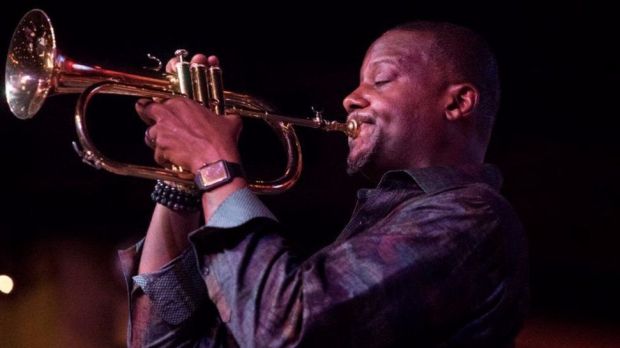



When trumpeter Sean Jones is at his best, listeners hear a convergence of virtuosity, musicality and sensitivity.
Such was the case Thursday night at the Jazz Showcase, where Jones led a quartet in music-making of considerable intensity but also lyric grace.
So for those who value instrumental prowess, Jones offered ample technical feats. Listeners who admire poetically spun phrases — at all tempos — also had a great deal to savor.
And though the music-making didn’t match the fervor that Jones and colleagues produce on his new album, “Live from Jazz at the Bistro,” there was sufficient expressive urgency and intellectual heft in play to keep an audience engaged.
Jones opened the evening with a suite of pieces that appear on “Live from Jazz at the Bistro,” starting with its opening track, his “Art’s Variable.” Here was Jones’ art in a nutshell, the pinpoint focus of his tone and hard-bop influence of his musical language providing the best of two worlds: elegant phrase-making and energy-charged rhythm. The sighs and cries of Jones’ solos, especially in the work’s climax, pointed to a musician with a wide range of stylistic devices at his fingertips.
“Lost, Then Found” began with a solo from bassist Luques Curtis, his sound fat, his cadenza expansive. The soft-and-sleek fluegelhorn lines that distinguished Jones’ first statements may have led listeners to expect a long stretch of introspection. But once pianist Brett Williams stepped forward with a muscular approach and brawny chords, Jones answered in kind, his hard-driving final phrases punctuated by fierce attacks from drummer Mark Whitfield Jr.
It would be difficult to overstate Whitfield’s contribution to this band (he also plays on some tracks on “Live from Jazz at the Bistro”). The man provided a constant rush of ideas, all articulated crisply, often with considerable force. If Jones was the driver of this band, Whitfield was its unstoppable engine.
Jones turned to quirkier fare in his “Prof,” the last piece in the suite from the album. Here, Jones pushed beyond his familiar modes of expression, articulating odd phrase lengths, stop-start rhythms, punctuating silences and other means of sabotaging expectation. This was some of his best work of the evening, the unpredictability of his gestures at the center of the music.
Jones introduced a performance of his “Belcourt” with disarming commentary. Noting that this would be just the second time the band had performed the work, Jones said he conceived “Belcourt” as a reflection of the troubled times in which we live. The piece, he added, was designed to provide some hope in its final measures, but even the opening pages suggested as much.
The melting lyricism and poignant balladry of Jones’ first solo surely set the tone, followed by passages of Debussy-like impressionism from the entire ensemble. Pianist Williams responded to the mysteries of this music with his most understated — and most persuasive — solo yet. And the closing measures proved uplifting by virtue of their harmonic simplicity and tonal purity.
If the band’s rollicking transformation of John Coltrane’s “Giant Steps” put an exclamation mark on the set, it also underscored the lyrical core of Jones’ art. Even at his most rambunctious, Jones wants his horn to sing.
When: 8 and 10 p.m. Friday and Saturday; 4, 8 and 10 p.m. Sunday
Where: Jazz Showcase, 806 S. Plymouth Court
Tickets: $25-$40; 312-360-0234 or www.jazzshowcase.com
Howard Reich is a Tribune critic.
hreich@chicagotribune.com
Twitter @howardreich
.galleries:after {
content: ”;
display: block;
background-color: #144A7C;
margin: 16px auto 0;
height: 5px;
width: 100px;
}
.galleries:before {
content: “Entertainment Photos and Video”;
display: block;
font: 700 20px Georgia,serif;
text-align: center;
color: #1e1e1e;
var playlist = ‘chi_ent_movie_trailers’,
layout = ‘autoblurb’,
iu = ‘%2F4011%2Ftrb.chicagotribune%2Fent’;
Watch the latest movie trailers.