



The artistic director of the Joffrey Ballet is unconvinced that watching dance on a laptop does the art form justice. “I’m embracing it because there’s nothing else,” says Ashley Wheater, now entering his second decade in that role with the company. “But it wouldn’t be my choice.” Even so, he says, “if it’s the right content, it can be really powerful.” Which is why the Joffrey is pushing ahead with Bolero, a new piece premiering February 26 free on YouTube. It will be the company’s first major appearance since The Times Are Racing a year earlier, before theaters shut down because of the pandemic.
Until now, the Joffrey has avoided going online for its performances. Logistically, staging a full-length concert is too difficult to do digitally — and “it would break the bank,” Wheater says. For the time being, the Joffrey is focusing on a handful of new works to be released this spring as smaller-scale digital premieres, starting with Bolero. On April 30, Joffrey rehearsal director Nicolas Blanc debuts his latest work, Under the Trees’ Voices. The company’s main goal is to stay afloat financially — which it’s managed so far through significant budget cuts and a $12 million fundraising campaign — and come back with a full 2021–22 season at the Lyric Opera House starting this fall.
The strategy is to create short, digestible studio performances and footage that Wheater says “pulls back the curtain” on the rehearsals and staging. At 16 minutes, the one-act Bolero is ideal for online viewers with short attention spans. Maurice Ravel’s infamous score, however, is an exercise in patience. The theme repeats incessantly, beginning with only woodwinds and gradually adding different parts of the orchestra until ending an overwhelming crescendo.
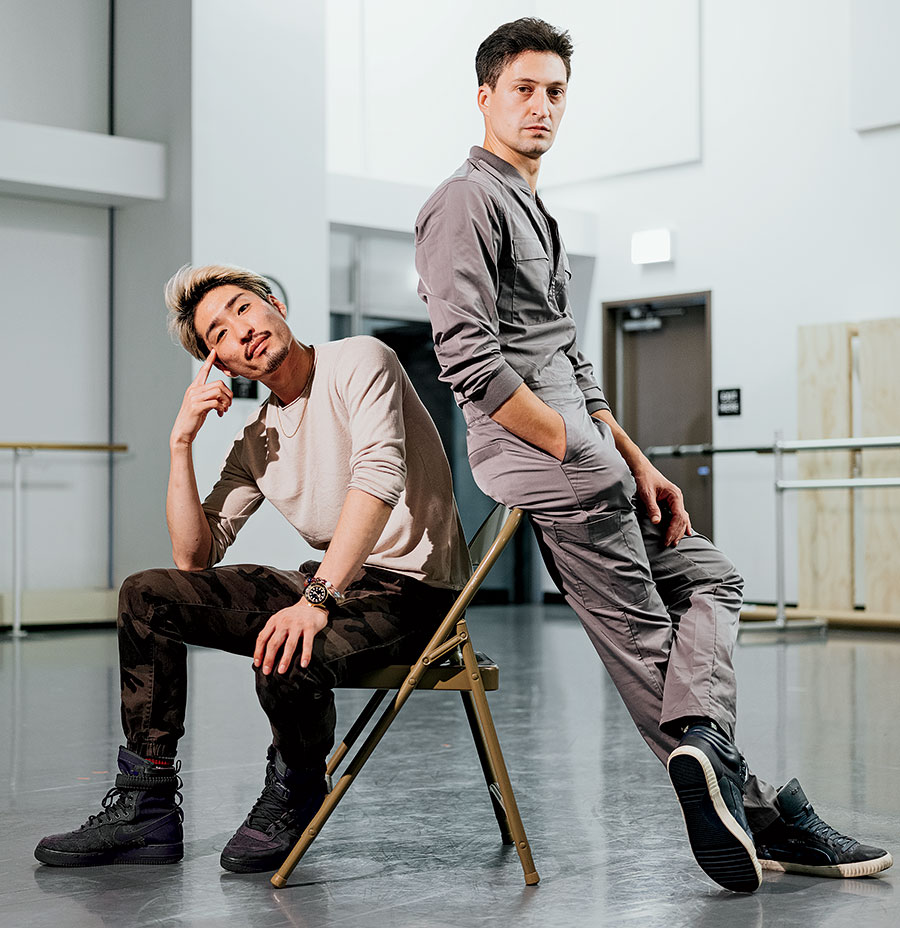
Though the intense music is a fitting score for our present predicament, choreographer Yoshihisa Arai didn’t initially know he’d be creating a pandemic dance — Bolero was originally slated for the company’s annual gala last April, which was canceled. “This music is suited for any moment in life,” he says. “I think that’s the beautiful thing about it.” The rehearsal process started in March, stopped the same month, then resumed in October after public gathering guidelines changed. Company member Anais Bueno plays the leading lady, accompanied by 14 additional Joffrey dancers. For health safety, Arai adjusted his choreography to remove all partnering and keep performers six feet apart.
Arai is justifiably acclaimed as one of the Joffrey’s most exciting dancers, but he’s less known as a choreographer. Bolero starts simply, with a two-dimensional relief, and incrementally escalates along with the music into a swirling climax. A subtle nod to the composer’s Spanish roots can be seen in the dancers’ raised chins and angular arm positions. Veteran Joffrey dancer Temur Suluashvili, who moonlights as a costume designer, developed ornate black masks that extend into the dancers’ hair and match the sweeping black dresses and split-leg pants that complement Arai’s full-bodied, expansive movements. The camera crew is planning some tight shots to bring viewers closer than ever to the dancers.
The circumstances have been challenging for Arai. “Ballet should be onstage,” he says. “Being at the theater, hearing the orchestra, and feeling the dancers breathing heavily or seeing their sweat in the lights — that’s what brings the whole evening together.” Still, he and Wheater envision digital platforms as a way to introduce new audiences to ballet. “We have a responsibility to engage at every level of our city,” Wheater says. “I’m hoping that people will see that we’ve kept ourselves going and that we are creating. We’ll all remember this. That’s for sure.”


