Content oversight provided by Studio 1847
It’s easy to view conservation as a massive, distant effort to save rainforests or measure melting ice caps. After all, what is a single person supposed to do about the increase in extreme wildfires, rising sea levels threatening coastal homes, or declining bird and bee populations? But the fight against biodiversity loss and climate change isn’t just a far away, overwhelming battle — it’s an actionable, local effort happening right here in Chicago.
At the Chicago Botanic Garden’s Negaunee Institute, researchers operate with a bold vision: a world where no plant goes extinct. To get there, the Institute isn’t keeping its research locked in a lab. Instead, they act as a shared resource, providing a blueprint for ecological resilience with a scalable approach to conservation that starts in a backyard or on a downtown balcony, expands across Midwestern prairies and stretches around the globe.
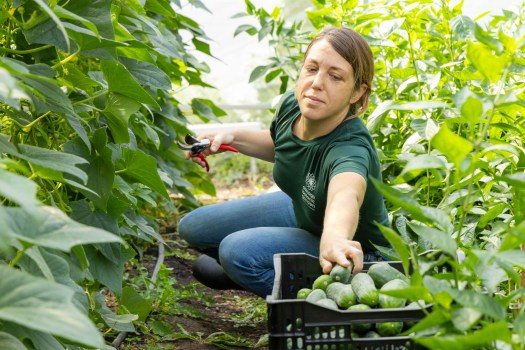
For the past 16 years, Dr. Jeremie Fant, director of conservation science at the Negaunee Institute, has been growing native plants on his small Chicago balcony. While a single apartment balcony or suburban backyard might seem environmentally insignificant on its own, these individual spaces piece together to form a vital, connected network of habitats across the city.
“I didn’t originally start growing native plants on my balcony to attract pollinators — I just wanted a small green space,” says Fant. “So it was genuinely surprising, and honestly rewarding, to see how many bees and other insects showed up. It’s a reminder that even small individual actions can add up in meaningful ways.”
Because native plant species have evolved to thrive in the Midwest, they require fewer inputs like water and fertilizer while improving air quality and sustaining the complex web of soil organisms that broader ecosystems depend on. For Fant, simply observing these benefits isn’t enough.
In collaboration with researchers and community scientists, his work furthers the Institute’s goal of quantifying those benefits. “Our work is increasingly focused on collecting the data that shows what native plants actually do in real-world settings — so decisions about landscapes, public spaces and even private yards are based on evidence, not assumptions,” Fant explains. “That’s how we move from good intentions to measurable ecological benefit.”
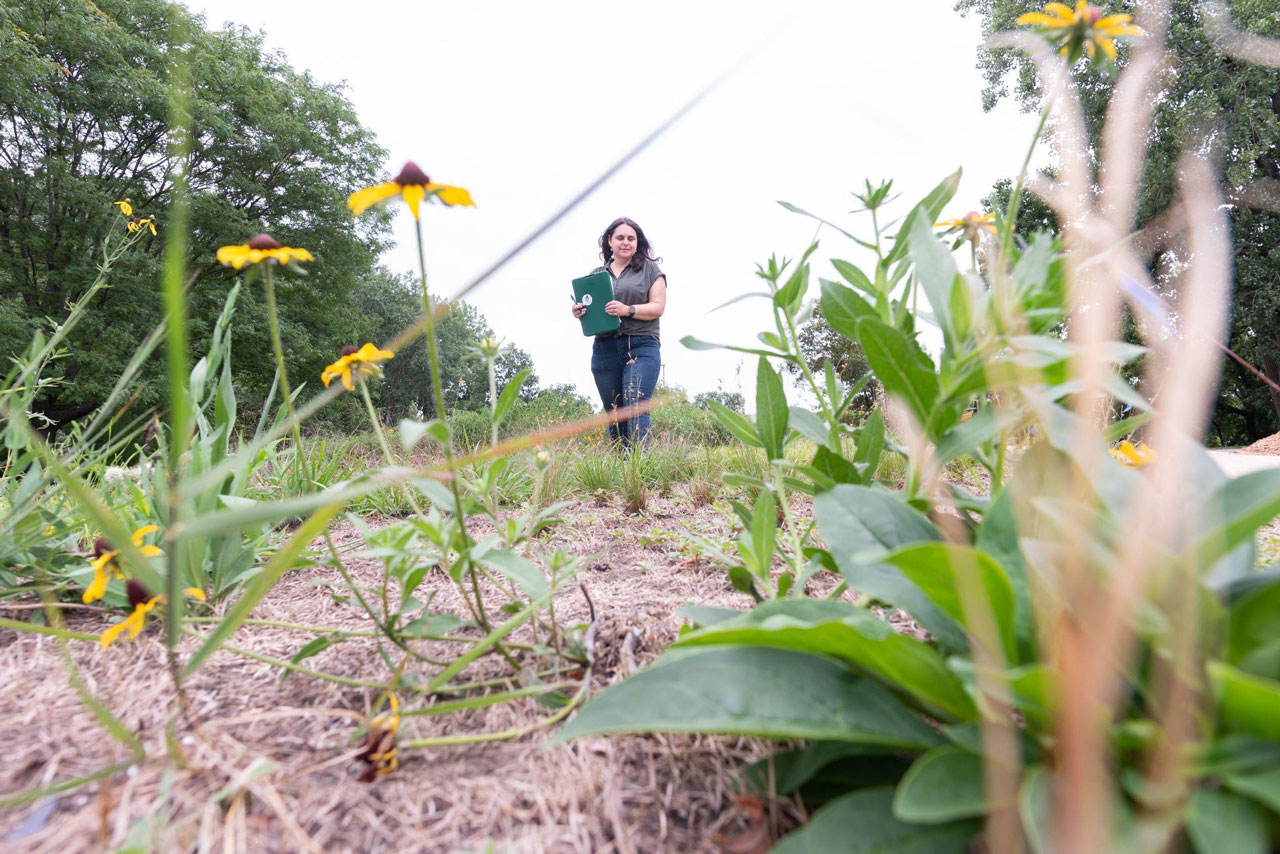
Moving from a single urban balcony to an entire regional ecosystem requires a significant jump in scale and a staggering amount of patience. Dr. Andrea Kramer, senior director of restoration ecology at Negaunee Institute, knows firsthand the importance of taking the long view.
Most mornings, Kramer rides her bike to work through the Garden’s McDonald Woods. “I can’t imagine a better, or more inspiring, way to bookend my day,” she says. “Knowing all that has gone into helping McDonald Woods thrive over the last 40 years only enhances my ride.”
It’s a landscape she knows intimately. Over her 26-year career at the Garden, she has watched it actively transform. As an intern, Kramer spent her days working to save a rare violet struggling against dense, invasive buckthorn. Saving a native species like that requires meticulous, painstaking work. Violet seeds are explosively released when ripe, making collection incredibly time-sensitive, and they demand a highly specific combination of temperature and moisture to germinate.
That patience paid off. “Now, decades later, the violet is doing well across the Woods,” Kramer says, “and has been joined by another 500 or so native species that were either absent or only present in small numbers.”
One of the biggest bottlenecks to repairing Midwestern prairies and woodlands is a critical shortage of these notoriously intricate, regionally adapted native seeds.
“The Forest Preserves of Cook County has ambitious goals of restoring 30,000 acres of land by 2040, which is going to require a lot of seeds,” Kramer notes.
To meet this immense need, the Institute acts as a regional hub. Through a co-developed Seed Amplification Program, the Garden grew more than 330 pounds of seed from more than 100 native plant species in 2025, increasing wild-collected seed by 300-fold, providing a blueprint for how botanical gardens and government agencies can successfully partner to rebuild climate-resilient habitats.
That same long-term blueprint extends far beyond the Midwest. As the Negaunee Institute shares its research on a national and global scale, it acts as a critical safety net against extinction.
“We adapted the approach zoos take to manage animals in living collections for plants in botanic garden collections,” explains Dr. Kay Havens, chief scientist and Negaunee vice president of science.
By using a “studbook” approach to track plant pedigrees and counteract inbreeding, the Institute has helped prevent the extinction of more than 100 critically rare species worldwide.

To safeguard this genetic diversity for the future, the Garden banks both seed and pollen. For Havens, these biological collections represent much more than just data. “A seed bank is really hope encapsulated,” she says. “Hope for a brighter future, a more stable climate, hope for protected natural areas where we will see these plants once again thrive.”
But this journey from a single local lab to global climate-adaptation strategies doesn’t happen without community backing.
“Most of what we do is reliant on grants or gifts,” Havens notes. Philanthropic support is the vital catalyst that allows the Institute to test new ideas and generate pilot data. “A donor gift is often the first stamp of approval an idea receives.”
That support scales exactly like the science does. A single, small gift might fund a pilot study on urban lawns, which generates the data needed to secure a major grant, which ultimately funds a global conservation initiative. From a small balcony in Chicago to a sprawling Midwestern woodland to a rare plant in Hawaii, every contribution is a necessary piece of the blueprint.
Inspired to become part of the blueprint? Plan your visit, discover native plants for your own backyard or make a gift to support the Negaunee Institute’s global research at ChicagoBotanic.org.