

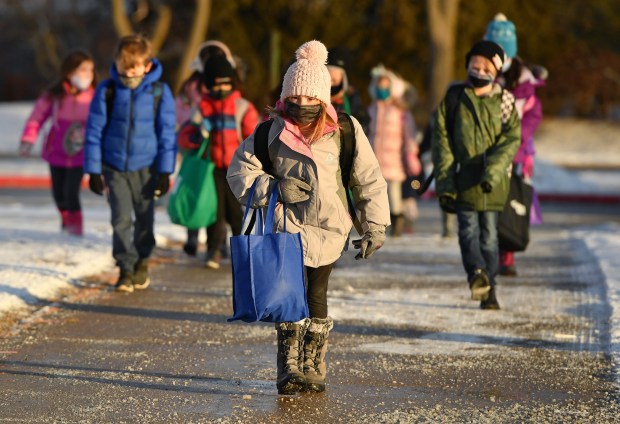

As school districts in central Lake County return from winter break to begin the new semester, coronavirus cases in the areas around them have been rising.
While some of those cases have been staff and students, district officials for the most part say the increase has not disrupted school in a significant way.
Across Libertyville, Mundelein and Vernon Hills, no districts up to this point have switched learning models. Staffing has become tighter, but has not become unmanageable. And even with what officials said has been a tough year for many reasons, the ultimate goal of keeping students in the classroom has worked.
Still, while things have trended in the right direction, cases within some districts are seeing sizable spikes as students and staff returned from winter break.
Hawthorn School District 73, for example, had 161 cases across students and staff during the entire first semester. Coming back from winter break, the district had 176 positive cases at the end of the first week. But by the end of the next week Friday, those cases were halved, officials said.
Alicia Corrigan, assistant superintendent of student services at Hawthorn 73, said no classes have been combined, or closed. While staff has been out, the district has handled those absences with substitutes and internal staffing.
“Every day looks a little different,” Corrigan said. “I do agree that we have been very lucky.”
At Mundelein High School District 120 and Mundelein Elementary School District 75, no classes or schools have been canceled or quarantined as well, said Pete Gill, director of public relations.
“We’re maintaining a business-as-usual schedule,” he said.
Michele Alex, a third grade teacher at Hawthorn, said there have been several challenges over the past nearly two years as teachers have dealt with moving to remote learning through Zoom, hybrid and then in-person again, only with distancing and masking guidelines. With all the changes, she said she and her colleagues worried about the kids, and what it meant for their learning and development.
“We all banded together, and we knew that we had to do it for the kids,” she said.
Alex said with the return to full-time in-person, its been a challenge dealing with a couple of students being out at different times for what was at one point 10 days of quarantine. Keeping track and managing when kids are coming back and getting materials for what they might have missed has been “almost impossible,” she said.
Factors of positive tests, as well as who is vaccinated and close contacts, have kept students coming in and out of the class.
“It was way different when the whole class was on Zoom,” Alex said. “But when you have a whole class here and one or two kids on Zoom, that’s a difficult feat …. One comes back and another’s gone.”
For the districts, keeping kids in school has been the ultimate priority. Corrigan said the story for SD73 has been the “Test-to-Stay” pilot program, which is predominantly run through the Lake County health department and the Illinois Department of Public Health.
The program takes students who have been in close contact with another person at school who has come up positive for coronavirus. Rather than quarantining like normal, those students participating in Test-to Stay, with permission from their parents, can be tested in the following days.
Those test results are reported to health agencies with the goal being to monitor the child to see if they’re positive. If a student who was exposed can test negative on a series of tests over the next several days, they can stay in school.
SD73’s dashboard shows almost 300 students have participated in Test-to-Stay since it began, which is nearly 10% of the entire body. Corrigan said of those students who have participated after being a close contact, the vast majority have come up negative and been able to stay in school.
“It’s working,” Corrigan said. “It’s keeping kids in school, and we’re not getting a lot of positive cases out of that.”
Staffing has also proved to be a challenge, but hasn’t yet become a critical issue for any district. Corrigan said finding substitute teachers has been an ongoing challenge since the pandemic started. Many subs employed by districts are retired teachers. As a result, they are more averse to being in-person across multiple classrooms and schools.
“I don’t know if any district has … escaped the challenge of getting subs in,” Corrigan said.
Robin Kollman, director of communications at SD70 said the district averages about 14 staff members off per day, but that includes other reasons outside of COVID-19, including other illnesses, time off and professional development.
“We do have a pool of substitute teachers who manage the majority of our absences,” Kollman told Pioneer Press. “And we cover internally as well with the current staff. So, as you say, D70 is filling the gaps.”
Corrigan said it’s not so much how many teachers are out every day. Rather it’s the district’s fill rate of those missing teachers that is important.
Officials throughout reiterated the importance of keeping students in-person. But if a decision were to be made to change that, officials said the process will involve the district and other health agencies.
Gill said SD120 and SD75 are prepared if necessary to move to hybrid or remote, but to this point there hasn’t been a level of concern to warrant it. If there were to be a significant outbreak in either MHS or SD75’s campuses, both would work with the Lake County health department on the best course of action.
“We’ve planned for such situations (remote learning, hybrid), and fortunately haven’t had to close an entire school during this school year,” Gill said.
At SD73, Corrigan and Superintendent Peter Hannigan said their priority is following the guidance, with the focus being on keeping kids in school as much as possible.
Corrigan added that if any decision to change learning models was made, it would be a layered approach, looking at individual classes where an outbreak is happening, followed by looking at the school. In short, there are many steps in between the transition to in-person and remote learning, and many involved in the decision, she said.
“We are committed to following the guidance and doing everything in our power to keep students learning in-person,” Hannigan said. “We believe the mitigation practices we have in place make our schools one of the safest places for students to be.”
Emily Young, public information officer for LCHD, said the department doesn’t have a list of schools in the county who have transitioned to remote, but did note schools in the area are being affected by the recent surge.
“We are glad that many students now have the protection of vaccination along with other tools to prevent serious illness such as masking, social distancing, and hand hygiene,” Young told Pioneer Press in an email.


