

“The best time to plant a tree was 20 years ago,” according to a Chinese proverb. “The second best time is now.”
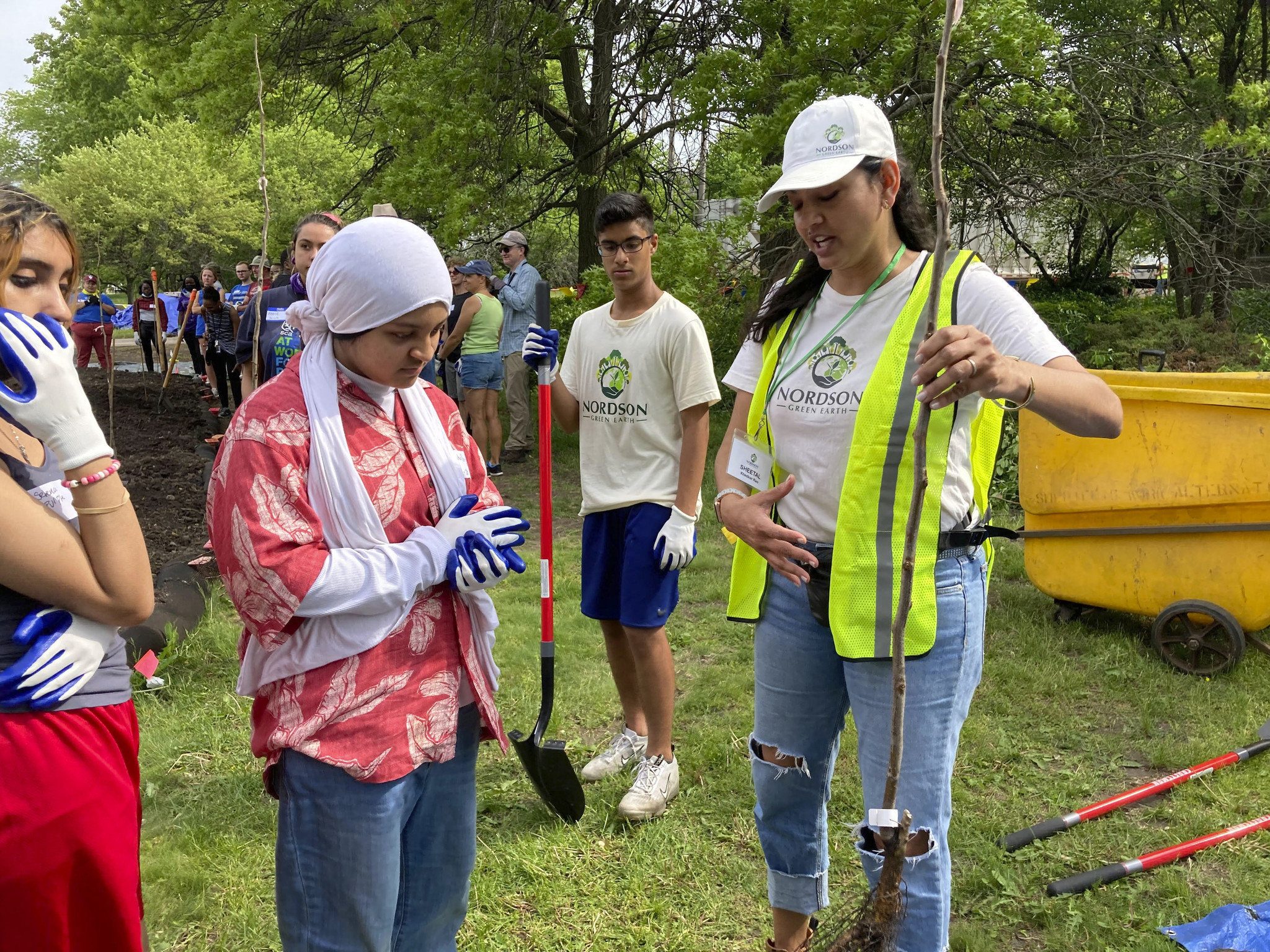
Dozens of volunteers, environmentalists, government workers and junior high students assembled Friday to plant trees and other vegetation in a Miyawaki tiny forest, a new type of garden outside the Cook County courthouse in Markham.
“This first forest is the beginning of a movement,” said Sheetal Khedkar Rao, chief health officer for Chicago-based Nordson Green Earth Foundation. “It isn’t very well known but we hope to change that.”
The tiny forest is the first in Illinois and among the first in the United States, organizers said. Akira Miyawaki, a Japanese botanist who died in 2021 at age 93, developed the concept.
“If this works there’s so much potential for transforming communities that are lacking trees and lacking nature,” said Christine Dannhausen-Brun, chief operations officer for Nordson Green Earth. “There are people who do not leave their homes to take a walk because there is no place for them to walk in their communities, no place where they feel safe.”
Miyawaki’s method involves extensive soil preparation and dense planting in order to encourage growth and survival of the fittest plants. The tiny forest is expected to reach maturity in 20 years, a much shorter time compared to conventional forests.
The tiny forest is located on the west side of the Circuit Court of Cook County Sixth Municipal District courthouse in the 16500 block of Kedzie Avenue. Though it is separated from the public sidewalk by an iron fence, the county intends to make the site accessible to the community.

“This is a great thing,” Markham Mayor Roger Agpawa said. “We want to get more healthy trees into the community.”
The plot of soil measures 40-by-20 feet and will be filled with 310 trees, shrubs and other plants.
Fifteen to 20 student volunteers from Prairie-Hills Junior High in Markham helped dig holes and plant trees Friday. Hundreds more students will visit the site and learn about the tiny forest.
“We have been learning about ecosystems in our classrooms,” science teacher Deonna Randle El said. “The kids have been taking on a composting project for most of the school year.”
A group of mothers concerned about climate change formed the Lincoln Park-based Nordson Green Earth Foundation a year ago, CEO Christine Diploma said.
“We thought, ‘What can we do during the pandemic that would have an impact locally?'” Diploma said. “The COVID pandemic has shown us the importance of trees and the quality outdoor space, and how important it is for our mental health and to see others and socialize.”
Miyawaki and others planted more than 1,000 tiny forests throughout Asia. The projects can resurrect degraded soil while providing numerous health and community benefits, particularly in urban and suburban areas.
“Historically our cities have been separate from nature,” Rao said. “They’re mostly concrete and asphalt. But we’re learning that it’s all connected.”
Small saplings can grow into tall shade trees that can reduce energy costs by blunting the impact of summer temperatures.

“From the tiniest bacteria in the soil to the leaves on the tips of our tallest trees, all of this impacts the purity of the air we breathe, whether bumblebees come to our gardens and the readings on our thermostats,” Rao said.
The Markham tiny project is the first time Cook County has partnered with Nordson Green Earth Foundation on a project, officials said. The nonprofit environmental group Openlands recently worked with the county to plant new trees at courthouses in Maywood and Bridgeview, officials said.
Miyawaki forests are ideally suited for planting in small areas, officials said. They encourage biodiversity and increase the tree canopy in urban areas that are more vulnerable to heat islands and the effects of climate change.
“It became clear that all communities didn’t have equal access to trees and parks,” Diploma said. “That’s how our mission of tree equity got started.”
Tags on some of the trees and plants going into the ground Friday included such names as fragrant sumac, black chokeberry, skyline locust, speckled alder, Allegheny serviceberry and hazelnut.
Organizers said the tiny forest symbolized a big idea in a modest footprint.
“If we plant these one at a time we can transform urban and suburban communities and integrate them and make them healthier for generations to come,” Rao said.
Ted Slowik is a columnist for the Daily Southtown.